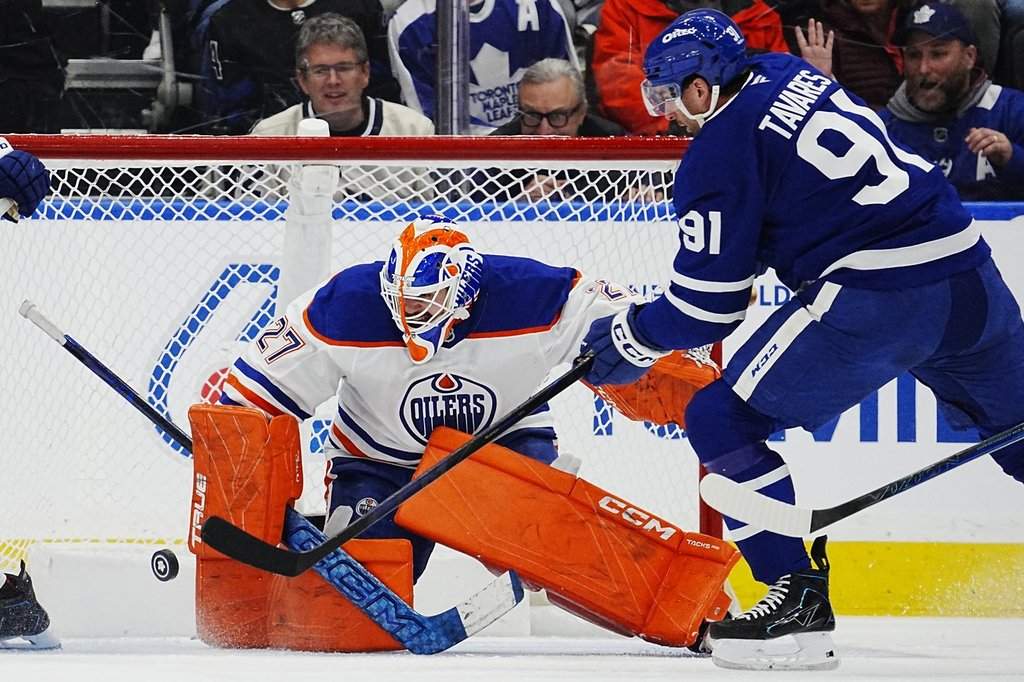
High-event hockey between the Edmonton Oilers and the Toronto Maple Leafs rarely resolves through structural parity; instead, outcomes hinge on the intersection of elite transition efficiency and short-sample goaltending resilience. When Edmonton defeats Toronto behind decisive contributions from Connor McDavid and goaltender Devon Levi, the box score reflects a specific tactical blueprint: compressing the neutral zone to force East-West turnovers while weaponizing straight-line speed through the middle lane. Standard post-game recaps reduce these matchups to superficial narratives about star power and timely saves. A rigorous operational breakdown reveals that Edmonton’s victory relies on exploiting Toronto’s aggressive defensive pinching through calculated risk-reward asymmetry, insulated by goaltending performance that absorbs high-danger slot volume without yielding second-chance rebounds.
The Mechanics of Transition Asymmetry
Modern NHL offenses operate on a spatial continuum between possession-heavy cycle play and rapid counter-attacking transitions. Toronto’s system emphasizes puck retention in the offensive zone, utilizing high-skill forwards to draw defenders toward the perimeter while defensemen activate down the weak-side boards. This structure generates sustained territorial pressure, yet it introduces a severe vulnerability: elongated recovery distances when possession is lost above the hash marks.
Edmonton’s counter-strategy targets this exact structural flaw. Rather than matching Toronto’s low-zone cycle, the Oilers prioritize quick-strike exits triggered by two distinct mechanisms:
- Weak-Side Outlet Mapping: When Toronto’s strong-side defenseman pinches to keep a rimmed puck alive, Edmonton’s weak-side winger immediately vacates the defensive zone to occupy the space behind the aggressive defender.
- Center-Lane Acceleration: Connor McDavid operates as the primary fulcrum in the neutral zone, timing his crossovers to receive a short-area touch at peak velocity rather than standing stationary at the defensive blue line.
This alignment alters the geometry of the ice. Once McDavid gains the neutral zone with speed, Toronto’s remaining defenseman faces an impossible spatial trade-off. Stepping up at the defensive blue line risks immediate blow-by separation, while backing off into the low slot concedes uncontested zone entry and opens passing lanes to trailing support players. The resulting defensive compression collapses Toronto’s backcheckers toward the middle, leaving the flanks exposed for cross-ice seam passes that force the opposing goaltender into lateral movement across the crease.
Quantifying the Goaltending Variance Buffer
An aggressive transition system inevitably concedes territorial volume. By prioritizing rapid vertical exits over conservative puck management, Edmonton accepts a higher volume of shot attempts against during extended defensive zone shifts. In this tactical environment, the goaltender does not merely function as a passive backstop; they serve as a variance buffer that stabilizes an inherently volatile risk profile.
Devon Levi’s performance in a high-tempo matchup against Toronto illustrates the operational requirements of this role. Facing a roster constructed around elite shooting talent and rapid pre-shot puck movement, goaltending efficiency depends on three measurable factors rather than raw save volume:
- Rebound Vector Control: High-danger offenses thrive on secondary scrambles. Directing initial shots into the corners or absorbing them cleanly prevents Toronto’s forwards from capitalizing on chaotic net-front recoveries.
- Depth Management Against Lateral Plays: Toronto’s primary offensive look involves cross-slot feeds designed to pull the goaltender off their angle. Maintaining a conservative depth profile—playing slightly deeper in the crease when an opposing forward holds the puck below the goal line—reduces the physical distance required to seal the backdoor post.
- Puck-Handling Disruption: Intercepting dump-ins behind the net neutralizes Toronto’s forecheck before it can establish a 2-1-2 containment structure, allowing Edmonton’s defensemen to initiate clean breakouts without absorbing physical contact.
When a goaltender executes these three functions simultaneously, the statistical impact cascades up the ice. Clean defensive zone exits reduce shift lengths for Edmonton’s top-six forwards, preserving their anaerobic capacity for offensive zone attacks. Conversely, a single failure in rebound control traps the defending unit in their own zone for upwards of forty-five seconds, neutralizing their transition advantage entirely.
Special Teams Leverage and Penalty Differential Economics
In matchups featuring top-tier offensive talent, five-on-five play often serves as a staging ground for special teams leverage. The speed differential created by Edmonton’s transition game directly influences officiating thresholds. Defensemen caught flat-footed against high-velocity entries default to obstruction infractions—hooking, tripping, and holding—to prevent breakaways.
This dynamic transforms Edmonton’s power play from a supplementary scoring unit into a primary strategic weapon. Toronto’s penalty kill typically employs an aggressive diamond or wedge-plus-one formation designed to pressure the puck carrier at the top of the umbrella. Against standard power-play units, this pressure disrupts rhythm and forces low-percentage perimeter shots. Against Edmonton, aggressive penalty killing creates fatal structural gaps:
- The Bumper-to-Goal-Line Triangle: When Toronto’s top forward pressures the point, McDavid rotates down the half-wall to create a two-on-one advantage against the low defender.
- Downhill Shooting Lanes: Over-commitment to the strong-side half-wall opens the weak-side flank for one-timers, forcing the penalty-killing unit into continuous recovery rotations.
The economic reality of this special teams mismatch forces Toronto into a passive defensive posture at even strength. Knowing that a single minor penalty carries a disproportionately high expected-goals penalty, Toronto’s defenders hesitate to engage physically in the neutral zone, inadvertently granting Edmonton the exact spatial freedom required to execute clean zone entries.
Tactical Vulnerabilities and System Limitations
No hockey strategy operates without structural vulnerabilities, and Edmonton’s reliance on transition speed and goaltending insulation carries distinct failure modes. Understanding where this system breaks down is essential for evaluating its sustainability across a full regular season or a seven-game playoff series.
The primary limitation lies in forecheck susceptibility. When opposing teams abandon aggressive defensive pinching and instead deploy a disciplined 1-2-2 neutral zone trap, Edmonton’s quick-strike outlet passes evaporate. Without open ice to accelerate into, McDavid is forced to carry the puck through layered stick checks, increasing turnover rates at the offensive blue line. If Edmonton’s defensemen lack the puck-moving precision to break a heavy two-man forecheck under pressure, the team becomes trapped in a cycle of defensive zone fatigue.
A secondary vulnerability involves goaltending regression. Relying on a netminder to consistently outperform expected-goals-against metrics over an extended sample is mathematically unsustainable. Even elite goaltenders experience variance spikes where high-danger deflections and screened point shots find the net. When goaltending performance regresses to league-average baselines, Edmonton’s willingness to trade defensive zone time for counter-attacking opportunities rapidly flips from a calculated advantage into a net negative goal differential.
Finally, line-matching dependencies constrain deployment flexibility on the road. Without last-change advantage, Edmonton’s coaching staff cannot consistently shield their bottom-six forwards from Toronto’s top scoring lines. If Toronto successfully isolates Edmonton’s depth defensemen against elite offensive talent, the resulting territorial dominance can overwhelm even peak goaltending performance before McDavid’s line returns to the ice.
Strategic Adjustments for Sustained Execution
To convert isolated victories against high-powered opponents into a repeatable competitive advantage, coaching staffs and front offices must optimize the underlying mechanics rather than relying on individual brilliance to mask structural inefficiencies.
First, defensive zone exit protocols must incorporate layered middle-lane support when the opposition adjusts to weak-side stretch passes. Rather than forcing low-percentage aerial clears against a sagging neutral zone trap, defensemen should utilize short, high-percentage bank passes to a curling center, maintaining puck possession through the neutral zone even if it sacrifices immediate breakaway velocity.
Second, forward backchecking responsibilities require strict above-the-puck discipline. High-risk offensive rushes only remain viable if the third forward high in the offensive zone commits unconditionally to defensive recovery the moment possession becomes contested. Eliminating cheat-for-offense habits among secondary scorers directly reduces the high-danger shot volume that stresses the goaltender.
Ultimately, defeating an elite possession team like Toronto demands ruthless operational discipline. By weaponizing transition speed through the middle of the ice, capitalizing on the resulting penalty differentials, and insulating the defensive zone with structured rebound control, a team dictates the tactical terms of engagement. Future matchups between these rosters will be decided not by which team generates more raw shot volume, but by which coaching staff enforces superior spatial discipline when possession changes hands inside the neutral zone.