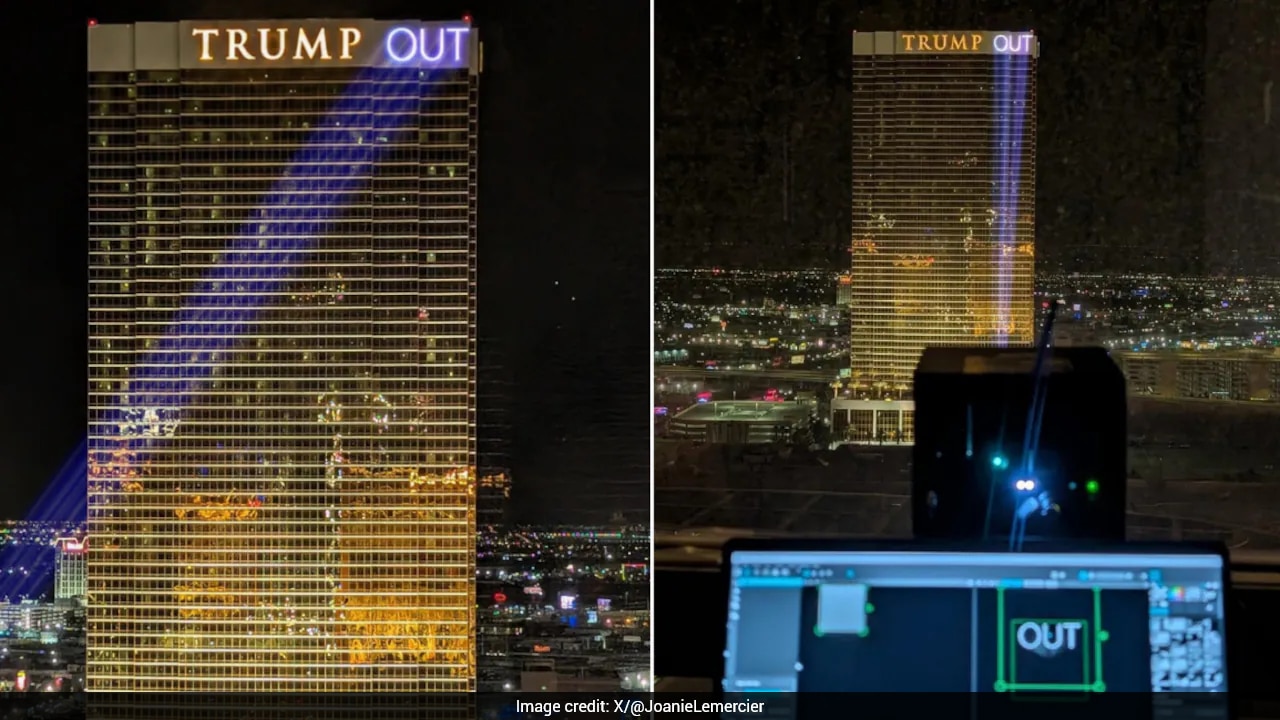
Guerrilla light projection against high-profile commercial architecture represents one of the highest-return, lowest-capital media interventions in modern political communications. When a single three-letter word—"OUT"—is projected onto the facade of a Trump Tower following a U.S. midterm election upset, the physical act of illumination is merely the catalyst. The true operational objective is not to persuade pedestrians on the street, nor is it to inflict structural damage on the property. The objective is to hijack the attentional economy by manufacturing a high-contrast, legally ambiguous visual artifact engineered specifically for algorithmic amplification.
Standard political coverage treats viral building projections as spontaneous outbursts of public sentiment or simple novelty stunts. That framing misses the underlying mechanics. A successful architectural projection operates as an asymmetric media weapon, exploiting the gap between traditional physical security protocols and modern digital distribution networks. To understand why a localized light beam routinely outperforms multi-million-dollar television ad buys in earned media impressions, we must dissect the physics of the medium, the legal arbitrage of public airspace, the psychological triggers of visual contrast, and the precise algorithmic incentives that govern post-election news cycles. For a deeper dive into similar topics, we recommend: this related article.
The Physics and Economics of Asymmetric Media Hijacking
Traditional outdoor advertising—billboards, transit wraps, digital spectaculars—operates on a linear cost-per-thousand-impressions (CPM) model dictated by real estate scarcity and municipal zoning. Acquiring prime visual real estate in a major metropolitan core like Manhattan or Chicago requires substantial capital outlay, long-term contracts, and strict editorial compliance from property owners. Guerrilla projection bypasses this entire supply chain by decoupling the display surface from the broadcasting hardware.
From an operational standpoint, the capital expenditure required to execute a high-visibility architectural projection is negligible compared to conventional campaign media. The hardware stack consists of four primary components: For additional details on this topic, detailed analysis can also be found on Al Jazeera.
- High-Lumen Projection Hardware: Commercial-grade laser or lamp projectors rated between 10,000 and 30,000 ANSI lumens, capable of overcoming ambient urban light pollution at distances exceeding 100 meters.
- Mobile Power Infrastructure: Pure sine-wave inverter generators or high-capacity lithium-iron-phosphate battery banks, allowing the unit to operate independently of the municipal grid from the back of a cargo van or a nearby rooftop.
- Optical Mapping and Keystoning Software: Real-time media servers that adjust the geometry of the projected image to compensate for severe vertical angles, ensuring crisp typography across recessed windows and structural mullions.
- The Visual Payload: A minimalist, high-contrast graphic—often monochromatic white or stark red against dark glass—designed for instantaneous legibility on a six-inch smartphone screen.
The return on investment is driven by a structural asymmetry. The target property owner bears the immense fixed costs of construction, maintenance, taxation, and brand prestige associated with a landmark skyscraper. The operator bears only the transient, depreciable cost of portable optics. By temporarily converting a billionaire's private real estate into an unauthorized billboard, the activist group achieves instant brand association—or brand subversion—without paying a cent in rent.
Legal Arbitrage and the Trespass Paradox
The persistence of guerrilla projection as a political tactic relies heavily on a persistent gray area in municipal property law: the distinction between physical trespass and photonic intrusion. While laws governing graffiti, wheat-pasting, and physical defacement are explicit and strictly enforced, the legal status of directing light onto a private structure from a public thoroughfare remains contested across most U.S. jurisdictions.
In common law, trespass requires a physical invasion of property that interferes with the owner's exclusive possession. Light waves carry no mass and leave no physical residue once the power source is cut. When an operator positions a projector inside a vehicle parked legally on a public street, or operates from a neighboring building with the tenant's permission, law enforcement faces immediate jurisdictional friction.
Building security personnel cannot legally exit the private property to seize equipment located on a public street without risking charges of theft or assault. They must summon municipal police. By the time officers arrive, assess whether a noise ordinance, traffic obstruction, or disorderly conduct statute is being violated, and locate the operator, the primary objective has already been achieved. The projection only needs to remain active for three to five minutes—just long enough for a dedicated camera crew to capture high-resolution stills and 4K video from pre-scouted angles. Once the visual assets are secured on a memory card, the physical installation becomes expendable. The operator powers down, drives away, and the digital payload begins its exponential distribution phase.
The Anatomy of Post-Election Narrative Capture
Timing is the decisive variable that separates a forgotten prank from a dominant cultural meme. Executing a projection on a random Tuesday yields minimal traction because the media ecosystem lacks a unifying narrative hook. Executing the exact same projection in the immediate aftermath of a midterm election upset exploits a specific vulnerability in the news cycle: the post-event vacuum.
During the 24 to 48 hours following an unexpected electoral shift, political journalism enters a state of frantic synthesis. Anchors, editors, and commentators are desperately searching for a singular visual shorthand that encapsulates a complex, multi-district statistical outcome. Data visualizations and precinct maps communicate complexity, but they lack emotional resonance. A three-letter word—"OUT"—emblazoned across the physical monument of the political figure in question solves the editorial problem instantaneously.
This mechanism operates through three distinct psychological and media channels:
- Semantic Compression: Complex midterm dynamics—suburban realignment, turnout differentials, down-ballot attrition—are compressed into a single, unambiguous syllable. The message requires zero contextual explanation for a global audience.
- Iconic Subversion: Skyscrapers bearing a founder's name are deliberately constructed as projections of permanence, wealth, and invincibility. Superimposing a message of rejection directly onto that steel and glass creates immediate cognitive dissonance, turning the monument's own scale against its owner.
- Algorithmic Frictionlessness: Social media ranking algorithms heavily weight engagement velocity—likes, shares, and replies per minute—immediately following publication. Because the image is starkly legible, emotionally polarizing, and tied to a trending real-time news event, it triggers rapid engagement from both supporters (who share it in triumph) and detractors (who share it in outrage). To the platform's recommendation engine, both reactions signal high relevance, driving the asset onto trending feeds globally.
Operational Limitations and Strategic Countermeasures
Despite its viral efficiency, guerrilla projection is constrained by hard physical and strategic limits. Treating it as a comprehensive political strategy rather than a tactical spike leads to severe misallocation of resources.
First, the medium is entirely hostage to ambient environmental conditions. Ambient street lighting, architectural facade illumination, and reflective glass coatings drastically degrade contrast ratios. Modern curtain-wall skyscrapers constructed with low-emissivity tinted glass absorb and scatter light rather than reflecting it cleanly back toward street-level cameras. Without exact photometric calculations and test runs, a multi-thousand-dollar projection setup can render an illegible blur. Weather introduces further fragility; light rain or atmospheric haze diffuses the beam, while heavy precipitation threatens high-voltage equipment.
Second, the tactic suffers from rapid diminishing returns. The novelty of architectural projection relies on surprise. Once a specific property becomes a recurring target, building management inevitably deploys permanent countermeasures. These include installing high-intensity upward-facing architectural floodlights designed to wash out unauthorized projections, deploying security patrols to monitor prime line-of-sight parking zones on high-risk dates, and lobbying municipal authorities for targeted local ordinances prohibiting commercial or political light projection without a permit.
Third, viral amplification does not automatically translate into durable political capital. Earned media generated through guerrilla stunts tends to reinforce existing ideological echo chambers rather than persuade undecided voters. While the visual artifact dominates social feeds for 48 hours, it rarely alters legislative dynamics or voter registration metrics on its own. If an organization mistakes digital impressions for structural organizing, the tactic becomes a vanity metric—generating applause from existing allies while failing to expand the coalition.
Tactical Execution Blueprint for High-Contrast Signaling
For communications strategists and advocacy operators seeking to deploy visual interventions without wasting capital on low-impact stunts, execution must follow a strict operational sequence rather than spontaneous activism.
Step 1: Photometric and Line-of-Sight Reconnaissance
Never select a target based solely on symbolic value. Conduct night-time site surveys to measure ambient foot-candles on the target facade and identify unobstructed sightlines from public roadways or cooperating private properties. Calculate the exact throw ratio required so the projected typography spans at least 30 percent of the visible structure's width, ensuring legibility when compressed into a mobile social feed thumbnail.
Step 2: Redundant Capture Architecture
The physical projection is merely a studio set for the digital asset. Deploy at least two independent camera teams positioned at different focal lengths—one wide-angle crew to establish the architectural scale and surrounding urban context, and one telephoto crew to capture crisp, tightly framed shots of the typography against the building's branding. Shoot in RAW or high-bitrate log formats to preserve highlight detail against dark glass.
Step 3: Synchronized Digital Seeding
Do not rely on organic discovery by passersby. The operational window before security intervention is often under ten minutes. Have pre-drafted copy, verified journalist contact lists, and coordinated social amplification accounts staged before the projector powers on. Release the highest-contrast wide shot within five minutes of illumination, targeting political reporters and visual desk editors who are actively covering the overarching news hook.
Step 4: Rapid Egress and Asset Extraction
Establish a strict hard-stop timer—typically seven minutes—regardless of whether law enforcement is visible. Once the primary visual assets are verified on camera monitors, cut power, secure the optics, and vacate the staging zone immediately. Extending the duration on-site yields zero additional media value while exponentially increasing the probability of equipment seizure and legal entanglement.
The strategic imperative for modern political communicators is clear: stop competing on the incumbent's financial terrain. When opposing networks hold overwhelming structural or capital advantages, victory belongs to the operator who treats physical landmarks not as impenetrable fortresses, but as blank screens waiting for a high-lumen narrative override.


