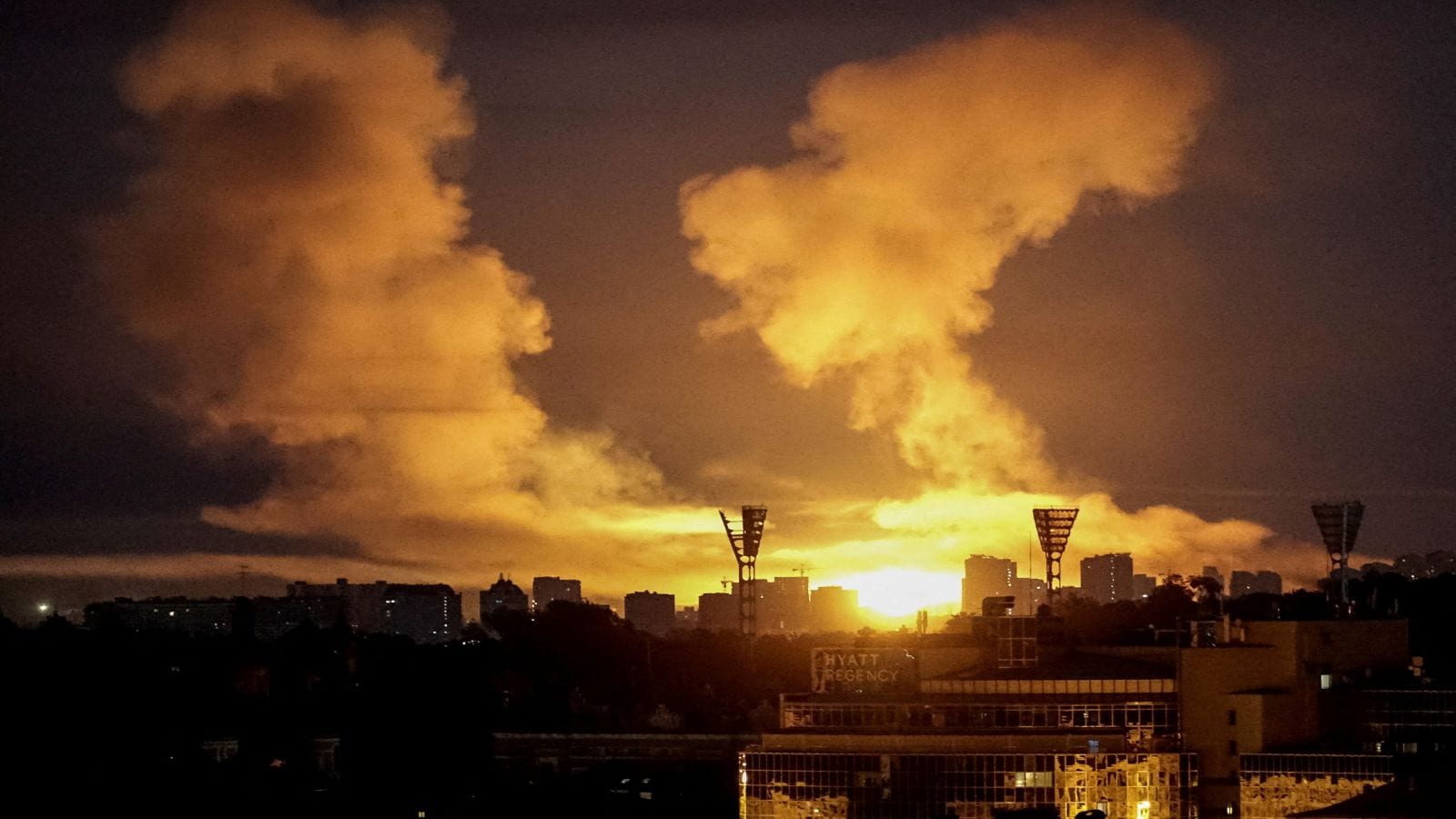
Political instability in South Asia rarely manifests as spontaneous chaos; it operates as a calibrated economic and logistical chokehold designed to raise the cost of governance beyond the state's capacity to pay. The outbreak of crude bomb detonations, transport blockades, and targeted arson in Bangladesh ahead of former Prime Minister Sheikh Hasina’s planned return represents a classic deployment of asymmetric disruption. Rather than seeking immediate territorial control or direct military confrontation, opposition networks and militant factions use low-cost kinetic acts to paralyze supply chains, fracture administrative loyalty, and force the ruling interim or incumbent apparatus into an overextension trap.
Standard media coverage treats these incidents—improvised explosive devices (IEDs) thrown at intersections, buses torched at dawn, highways severed by felled trees—as isolated acts of street violence. That framing misses the underlying operational logic. Every burned transit vehicle and blocked arterial corridor functions as a tax on daily economic activity, transferring political pressure onto the urban working class and export-oriented industrialists. Understanding this crisis requires dissecting the mechanics of political coercion, the economic vulnerability of Bangladesh’s export infrastructure, and the game-theoretic dilemma facing state security forces.
The Architecture of Asymmetric Disruption
When an opposition movement lacks institutional access to power or faces a heavily armed state apparatus, it shifts from electoral competition to friction generation. In Bangladesh, this friction relies on three distinct tactical mechanisms that reinforce one another without requiring centralized command-and-control structures.
1. Low-Cost Kinetic Signaling
Crude bombs—locally known as cocktails—seldom aim for mass casualties. Their primary function is acoustic and psychological signaling. Detonating a low-yield device near a commercial hub or government office achieves two operational objectives at minimal material cost:
- Enforcement of Strikes: During a hartal (general strike) or oborodh (blockade), the threat of an explosion keeps commuters, shopkeepers, and bus operators off the streets without requiring insurgents to physically police every intersection.
- Media Amplification: A single detonation generates immediate national and international headlines, projecting an image of state collapse that far exceeds the actual kinetic damage inflicted.
2. Arterial Logistics Paralysis
Bangladesh’s economy depends heavily on a narrow geographic corridor connecting the manufacturing belts around Dhaka and Gazipur to the deep-water port of Chattogram (Chittagong). Blockades exploit this single point of failure. By targeting highway transit nodes with arson—specifically commercial trucks and passenger coaches—agitators sever the physical link between factory floors and global shipping lanes. The objective is not to destroy the entire transport fleet, which is impossible, but to spike insurance premiums and driver attrition rates until freight movement halts voluntarily.
3. Decentralized Cell Execution
Modern political agitation in Dhaka and regional districts avoids large, easily dispersed street rallies in favor of micro-cells operating on hit-and-run timelines. Two or three operatives on a motorcycle can deploy an incendiary device or hurl a crude explosive and vanish into dense urban traffic within thirty seconds. This decentralization neutralizes traditional riot-control formations, forcing security agencies to spread personnel thin across thousands of static guard posts rather than concentrating force against leadership nodes.
The Economic Cost Function of Street Agitation
To understand why blockades and arson precede a major political event like Hasina’s return, one must examine the financial vulnerability of the Bangladeshi state. Over the past decade, the country’s macroeconomic stability has rested on two primary pillars: Ready-Made Garment (RMG) exports and inward remittances from overseas workers. Street-level kinetic disruption attacks the first pillar directly.
The RMG sector operates on razor-thin margins and strict lead times dictated by Western retail buyers. When transport blockades halt raw material imports at Chattogram or prevent finished goods from reaching vessels on schedule, factories face immediate financial penalties:
- Air Freight Substitution: To avoid canceled orders, manufacturers must shift delayed shipments from sea freight to air cargo, erasing profit margins on entire production runs.
- Order Diversion: International buyers operate with low tolerance for supply chain volatility. Prolonged blockade cycles push procurement officers to reallocate contracts to competing manufacturing hubs in Vietnam, India, or Cambodia.
- Domestic Inflationary Feedback Loops: Interdicting the Dhaka-Chattogram corridor and northern agricultural supply routes immediately restricts the flow of perishable foodstuffs into urban centers. Wholesale prices spike within 48 hours of a sustained blockade, turning economic hardship into public resentment directed at whichever authority currently holds state power.
Agitators calculate that if the daily economic bleed exceeds a critical threshold, powerful domestic stakeholders—specifically business associations, banking elites, and civil bureaucrats—will pressure the administration to either strike a political compromise or abandon plans for a high-profile political return.
The State Security Dilemma and Overextension
The impending return of a polarizing political figure creates an acute operational dilemma for law enforcement and military units tasked with maintaining order. This dynamic mirrors the classic counterinsurgency bind: every tactical response available to the state carries a high probability of generating secondary political blowback.
If security forces adopt a containment posture—deploying massive checkpoints, preemptive mass arrests, and curfews—they inevitably disrupt commerce themselves. A city locked down by police barricades suffers the exact same economic paralysis that a blockade seeks to induce. The state effectively accomplishes the agitators' logistical objective while absorbing the blame from citizens unable to commute or conduct business.
Conversely, if authorities maintain a reactive posture to keep commercial corridors open, decentralized arson cells exploit the gaps in coverage. High-profile incidents of burned buses or bombed intersections erode public confidence in the administration’s monopoly on the legitimate use of force. Security planners are forced to allocate elite units—such as the Rapid Action Battalion (RAB) or Border Guard Bangladesh (BGB) detachments—to static infrastructure protection, degrading their capacity for intelligence-led disruption of the networks supplying explosives and funding.
Catalyst Mechanics of a High-Stakes Political Return
Why does the specific prospect of Sheikh Hasina’s return trigger an immediate escalation in kinetic activity? In political science, leadership re-entry acts as a coordination focal point.
For months, fragmented opposition groups, disillusioned party cadres, and radicalized factions may operate without a unified timeline. The announcement or rumor of a returning leader compresses that timeline, creating a binary deadline. For loyalists, the return represents a potential restoration of patronage networks and political protection, incentivizing them to demonstrate strength on the streets to prove their utility. For adversaries, the period before the return is the final window to alter the political terrain and make re-entry physically or politically untenable.
This dynamic produces a security vacuum characterized by preemptive violence:
- Deterrence Signaling: Rival factions use arson and bombings to signal to administrative officials, judges, and police commanders that the returning figure will not inherit a pacified state. This targets the loyalty of mid-level bureaucrats who hedge their bets during political transitions.
- Narrative Capture: Both sides compete to define the legitimacy of the political environment. Pro-return factions frame street violence as proof that only a strong, experienced hand can restore order. Anti-return factions frame the exact same violence as evidence that the leader's mere presence invites national ruin.
- Provocation Traps: Agitators escalate kinetic attacks specifically to provoke disproportionate lethal force from security personnel. A high casualty count among protesters or bystanders shifts international diplomatic pressure onto the authorities, complicating travel logistics, visa approvals, and security guarantees required for a high-profile return.
Strategic Limits and Operational Friction
While asymmetric street disruption imposes severe short-term costs, it suffers from inherent structural limitations that prevent it from achieving decisive political victory on its own.
First, arsons and blockades suffer from diminishing marginal returns. During the initial 72 hours of a blockade, fear keeps citizens indoors and commerce halts. However, in an economy dominated by daily wage earners and informal sector workers, prolonged inactivity equals starvation. After three to five days, economic necessity overrides physical fear. Drivers resume operating damaged vehicles, markets reopen, and the psychological shock of crude bomb detonations dulls into background noise.
Second, indiscriminate kinetic tactics alienate the urban middle class. When arson targets public commuter buses or disrupts hospital access, the public anger initially directed at the government for failing to maintain order inevitably pivots toward the perpetrators. Opposition movements that rely too heavily on physical destruction lose the moral authority required to convert street disruption into sustained political legitimacy.
Third, intelligence penetration scales with operational tempo. Every crude bomb manufactured and every arson attack coordinated requires supply chains—procurement of precursor chemicals, safe houses, cash disbursements, and encrypted communications. Increasing the frequency of attacks exposes operatives to signals intelligence and human informant networks, allowing state security agencies to roll up entire cells within weeks of a campaign's peak.
Tactical Risk Mitigation for Institutional Stakeholders
Organizations, logistics operators, and administrative bodies operating within Bangladesh during pre-return escalation cycles cannot rely on standard security protocols. Passive monitoring fails when street conditions shift from calm to kinetic within minutes.
- Decouple Freight from Predictable Schedules: Logistics managers must abandon daytime highway convoys along the N1 (Dhaka-Chattogram) corridor. Freight movement should shift to irregular nighttime windows accompanied by real-time crowd-sourced route intelligence rather than static police escorts, which often attract targeted attacks.
- Harden Critical Nodes Over Linear Routes: Because defending hundreds of kilometers of highway is mathematically impossible, security resources must concentrate on chokepoints: port gates, fuel depots, bridge approaches, and industrial park perimeters.
- Implement Liquidity and Inventory Buffers: Manufacturing and retail enterprises must maintain a minimum 14-day buffer of raw materials and finished goods inside secure bonded warehouses near port facilities to insulate export contracts from sudden 72-hour blockade cycles.
- Monitor Bureaucratic Defection Indicators: Political analysts tracking the viability of Hasina’s return should ignore public rhetoric and street casualty counts, focusing instead on institutional behavior. The decisive metric is the compliance rate of civil administration officials, judiciary rulings on pending legal cases, and the deployment posture of regular military units. Until those institutional levers shift, street-level bombings and arson remain tactical noise rather than a strategic realignment of power.