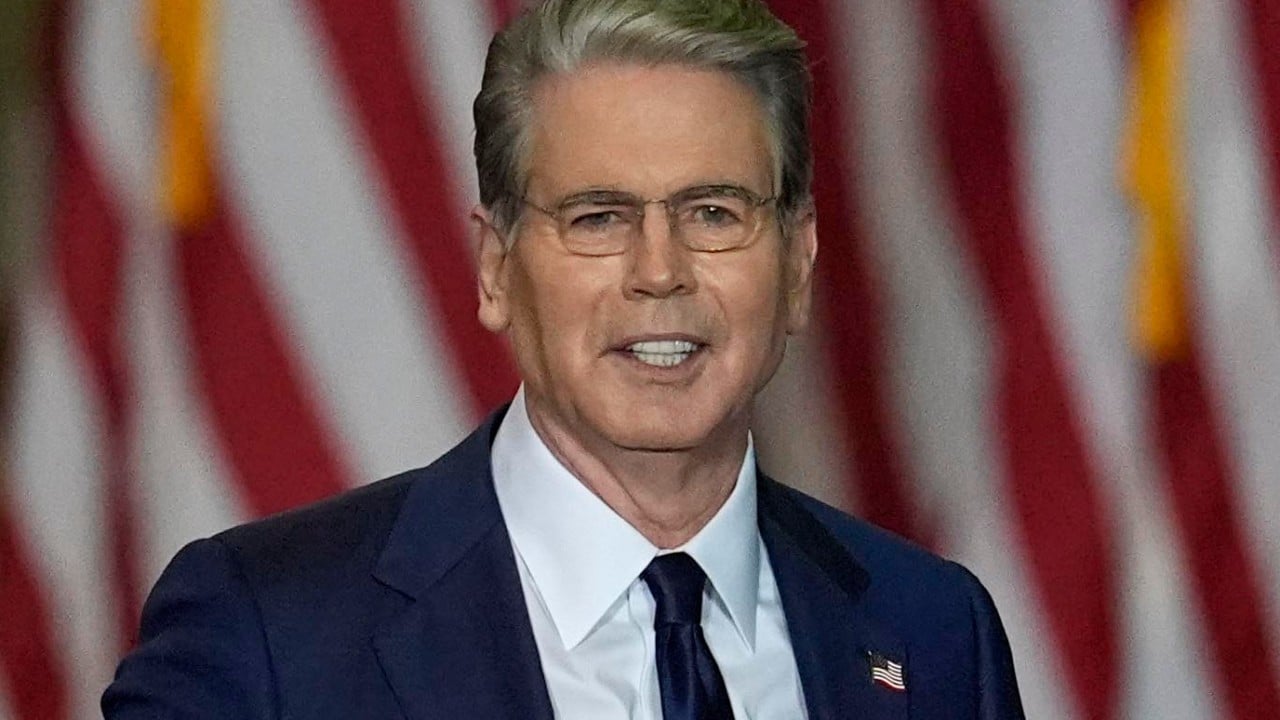
The relocation of U.S. Treasury Secretary Scott Bessent and his family from a private Georgetown residence to an undisclosed military installation in November 2026 marks a structural shift in modern statecraft. Financial warfare has formally crossed the threshold into kinetic personal risk for civilian economic architects. Standard news coverage frames this event as a routine security precaution triggered by media exposure and vague geopolitical friction. That framing misses the operational reality. Moving a sitting Treasury Secretary inside a hardened military perimeter is the direct physical consequence of a three-part strategic collision: the weaponization of the U.S. dollar via "Operation Economic Outcast," the erosion of executive privacy through open-source intelligence, and the asymmetric retaliation doctrine of a cornered adversary.
To understand why a financial official requires the same force-protection posture as a theater commander, analysts must look past diplomatic rhetoric and examine the mechanics of economic attrition, physical vulnerability, and retaliatory deterrence.
The Architecture of Operation Economic Outcast
Conventional sanctions act as friction; they raise the cost of doing business, force adversaries into gray-market workarounds, and degrade state capacity over years. The campaign directed by Bessent since the outbreak of direct U.S.-Israeli military strikes against Iran in February 2026 operates on a fundamentally different model. Rather than applying incremental pressure, Operation Economic Outcast pairs total financial exclusion with physical interdiction to induce rapid systemic collapse.
This strategy relies on three interlocking mechanisms that explain why Tehran views the Treasury Department not as a regulatory bureaucracy, but as an active belligerent:
- Maritime Chokepoint Denial: Since July 2026, U.S. naval forces have enforced a blockade on Iranian ports, redirecting over 150 merchant vessels and disabling ships attempting to run the perimeter. By November, Bessent reported that Iranian crude exports had dropped to zero waterborne barrels. Without maritime transit, Tehran loses its primary source of hard currency.
- Terrestrial and Caspian Interdiction: Recognizing that naval blockades push smuggling inland, U.S. Central Command established Task Force Iron Gate in November 2026. This interagency mechanism targets cross-border overland routes and Caspian Sea transit to choke off illicit revenue streams and dual-use industrial components.
- Secondary Financial Contagion: The Treasury has aggressively severed Middle Eastern bank branches, shadow banking networks, and aviation facilitators from the U.S. dollar clearing system. By threatening third-party institutions with immediate dollar exclusion, Washington forces global compliance without needing direct jurisdiction over foreign entities.
When an economic campaign achieves near-total isolation, it triggers acute domestic inflation, currency freefall, and elite fragmentation inside the target state. From the perspective of the Islamic Revolutionary Guard Corps (IRGC), the architect of that financial strangulation poses an existential threat equivalent to a military general. Retaliation against the civilian official becomes a logical extension of battlefield defense.
The Open-Source Intelligence Vulnerability Curve
High-ranking cabinet officials have historically relied on low-profile security details and residential obscurity to operate safely in Washington, D.C. That protective model fails when high-visibility geopolitical targeting intersects with commercial media practices.
In early 2025, following his confirmation, Bessent purchased a $12.5 million residence in Georgetown. In November 2026, the Wall Street Journal published an aerial photograph of the property. While intended to illustrate wealth or lifestyle, the image inadvertently solved the hardest problem for a hostile intelligence service: target acquisition and physical geolocation.
In modern threat environments, an aerial photograph of an urban residence creates immediate, unmitigable vulnerabilities:
- Line-of-Sight and Perimeter Exposure: Dense urban neighborhoods like Georgetown feature narrow streets, adjacent rooftops, and public thoroughfares that prevent protective details from establishing a deep standoff buffer. Once the exact structure is mapped, hostile actors can calculate sightlines, access points, and traffic choke points using publicly available mapping data.
- Pattern-of-Life Predictability: Unlike a secure compound with multiple concealed exits and subterranean transit links, a historic townhouse funnels residents through predictable ingress and egress routes.
- Asymmetric Threat Profiles: U.S. intelligence assessments reported in November 2026 noted elevated Iranian threats against Americans domestically and abroad, alongside concerns regarding unconventional delivery mechanisms, including weaponized drones. Defending a civilian townhouse against low-altitude unmanned aerial systems or coordinated ground surveillance requires counter-drone arrays, airspace restrictions, and continuous perimeter patrols that are legally and physically incompatible with a residential neighborhood.
Once a residence is compromised via open-source geolocation, the cost of defending it in place exceeds the operational capacity of standard protective details. Relocating the principal to a Department of Defense installation immediately solves the standoff problem. Military bases provide controlled airspace, layered perimeter defense, hardened structures, and continuous counter-intelligence screening at zero marginal infrastructure cost.
The Logic of Asymmetric Deterrence and Cabinet Hardening
Bessent is not an isolated case. By November 2026, multiple senior figures in the Trump administration—including Defense Secretary Pete Hegseth, Secretary of State Marco Rubio, White House Chief of Staff Stephen Miller, and Attorney General Todd Blanche—had also relocated to military installations in response to Iranian threat reporting.
This mass migration of the civilian executive branch into military cantonments illustrates a specific doctrine of asymmetric warfare. Unable to match U.S. naval and air superiority in the Persian Gulf or break the blockade around Kharg and Jask, Tehran shifts the contest to a domain where costs are inverted. Mounting a credible assassination plot—or even generating sufficient intelligence chatter to suggest one—costs a state sponsor very little. Conversely, the defensive response imposes massive logistical friction on the target government.
However, intelligence communities must distinguish between capability, intent, and deterrence signaling. In mid-November 2026, Secretary Rubio stated that Washington did not face an imminent homeland attack, and the White House noted it had not identified a specific, executable plot on U.S. soil, even as Director of National Intelligence Jay Clayton confirmed a substantial overall rise in Iranian threat activity. Meanwhile, Iran's Foreign Ministry officially denied plotting attacks inside the United States.
This divergence between public threat assessments and extreme protective measures points to two distinct operational realities:
- Zero-Tolerance Risk Management: Following high-profile assassination attempts during the 2024 election cycle and persistent Iranian vows to avenge past strikes, the Secret Service and Diplomatic Security operate under a zero-fail mandate. When a cabinet official is explicitly named in threat intelligence and their home address is compromised, protective agencies do not wait for tactical confirmation of an operational cell before hardening the target.
- Strategic Signaling: Bessent publicly framed the alleged bounty on his life as proof that Operation Economic Outcast is working, characterizing the Iranian regime as a "wounded cornered animal" and a "sinking ship". By moving to a military base while maintaining an aggressive public media schedule, the administration signals to both Tehran and global financial markets that personal intimidation will not alter U.S. sanctions policy.
Operational Trade-Offs and Governance Friction
While relocating civilian leaders to military bases neutralizes immediate physical threats, it introduces secondary vulnerabilities and governance bottlenecks that standard reporting overlooks. Hardening the executive branch carries measurable institutional costs:
- Civil-Military Boundary Erosion: The American constitutional system relies on a clear separation between civilian governance and the military establishment. Housing the heads of Treasury, State, Justice, and the White House staff inside military bases creates an insular operational environment. Informal access by civilian lawmakers, external economists, and diplomatic counterparts becomes restricted by base security protocols, narrowing the information inputs reaching decision-makers.
- Escalation Trap Dynamics: Publicly linking personal security measures to ongoing economic warfare locks both sides into rigid postures. If Washington eases sanctions, it risks appearing intimidated by threats against its officials. Conversely, if Tehran perceives that economic collapse is imminent regardless of its actions, the regime faces a "use it or lose it" incentive regarding its remaining retaliatory capabilities—whether missile strikes against regional energy infrastructure or covert operations abroad.
- The Limits of Blockade Economics: Relying on total economic strangulation assumes that severe deprivation forces political capitulation. Historical precedent demonstrates that comprehensive blockades often consolidate hardline control over scarce resources in the short term, punishing the civilian population while empowering the security apparatus that controls smuggling networks and rationing.
Strategic Forecast and Risk Mitigation
The integration of total financial warfare with kinetic military blockades has permanently altered the risk profile for senior economic policymakers. As long as the U.S. maintains Operation Economic Outcast and naval interdiction in the Persian Gulf, civilian officials overseeing sanctions enforcement will remain high-priority targets for asymmetric retaliation.
For institutional risk managers, corporate security teams, and policy analysts tracking the trajectory of the U.S.-Iran conflict through early 2027, three operational imperatives follow from this reality:
- Treat Executive OPSEC as National Security Infrastructure: High-ranking financial and regulatory officials must be integrated into secure residential frameworks prior to assuming office, rather than after open-source leaks occur. Real estate transactions involving incoming cabinet members require blind trusts and strict non-disclosure protocols to prevent commercial geolocation.
- Price in Prolonged Maritime and Financial Disruption: Because Bessent and the administration have staked their credibility on enduring personal threats without yielding, markets should not expect a near-term relaxation of secondary sanctions or a reopening of the Strait of Hormuz. Compliance teams at global banks and shipping firms must prepare for aggressive enforcement against shadow fleets and third-party clearing houses throughout the winter.
- Monitor Asymmetric Flashpoints Over Diplomatic Channels: With senior U.S. principals operating from hardened military bases and Iranian hardliners threatening regional shipping and European bases, traditional diplomatic off-ramps are severely constrained. Strategic monitoring must prioritize indicators of desperation inside the IRGC—specifically attempts to run naval blockade perimeters with state-backed tanker convoys—as the primary trigger for wider regional escalation.