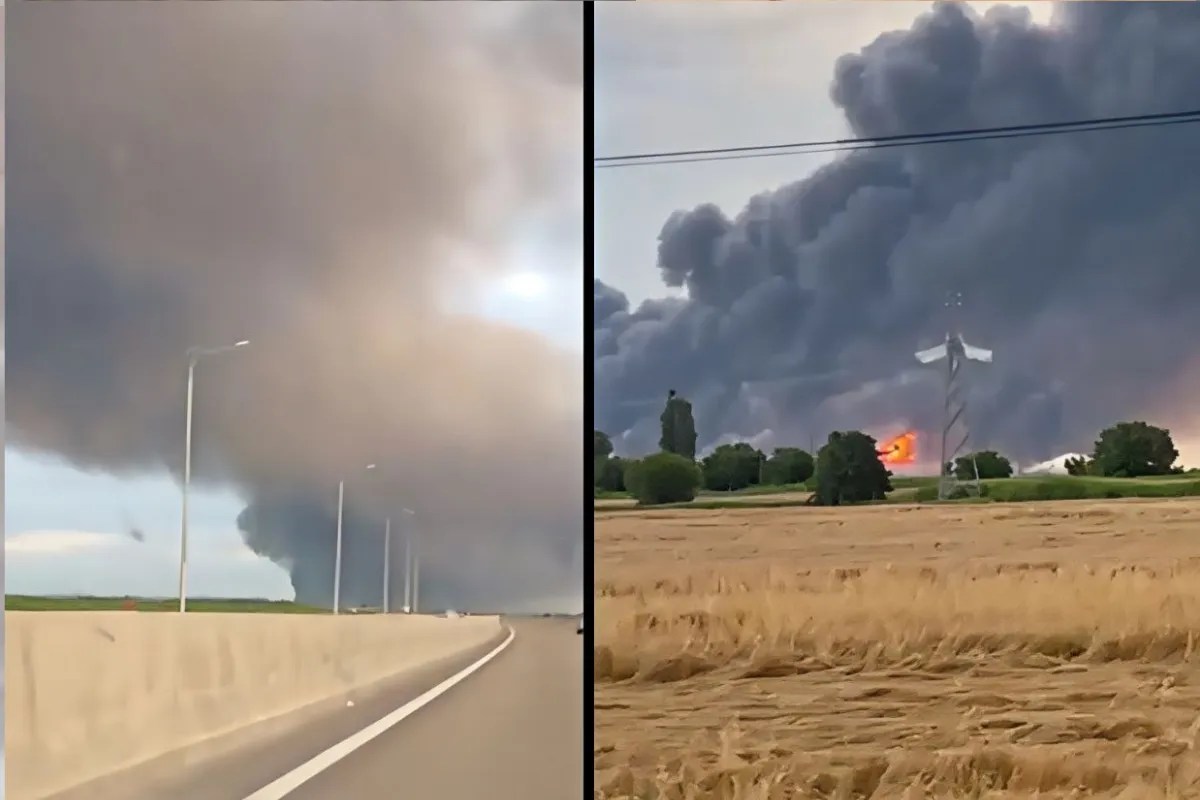
The strategic calculus of modern attritional warfare dictates that victory is not merely a function of territory captured, but of the relative cost curves imposed by adversaries upon each other. Recent operational developments in the Russia-Ukraine conflict—specifically the synchronized destruction of advanced aviation assets and downstream energy infrastructure—signify a structural shift in Ukraine's deep-strike doctrine. By analyzing these events through the lens of asymmetric economic warfare and logistical bottlenecks, we can map the precise mechanisms through which low-cost unmanned aerial vehicles (UAVs) disrupt high-value military and macroeconomic targets.
The central thesis of this analysis is that Ukraine has transitioned from sporadic, retaliatory strikes to a systematic campaign targeting Russia’s economic engine and military power projection. This strategy operates on a massive cost-imbalance ratio, using expendable technology to force disproportionate capital expenditure and operational downtime on the adversary.
The Aviation Interdiction Pillar: Capital Degradation and Tactical Contraction
The degradation of Russian tactical aviation, highlighted by the reported destruction of advanced fighter jets, introduces an immediate constraint on air superiority doctrines. Military aviation assets operate within strict maintenance-to-flight hour ratios. When an airframe is destroyed on the ground, the loss extends far beyond the financial cost of the platform; it represents a permanent reduction in sorties-per-day capacity.
The tactical mechanism relies on long-range, low-signature UAV strikes directed at forward operating bases. These bases harbor high-value assets such as the Su-34 or Su-35, which are frequently used to deploy glide bombs. The destruction of even a single unit alters the local operational equilibrium through three distinct vectors:
- Geographic Displacement: To preserve remaining assets, air commands are forced to retrogress aircraft to airfields deeper within sovereign territory. This increased distance directly impacts loiter time over target zones and escalates fuel consumption exponentially.
- Logistical Strain: Operating from distant bases compresses the time-window available for close air support, requiring complex aerial refueling coordination or reducing the frequency of tactical bombing runs.
- Air Defense Misallocation: Protecting localized military infrastructure requires the reallocation of mobile air defense systems (such as the Pantsir or S-400 modules) away from active front lines, creating systemic vulnerabilities in frontline air shields.
The Energy Infrastructure Function: Disrupting the Hydrocarbon Processing Chain
Simultaneous strikes against two Russian oil refineries demonstrate a calculated expansion of the economic warfare front. Energy infrastructure is inherently rigid, highly centralized, and highly vulnerable to kinetic disruption. The objective here is not the total cessation of crude extraction, but rather the systematic throttling of processing capability.
To understand the strategic impact, one must look at the anatomy of a refinery. A refinery is not a homogenous block; it is a complex sequence of chemical processing units. The primary vulnerability lies in the Atmospheric and Vacuum Distillation Units (AVUs), which crack crude oil into its primary commercial components—diesel, gasoline, and aviation fuel.
[Crude Oil Input] -> [Atmospheric & Vacuum Distillation Units (AVUs)] -> [Fractionated Outputs: Diesel / Jet Fuel]
                                    |
                           (Targeted by UAVs)
                                    |
                       [Systemic Refinery Shutdown]
These distillation columns are massive, highly customized pieces of industrial engineering. They cannot be easily bypassed, nor can they be replaced using standard off-the-shelf components.
When a drone strike successfully penetrates a refinery’s perimeter and detonates within the AVU cluster, the resulting thermal damage triggers an immediate, systemic shutdown. The economic and military ramifications cascade rapidly:
- Refined Product Deficits: A localized reduction in refining capacity instantly constricts the domestic supply of specialized fuels. For a military apparatus heavily reliant on diesel for mechanized units and high-octane fuel for aviation, short-term localized shortages force complex logistical rerouting.
- Export Revenue Compression: Refined petroleum products yield significantly higher profit margins than unrefined crude oil. By forcing Russia to export raw crude rather than processed products, Ukraine directly suppresses the capital inflows required to fund long-term military procurement.
- The Repair Bottleneck: The primary limitation in restoring damaged refining capacity is the availability of specialized Western-manufactured components or sophisticated metallurgy. Sanctions create a severe friction point, extending repair timelines from weeks to months, or even years in scenarios requiring total component fabrication.
The Math of Asymmetric Attrition
The core operational framework driving this campaign is the radical asymmetry of the engagement math. Consider the financial and material inputs required to execute this deep-strike strategy versus the defensive inputs required to mitigate it.
A long-range one-way attack UAV utilized by Ukrainian forces typically costs between $20,000 and $100,000 to manufacture, utilizing commercially available GPS guidance systems, composite materials, and small internal combustion engines. Conversely, a single modern air defense missile (such as those fired by an S-400 system) costs between $1 million and $3 million.
If an adversary fires three multi-million dollar interceptors to down a flock of $50,000 drones, the defender faces economic exhaustion long before the attacker runs out of inventory. If a drone evades interception and successfully damages a $50 million aircraft or a $100 million distillation column, the return on investment for the attacker reaches orders of magnitude that challenge traditional military doctrines.
Defensive Saturations and Tactical Limitations
While structurally sound, the Ukrainian deep-strike strategy faces clear operational limitations. An objective assessment reveals several friction points that prevent this doctrine from becoming a singular turning point in the conflict.
The first limitation is the evolution of electronic warfare (EW). As deep-strike campaigns scale, the adversary deploys dense, localized EW blankets capable of jamming GPS and GLONASS frequencies, forcing UAVs to rely on less precise inertial navigation or vision-based terminal guidance systems. This adaptation increases the failure rate of long-range strikes.
The second limitation involves target hardening. Refineries and airfields are sprawling installations. Passive defense measures, such as anti-drone netting, metal cages built over critical valves, and concrete revetments around parked aircraft, can significantly mitigate the kinetic energy of small drone payloads. A strike that hits a storage tank causes a localized fire; a strike that hits the core distillation column cripples the facility. The margin of operational success depends entirely on precision targeting.
Strategic Realignment and Projecting the Logistical Endstate
The integration of aviation interdiction and refinery degradation indicates a move toward a holistic logistical denial strategy. The objective is to create a compounded bottleneck where the adversary faces a simultaneous deficit in operational air power and the refined fuel assets required to sustain mechanized operations.
The logical trajectory of this campaign points toward an escalation in strike density. To achieve a permanent reduction in Russian industrial output, Ukraine must maintain a strike cadence that outpaces the adversary's capacity to repair infrastructure and adapt air defense arrays. This requires continuous domestic manufacturing scaling and iterative software updates to bypass evolving electronic countermeasures.
The ultimate indicator of this strategy's efficacy will not be found in territorial gains on the immediate frontline, but in the macroeconomic data points of the coming months: specifically, domestic wholesale fuel price spikes within Russia, sudden drops in refined oil export volumes, and a measurable reduction in the frequency of tactical air sorties along the contact line. Military planners must monitor these structural variables to gauge the true degradation of the adversary's deep combat sustainability. Operational pressure must now be focused on sustaining the strike cadence against regional electrical substations feeding these industrial corridors to completely freeze the repair capabilities of the targeted facilities.