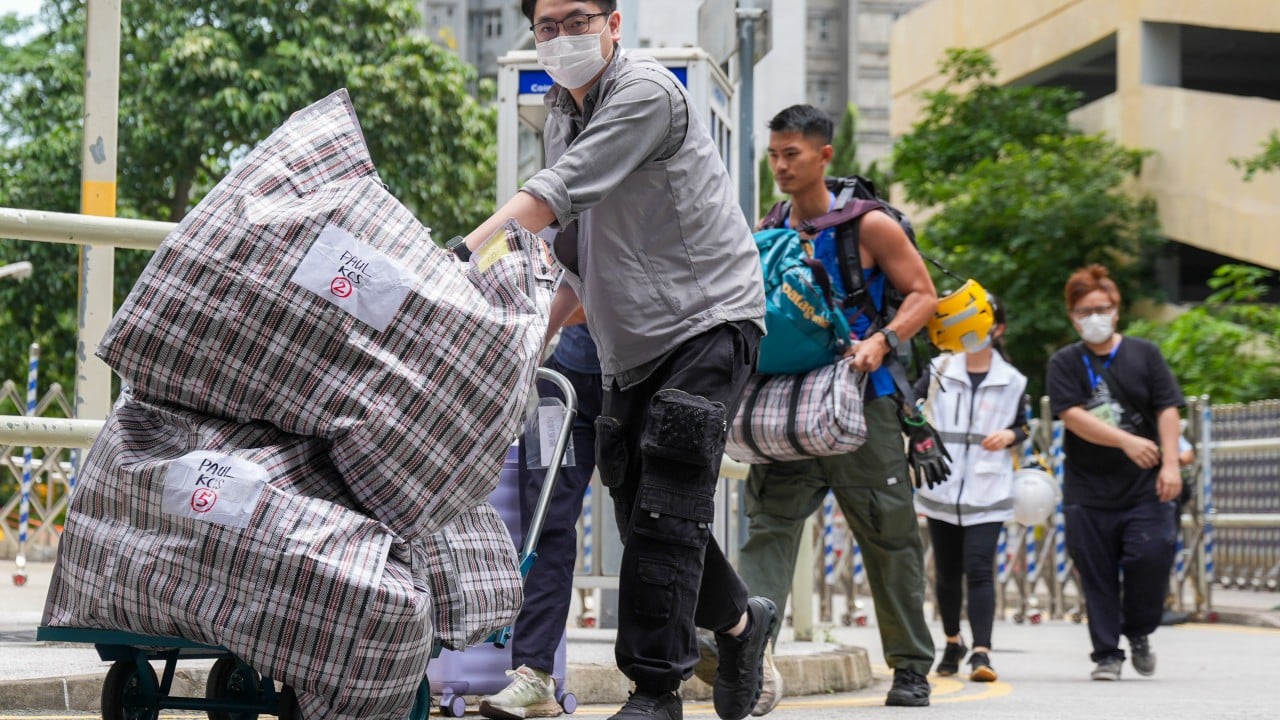
The air inside the public housing estate of Wang Fuk Court didn't smell like a typical Tuesday. It smelled of wet charcoal and the chemical tang of melted plastic. For the residents of the Tai Po district, the fire wasn't just a news segment or a siren in the distance. It was the sound of windows shattering under heat and the sight of black smoke swallowing the laundry hanging from their balconies. When the flames were finally quenched, a different kind of panic set in. It was the quiet, cold realization that occurs when you stare at a metal box that used to hold your life’s savings.
In many Hong Kong households, especially among the elderly who remember leaner years, the bank is a place for dividends, not for secrets. There is a deep-seated culture of keeping "emergency" cash under mattresses or tucked into the back of closets. It is a physical tether to security. When the fire ripped through the flats at Wang Fuk Court, it didn't just take furniture. It turned years of disciplined saving—hundreds of thousands of Hong Kong dollars—into brittle, blackened flakes.
The Anatomy of a Ghost Note
Imagine holding a stack of thousand-dollar bills that feels like dried seaweed. If you breathe too hard, the corners disintegrate. If you try to peel them apart, the ink stays stuck to the wrong side. This is "burnt cash," a nightmare for any currency holder. For one resident, a sum totaling roughly $60,000 HKD had been reduced to a charred brick. This wasn't just money. It was a daughter’s tuition. It was a medical fund. It was the buffer between a dignified retirement and total dependence.
The problem with burnt money is that it ceases to be a legal tender the moment its security features vanish. A vending machine won't take it. A wet market vendor will look at it with pity but won't trade a head of bok choy for it. In the eyes of the law, a banknote is a contract. If the contract is unreadable, the value is gone.
Or so it seems.
The real story isn't about the fire itself, but what happened when the smoke cleared. In an era where we are told that banking is a cold, algorithmic world of high-frequency trading and faceless apps, a very human process began. Hong Kong’s major banking institutions—HSBC, Bank of China (Hong Kong), and Standard Chartered—stepped into the soot.
The Forensic Art of Redemption
When a resident walks into a bank branch with a bag of ash, the teller doesn't just hand over fresh bills. That would be an invitation to fraud. Instead, a meticulous, almost surgical process begins.
Consider the "three-quarters" rule. It is a standard used by many central banks and commercial institutions globally, including the Hong Kong Monetary Authority. If you have more than 75% of a banknote intact, you usually get full value. If you have between 50% and 75%, you might get half. If you have less than half? It’s a scrap of paper.
But fire is rarely so precise.
The bank staff at the Tai Po branches had to become forensic accountants. They used tweezers. They used magnifying glasses. They spent hours separating layers of carbonized paper that had fused together under the intense heat of the Wang Fuk Court blaze. Each note had to be authenticated. Was the watermarked window still visible? Could the silver thread be traced?
This is where the invisible stakes of banking become visible. The banks waived the usual processing fees for the fire victims. They recognized that the value they were restoring wasn't just fiscal; it was the restoration of a person’s sense of order. By meticulously verifying and replacing the damaged notes, they were essentially telling the residents that their hard work hadn't been vaporized by a faulty electrical socket or a stray spark.
The Psychology of the Hidden Hoard
One might wonder why, in one of the most technologically advanced financial hubs on the planet, people still keep large sums of cash at home. To understand this is to understand the soul of Hong Kong’s older generation.
For many, the physical presence of cash represents "true" ownership. Digital numbers on a screen feel ethereal. They feel like something that can be turned off by a power outage or a system glitch. A stack of bills in a tin box is something you can grab if you need to run. It is the ultimate insurance policy against an unpredictable world.
The fire at Wang Fuk Court exposed the flaw in that logic, but the banks’ response acknowledged the emotion behind it. They didn't lecture the residents on the benefits of digital savings accounts or the risks of fire-prone storage. Instead, they focused on the immediate trauma of loss.
A Gesture Beyond the Balance Sheet
There is a technical term for this: "mutilated note reclamation." It sounds clinical. It sounds like something involving a factory and a shredder. But on the ground in Tai Po, it looked like a bank manager sitting with an elderly man who was trembling because his life’s savings looked like a bag of BBQ charcoal.
The banks sent teams to the estate. They set up mobile units and simplified the bureaucracy. They coordinated with the Hong Kong Monetary Authority to ensure that even the most severely damaged notes were sent to the government’s specialized labs for assessment.
This coordination is a reminder that the financial system is, at its core, a social contract. We agree that these pieces of paper have value. When the paper is destroyed, the institution has a choice: stand on the letter of the law or honor the spirit of the agreement. By replacing the burnt cash, the banks opted for the latter. They chose to validate the years of labor that the ash represented.
The Resilience of Value
By the end of the recovery period, the majority of the residents who brought in their damaged currency received a significant portion of their money back in crisp, new notes. The smell of the fire eventually faded from the lobbies of the bank branches, replaced by the mundane scents of air conditioning and floor wax.
But the lesson remains.
We often think of wealth as something permanent—gold bars in a vault, numbers in a cloud, property titles. The reality is that wealth is fragile. It is susceptible to the elements. It can be melted, burnt, or washed away. What isn't fragile, however, is the community’s infrastructure for recovery.
The fire at Wang Fuk Court was a tragedy of loss, but the aftermath was a quiet victory for institutional empathy. It proved that even in a city of skyscrapers and high-stakes finance, the most important work often happens at a small desk, with a pair of tweezers, over a pile of ash.
The residents went back to their lives. They moved back into repaired flats. Many of them likely went straight to a new hiding spot to tuck away their replaced notes, perhaps this time in a fireproof safe. The banks went back to their ledgers. But for a few weeks in Tai Po, the ledger wasn't about profits or losses. It was about making sure that the smoke didn't get the last word.
A woman walks out of a branch on On Chee Road. She clutches a small envelope. Inside is the replacement for the $20,000 she thought she’d lost forever. She stops at a bakery, buys a single pineapple bun, and pays with a brand-new ten-dollar bill. The cashier takes it without a second thought. The cycle continues. Value is restored, not by magic, but by the patient, methodical labor of those willing to look closely at what remains.