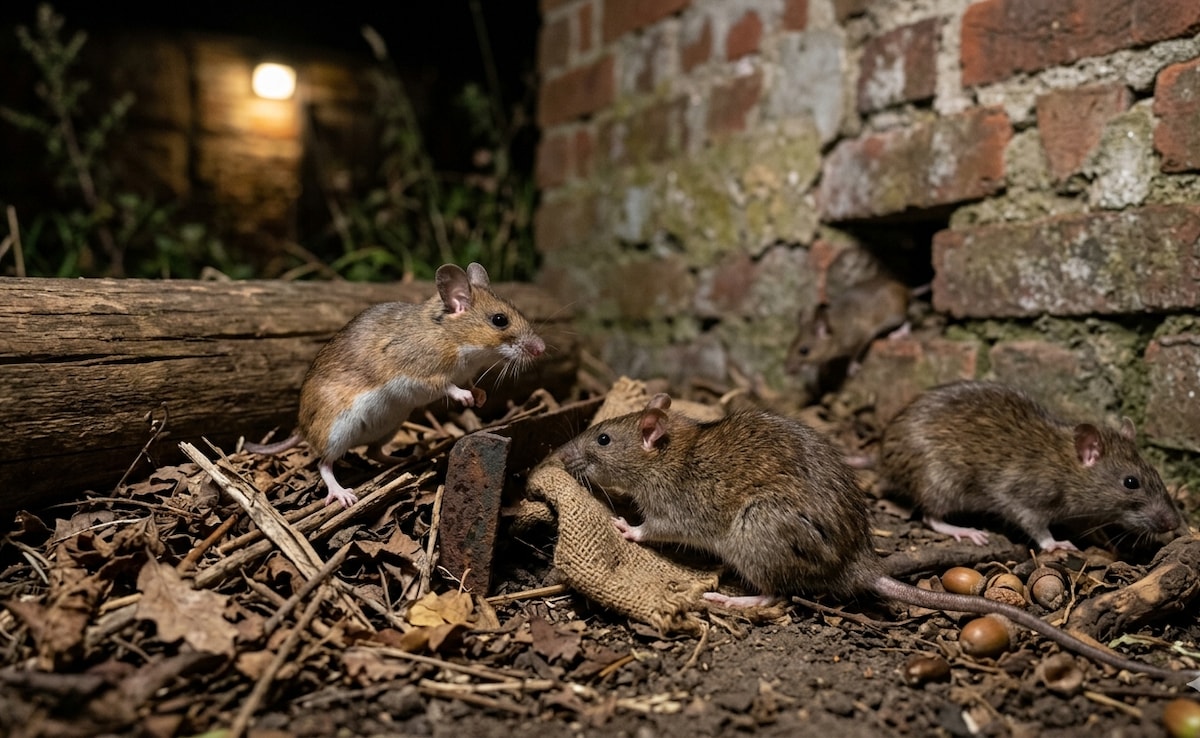
Biologists and park rangers didn't wait for daylight. As darkness crept over the dense, cold forests of Tierra del Fuego National Park, they bent down on hiking trails to lay dozens of small, rectangular metal cages. They wore thick gloves and heavy masks. They were looking for mice.
It sounds like a minor local field study. It isn't. This is a high-stakes scientific dragnet triggered by an international health scare that left three cruise ship passengers dead.
The MV Hondius cruise ship departed from Ushuaia, the picturesque city at Argentina's southernmost tip, on April 1. By the time the dust settled, a hantavirus outbreak on board killed three people, forced British paratroopers to land on the remote island of Tristan da Cunha to assist, and left global health officials frantic to find the source. Two of the victims, a married Dutch couple, spent four months traveling through Argentina, Chile, and Uruguay before stepping onto the ship. They spent 48 hours in Ushuaia right before boarding.
Now, the Argentine Health Ministry is trying to prove whether the deadly pathogen was picked up in the pristine wild lands of Tierra del Fuego or if the global panic originated somewhere else entirely.
The Zero Case Problem in Tierra del Fuego
If you ask provincial health officials in Tierra del Fuego, they will tell you the island is completely clean. The province hasn't recorded a single confirmed case of hantavirus since reporting became mandatory 30 years ago. Local mammal expert Sebastian Poljak was blunt about the historical data, noting there is simply no precedent for the virus in this specific region.
But public health doesn't rely on assumptions. You go out and you trap.
The scientific team dispatched from Buenos Aires set up roughly 150 traps across strategic locations. They are hunting specifically for the long-tailed pygmy rice rat, known locally as the colilargo. This tiny rodent is the natural reservoir for the Andes strain of hantavirus.
To understand why this hunt is creating waves in the medical community, you have to understand what makes the Andes strain different from every other hantavirus on Earth. Most hantaviruses are a dead end for human-to-human transmission. You breathe in dust contaminated with the urine, feces, or saliva of an infected rodent, you get sick, and the chain stops there.
The Andes strain doesn't play by those rules. It's the only hantavirus known to science that can spread directly from person to person.
What Scientists Actually Know About the Andes Strain
Whenever hantavirus makes headlines, people panic that we're staring down the barrel of a new COVID-19. That's a fundamental misunderstanding of the science.
I've looked closely at how these outbreaks behave, and the data tells a very specific story. The Andes virus isn't a highly volatile, rapidly mutating monster like influenza. It's an incredibly stable virus that has evolved alongside its rodent hosts over millennia. When human-to-human transmission happens, it isn't because the virus suddenly mutated into an airborne super-bug.
Epidemiologists from the Hospital Zonal de Bariloche, who have spent decades managing Patagonian outbreaks, emphasize that person-to-person spread is an exceptional event. It requires close, prolonged contact. We're talking less than one meter of distance for at least thirty minutes. It usually happens between people living in the same household or someone actively caretaking a sick relative during the early stages of the disease.
The real danger isn't that it spreads like wildfire. The danger is that it's incredibly lethal.
Hantavirus Pulmonary Syndrome has a staggering fatality rate that can hover around 40% to 50% in the southern provinces of Argentina. It destroys the lungs, causing severe respiratory failure for which there is no specific cure, no antiviral magic bullet, and no vaccine. You either survive with intensive supportive care, or you don't.
The 2018 Epuyen Warning Sign
We've seen what happens when the Andes strain gets loose in a community. In late 2018, a catastrophic outbreak hit the small Patagonian town of Epuyen. An infected rural worker went to a birthday party. By the time the outbreak subsided in early 2019, 29 laboratory-confirmed cases emerged, and 11 people died.
The Epuyen disaster forced health authorities to implement strict, unprecedented measures:
- Rigorous contact tracing that tracked down every single guest.
- Mandatory, enforced isolation of close contacts.
- Strict clinical monitoring to catch symptoms early.
Just recently, researchers managed to isolate that specific strain—the ARG-Epuyen strain—directly from clinical samples. Animal model testing on hamsters confirmed that this wild-type virus spreads with terrifying efficiency through direct contact.
The fact that the survivors of the MV Hondius cruise ship tested positive for this exact same Andes strain is why the international community is watching the traps in Ushuaia so closely. If the scientists find infected rodents in Tierra del Fuego, it redraws the map of where this lethal pathogen lives.
Weather Patterns and Rodent Booms
If the virus hasn't changed, why are we seeing these sudden spikes? The answer lies in the environment, and it's a pattern that population geneticists are studying closely.
Dr. Raúl González Ittig from the National University of Córdoba pointed out that Argentina went through severe droughts during 2023 and 2024. Droughts and wildfires naturally crush rodent populations because food disappears. But when those dry spells are followed by heavy El Niño rainfall, the vegetation explodes.
More seeds and more cover mean a massive rodent baby boom. When the colilargo population surges, the mice expand their territory. They move into woodpiles, tourist cabins, and hiking trails.
"There are more individuals and a greater likelihood that a rural worker or a tourist becomes infected." — Dr. Raúl González Ittig, National University of Córdoba
It's a simple numbers game. More mice mean more chances for a human to sweep out an old shed or hike down a trail and breathe in dried, aerosolized rodent droppings.
What Happens Next
The team in Ushuaia will spend the coming days collecting the traps, carefully securing any captured rodents, and sending samples to specialized laboratories in Buenos Aires. They will run genetic sequencing to see if these southern mice carry the virus.
Local scientists still believe the Dutch tourists likely contracted the illness further north in places like Rio Negro or Chubut, where the virus is known to be endemic, or perhaps during their travels in Chile. But until those 150 traps come back clean, Ushuaia remains the focal point of a global epidemiological mystery.
If you live in or are traveling through regions where hantavirus is a known risk, stop waiting for public health updates and protect yourself immediately.
Don't enter long-abandoned buildings without airing them out for at least 30 minutes first. Spray down suspected rodent droppings with a mixture of bleach and water instead of sweeping them up, because sweeping kicks the lethal dust right into the air you breathe. Keep your food in airtight containers, and stick to marked trails when hiking through the Patagonian wild. Prevention is the only real defense we have.