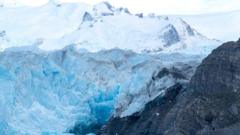
The ice isn't just melting. It's retreating so fast you can almost see the rock beneath it gasping for air. If you've ever stood in front of the Perito Moreno glacier in Patagonia, you know that thunderous crack. It sounds like a gunshot. Most tourists think they're witnessing a natural cycle of "calving," but scientists on the ground will tell you a different story. They're worried. I'm worried too. Argentina is home to some of the world’s most critical freshwater reserves, yet we’re watching our water towers crumble while politicians argue over mining rights.
This isn't about some distant environmental catastrophe. It's about drinking water, irrigation for the vineyards you love, and the literal survival of towns from Salta down to Santa Cruz. Glaciers act as natural regulators. They store water in the winter and release it during the dry summer months. When they disappear, that safety net vanishes. We’re left with a feast-or-famine water cycle that the region isn't built to handle.
The Shocking Pace of the Great Retreat
Recent data from the Argentine Institute of Nivology, Glaciology and Environmental Sciences (IANIGLA) paints a grim picture. They've been tracking thousands of glaciers across the Andes. The results? Total ice mass is shrinking across nearly every latitude. We aren't just talking about a few inches. Some glaciers have lost kilometers of length over the last few decades.
Take the Upsala Glacier. It was once one of the largest in South America. Now, it’s a shadow of its former self, retreating at a pace that defies historical norms. Why does this happen? It’s a double whammy. Temperatures are rising, which is obvious. But precipitation patterns are also shifting. Less snow falls in the high peaks, meaning the "accumulation zone" isn't getting the deposits it needs to offset the melting at the bottom. The bank account is being drained, and nobody is making a deposit.
This isn't just a southern problem. In the Central Andes—areas near Mendoza and San Juan—the situation is arguably more desperate. These are arid regions. They rely almost entirely on glacial melt for agriculture. If you like Argentinian Malbec, you should be paying attention. Without that steady trickle of mountain water, those world-famous vineyards face a dust-bowl future.
Why the Glacier Protection Law is Under Fire
Argentina actually has some of the best environmental legislation on paper. The National Glacier Law, passed years ago, was designed to protect these icy giants and the "periglacial" areas around them. It sounds great, right? It bans mining and oil drilling in areas that could damage the water source.
But here’s the problem. Laws are only as good as the people enforcing them. In recent years, there has been a massive push from industrial lobbies to "redefine" what a glacier is. They want to narrow the definition so they can dig for gold, silver, and copper in the surrounding permafrost. They argue that these frozen grounds aren't "true" glaciers.
It’s a dangerous game. Rock glaciers—which look like stone rivers but contain massive amounts of internal ice—are just as vital for water storage as the white, scenic ones you see on postcards. When a mining company moves into a high-altitude area, they don't just dig a hole. They build roads, use chemicals, and vibrate the ground. All of that speeds up the melt. It’s shortsighted. You can’t drink gold.
The Economic Reality of Melting Ice
Let’s be blunt about the money. Tourism is a huge chunk of Argentina’s GDP. People fly from every corner of the globe to see the Southern Patagonian Ice Field. It’s the third-largest frozen mass outside the poles. If the glaciers lose their majesty, the tourists stop coming. El Calafate and El Chaltén exist because of that ice.
But the real economic hit is hidden. It’s in the hydroelectric dams that provide power to millions. Glacial runoff feeds the rivers that spin the turbines. If the flow becomes unpredictable—too much in a spring flood, too little in a summer drought—the power grid becomes unstable. We’re looking at a future of energy shortages and skyrocketing food prices because farmers have to dig deeper wells at a massive cost.
What Scientists Wish You Knew
I’ve talked to glaciologists who are tired of being ignored. They’ll tell you that glaciers are "sentinels" of climate change. They react faster than the oceans or the forests. They are the early warning system. Right now, that system is screaming.
One common misconception is that all glaciers are the same. They aren't.
- Cold glaciers are frozen to the bedrock.
- Temperate glaciers (like many in Argentina) are right at the melting point throughout their mass.
Because our glaciers are temperate, even a half-degree shift in average temperature has a massive impact. It’s the difference between staying solid and turning into a river. We’re seeing more "glacial lake outburst floods" (GLOFs). This happens when a lake dammed by ice suddenly bursts, sending a wall of water downstream. It’s terrifying, and it’s happening more often.
Real World Impact in the North vs South
In the North, the ice is often hidden. You have "rock glaciers" covered in debris. They don't look pretty, so people don't fight for them as hard. But for a farmer in the Huasco Valley or near San Juan, that hidden ice is the only reason their crops stay alive during a five-year drought.
In the South, the retreat is visual and violent. The ice shelves are thinning. When the ice thins, it loses its "buttressing" effect. Think of it like a flying buttress on a cathedral. Once that thin edge breaks, the rest of the glacier behind it can slide into the ocean or lake much faster. It’s a runaway train.
The Fight for the Frozen Frontier
So, what do we do? It’s easy to feel helpless when you’re looking at a billion tons of melting ice. But the fight is happening in the courts and in the streets. Environmental groups like Greenpeace Argentina and local assemblies are constantly battling to keep mining projects out of sensitive zones.
The most important thing right now is the National Glacier Inventory. It’s a massive project to map every single ice body in the country. Why does this matter? Because you can’t protect what you haven't documented. By putting every rock glacier on a map, it becomes legally much harder for a corporation to claim "there’s nothing here but rocks."
Immediate Steps to Take
If you care about this, don't just look at the pretty pictures. Support the organizations that are legally challenging the "reform" of the Glacier Law. The current political climate often favors short-term extraction over long-term survival. We need to demand that the IANIGLA remains independent and fully funded. Their data is the only shield the ice has left.
If you’re traveling to Patagonia, go with eco-conscious operators. Ask how they manage waste. Use your voice on social media to highlight the retreat, not just the beauty. When people see the "before and after" photos of the Martial Glacier in Ushuaia or the Ventisquero Negro, it hits home.
The water is running out. Every drop really does count, but only if we stop the drain at the top of the mountain. Demand transparency in mining permits. Support local Andean communities who are the first to feel the thirst. The ice doesn't have a voice, so you have to be one.