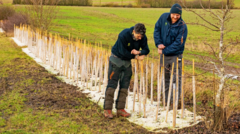
Agricultural productivity and ecological stability are often viewed as opposing vectors in a zero-sum game, yet the structural restoration of hedgerows represents a rare alignment of biological infrastructure and long-term asset protection. While superficial reports focus on the aesthetic or "green" sentiment of planting shrubs, a rigorous analysis reveals hedgerows as complex biological barriers that function through three primary mechanisms: hydraulic regulation, thermal buffering, and biodiversity corridors. The failure of past restoration attempts usually stems from a lack of site-specific configuration—treating a hedgerow as a simple fence rather than a multi-functional ecosystem.
The Tri-Modal Functionality of Hedgerow Systems
To understand why a restoration project succeeds or fails, one must quantify the specific utility the hedge is intended to provide. These utilities break down into three distinct functional pillars.
1. Hydraulic Control and Soil Retention
The root architecture of a mature hedgerow acts as a sub-surface anchor, significantly altering the hydrology of the surrounding acreage.
- Infiltration Rates: Soils adjacent to established hedgerows exhibit higher permeability due to the presence of deep-rooting woody species. This reduces surface runoff during peak precipitation events.
- Sediment Trapping: A well-structured hedge functions as a physical filter. By slowing the velocity of overland flow, it forces the deposition of suspended solids, preventing the loss of topsoil and the leaching of expensive nitrates into watercourses.
2. Micro-Climatic Thermal Buffering
The physical mass of a hedgerow creates a "shelterbelt" effect that extends horizontally up to twenty times the height of the hedge.
- Wind Speed Reduction: By breaking the laminar flow of wind, hedgerows reduce the mechanical stress on crops and lower the rate of evapotranspiration. This preserves soil moisture during periods of drought.
- Temperature Regulation: In winter, the barrier reduces wind chill for livestock, translating directly into lower metabolic energy requirements and higher feed conversion ratios. In summer, the shade and transpiration provide a cooling effect that mitigates heat stress in cattle and sheep.
3. Biological Pest Suppression
Rather than relying solely on chemical interventions, a restored hedgerow serves as the primary habitat for predatory insects and birds. This creates a permanent reservoir of "beneficials" that can migrate into adjacent fields to suppress aphid and mite populations, effectively internalizing a service that would otherwise require external expenditure.
The Economics of Restoration: CapEx vs. OpEx
Restoring a hedgerow is a capital-intensive project with a long-dated ROI. The primary costs are concentrated in the first five years, after which the system shifts into a maintenance phase.
Initial Investment (CapEx):
- Species Selection: A high-functioning hedge requires a mix of at least five to seven species (e.g., Hawthorn, Blackthorn, Hazel, Holly, Field Maple). Mono-species hedges are vulnerable to disease and provide poor structural density.
- Ground Preparation: Mechanical sub-soiling may be required to alleviate compaction before planting.
- Protection Infrastructure: The single most common point of failure is inadequate fencing. Young whips must be protected from both livestock and wild herbivores (rabbits and deer) using specialized guards and double-fenced margins.
Ongoing Maintenance (OpEx):
- The Three-Year Establishment Rule: Success depends on weed suppression and hydration during the first 36 months. Competition from aggressive grasses can stunt growth or lead to total crop failure.
- Structural Management: Conventional "flailing" (mechanical trimming) is often performed too frequently, which prevents the development of flowers and fruit. A staggered cutting regime—trimming different sections every three years—maximizes ecological value while maintaining the required density.
Technical Barriers and Failure Points
The transition from a "project" to a "permanent asset" is often derailed by two technical oversights: soil-species mismatch and the "gap" problem.
Soil-Species Mismatch
Planting species that are poorly suited to the local pH or drainage profile leads to uneven growth. A systematic approach requires soil testing every 100 meters along the proposed line. For instance, Blackthorn thrives in heavy clay, whereas Hawthorn is more adaptable but requires better drainage to reach its full structural potential.
The Structural Gap Problem
A hedgerow with frequent gaps is functionally useless for wind protection and wildlife movement. Gaps create wind tunnels that can actually increase soil erosion through a "venturi effect," where wind is funneled and accelerated through the opening. Remediation requires "hedge laying"—a traditional management technique where stems are partially cut and bent horizontally to encourage thick, bushy growth from the base.
Quantifying the Value of Carbon Sequestration
In the emerging market for carbon credits, hedgerows represent a significant undervalued asset. Unlike timber forests, which are harvested, hedgerows are permanent fixtures.
- Above-Ground Biomass: The woody volume of a mature hedge stores carbon in the stems and branches.
- Below-Ground Carbon: The perennial root systems and the accumulation of leaf litter lead to a steady increase in soil organic carbon (SOC) within the hedge footprint.
- Verification Challenges: The current limitation for farmers is the lack of standardized, low-cost verification methods. Remote sensing and LiDAR are beginning to solve this by allowing for the 3D volume mapping of hedges to estimate carbon tonnage without manual measurement.
Operational Roadmap for High-Yield Restoration
To move beyond the performative aspects of environmentalism, farm managers should execute restoration using a phased, data-driven framework.
- Baseline Mapping: Use historical maps to identify where hedges previously existed. These locations often follow natural drainage lines and provide the highest utility if restored.
- Modular Planting: Rather than attempting to restore ten kilometers at once, prioritize sections that connect existing woodland fragments. This "corridor" strategy yields higher biodiversity gains per meter planted.
- Variable Density Planting: Adjust the spacing based on the primary objective. If the goal is a windbreak, a staggered double-row of 5–7 plants per meter is required. If the goal is purely boundary marking, a lower density may suffice.
- Integrated Pest Management (IPM) Alignment: Map the hedgerow restoration to the crop rotation. Planting specific flowering species that bloom during the emergence of key crop pests ensures that predator populations are active when most needed.
The strategic play is to treat the hedgerow not as a peripheral margin, but as a critical infrastructure component. The immediate action for any land manager is to perform a gap analysis across existing boundaries and prioritize "interconnection" planting. This ensures that the biological capital is not fragmented, but unified into a single, resilient system that reduces reliance on chemical inputs and provides a measurable hedge against climate volatility.