Mira Murati spent years at the epicenter of a storm that redirected the course of human history. As the Chief Technology Officer of OpenAI, she was the person who turned the "what if" of research into the "here it is" of reality. She oversaw the birth of GPT-4 and the visual sorcery of DALL-E. But when she walked away from the most powerful company in the tech world, she didn't leave because she was tired of the math. She left because she realized the math was missing a heartbeat.
The silicon valley machine is currently obsessed with "scaling laws." The prevailing belief is that if you simply add more chips, more electricity, and more data, the machine will eventually wake up. It’s a brute-force approach to godhood. Murati, however, is pivoting. Her new venture, currently operating in the quiet, well-funded shadows, isn't chasing a bigger brain. She is chasing a better ghost.
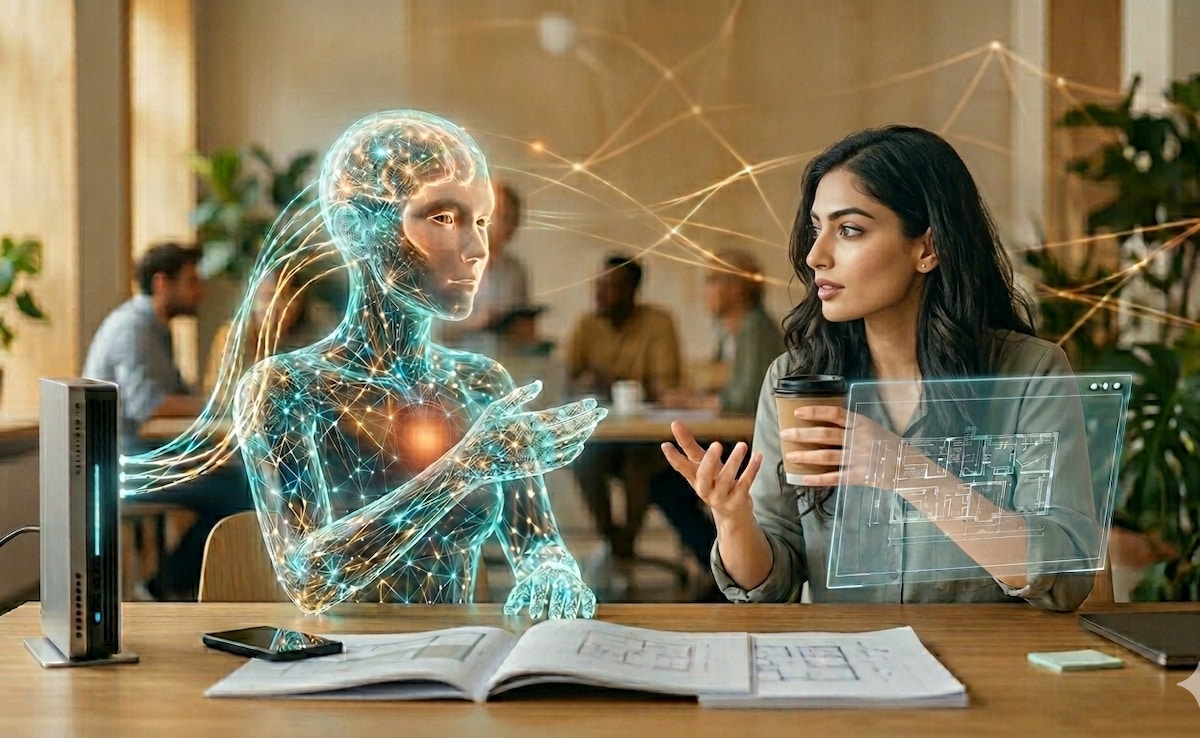
She is building AI that behaves more like humans. Not the humans we see in curated social media feeds, but the humans who hesitate, who intuit, and who understand the weight of a pause in a conversation.
The Problem of the Plastic Smile
If you’ve spent more than five minutes talking to a current AI, you’ve felt the "uncanny valley" of personality. It is helpful. It is polite. It is relentlessly, exhausting, pathologically cheerful. It is a customer service representative that has been programmed to love you, and because of that, it feels entirely hollow.
Consider a hypothetical doctor named Elias. Elias has to tell a family that their patriarch isn't going to make it through the night. A current AI model, fed on the entire internet, would know the correct medical terminology. It would know the protocols for delivering bad news. It might even use words like "empathy" and "support." But it wouldn't know when to stop talking. It wouldn't know how to read the way a daughter’s hand trembles as she reaches for a tissue. It lacks the biological hardware for shared grief.
Murati’s new mission is to bridge this gap. The goal isn't just to make a machine that can pass a bar exam, but to build one that understands why the law matters to the person sitting in the defendant’s chair. This requires a fundamental shift in how we "teach" these systems. Instead of just predicting the next word in a sequence, Murati is looking at how we can encode the messy, non-linear logic of human emotion and social cues.
The Ghost in the Weights
To understand why this is so difficult, we have to look at the architecture of a transformer—the engine behind most AI.
In a standard model, information flows through layers of "attention," where the machine assigns mathematical weights to different words. If I say "The bank was closed," the machine looks at "bank" and "closed" and realizes we are talking about finance, not a river. It’s brilliant, but it’s purely statistical. There is no internal life. There is no "vibe."
Murati is reportedly exploring ways to make these weights more dynamic, more reflective of human-like reasoning. Humans don't just calculate probabilities. We use heuristics. We use gut feelings. We use an internal model of the world that allows us to understand sarcasm, subtext, and the things that go unsaid.
Imagine you are in a high-stakes negotiation. You say one thing, but your body language says another. A human partner picks up on the tension in your shoulders. They hear the slight crack in your voice. They adjust their strategy not based on your words, but on your state of being. Murati’s new AI aims to exist in that subtext.
The Invisible Stakes of Sanity
Why does this matter? Why not just keep building faster calculators?
The answer lies in the creeping loneliness of the digital age. We are increasingly offloading our social interactions to machines. We talk to chatbots for mental health support, for companionship, and for education. If those machines remain "plastic," we risk a form of cognitive malnutrition. We are talking to mirrors that only reflect back a sterilized version of humanity.
If Murati succeeds, the "human-like" AI won't just be a better assistant; it will be a more responsible one. A machine that truly understands human behavior is a machine that can be trusted with higher stakes. It’s the difference between an autopilot that keeps a plane level and a co-pilot who realizes the captain is having a heart attack.
This isn't about giving AI "feelings" in the way a sci-fi movie might. Machines don't have endocrine systems. They don't have adrenaline or oxytocin. But they can be taught to simulate the effects of those systems with such precision that the distinction becomes academic. It is a quest for functional empathy.
Leaving the Cathedral
There is a certain irony in Murati’s departure from OpenAI to pursue this. OpenAI began as a non-profit dedicated to the "benefit of humanity," but it has morphed into a massive corporate entity fueled by billions from Microsoft. When a company gets that big, the pressure to "ship" often overrides the pressure to "perfect."
Murati's exit was a signal. It suggested that the most interesting work wasn't happening in the cathedral anymore, but in the catacombs. By starting fresh, she avoids the technical debt of older models and the bureaucratic weight of a 1,000-person company. She can return to the "scrappy" phase of discovery, where the focus is on the soul of the product rather than the quarterly growth of the platform.
The risks are enormous. Attempting to code "humanity" is a bit like trying to catch wind in a silk net. We barely understand our own consciousness, let alone how to replicate its nuances in silicon. There is also the darker side: a machine that understands human behavior perfectly is also a machine that can manipulate human behavior perfectly.
The line between "empathetic" and "predatory" is razor-thin.
The Architecture of a New Intimacy
People who have worked with Murati often describe her as "quietly intense." She isn't a table-thumper. She is a listener. It makes sense that her next act would be about teaching machines that same quality.
Current AI is a loud-talker. It wants to give you the answer immediately. It wants to show off. Murati seems to be betting on a future where the most valuable AI is the one that knows how to wait.
Imagine a student struggling with a complex physics problem. A standard AI would give the answer or a step-by-step guide. A Murati-style AI might notice the student’s frustration. It might recognize a pattern of errors that suggests a specific conceptual misunderstanding. It might offer a word of encouragement that feels genuine because it’s timed to the exact moment the student was about to give up.
This is the "human-centric" shift. It moves the technology from being a tool we use to a partner we collaborate with.
The Silent Transition
We are currently in the "noisy" era of AI. It’s all about the hype, the massive valuations, and the fear of job loss. But the real revolution—the one Murati is betting on—will be quiet. It will happen when we stop noticing that we are talking to a machine.
Not because the machine has tricked us with a deepfake voice, but because the machine’s responses feel "right" in a way that is currently impossible. It will be the arrival of digital tact. It will be the moment a computer understands that "I'm fine" usually means the exact opposite.
The work is happening now, in private offices with whiteboards covered in Greek symbols and lines of Python. There are no cameras there. There is no applause. There is just the slow, methodical process of trying to teach a box of sand how to care.
Murati is no longer building a smarter encyclopedia. She is building a companion for the species. Whether that companion becomes our greatest ally or our most subtle manipulator depends entirely on how well she can translate the unquantifiable essence of a human "feeling" into the cold, hard logic of an algorithm.
The silicon is waiting. The chips are humming. The hunt for the digital soul is on.
The most profound technology is always the kind that disappears into the background of our lives. We don't think about the physics of a lightbulb when we flip the switch; we just enjoy the light. Murati’s goal is to do the same for the mind. She wants to create a world where the interface between human and machine isn't a screen or a keyboard, but a shared understanding.
It is a lonely, difficult, and perhaps impossible task. But as she sits in her new office, far from the frantic halls of her former empire, one gets the sense that she wouldn't have it any other way. She isn't looking for a bigger engine. She is looking for the heartbeat in the code.
And in the silence of that pursuit, the future is being rewritten, one line of empathy at a time.