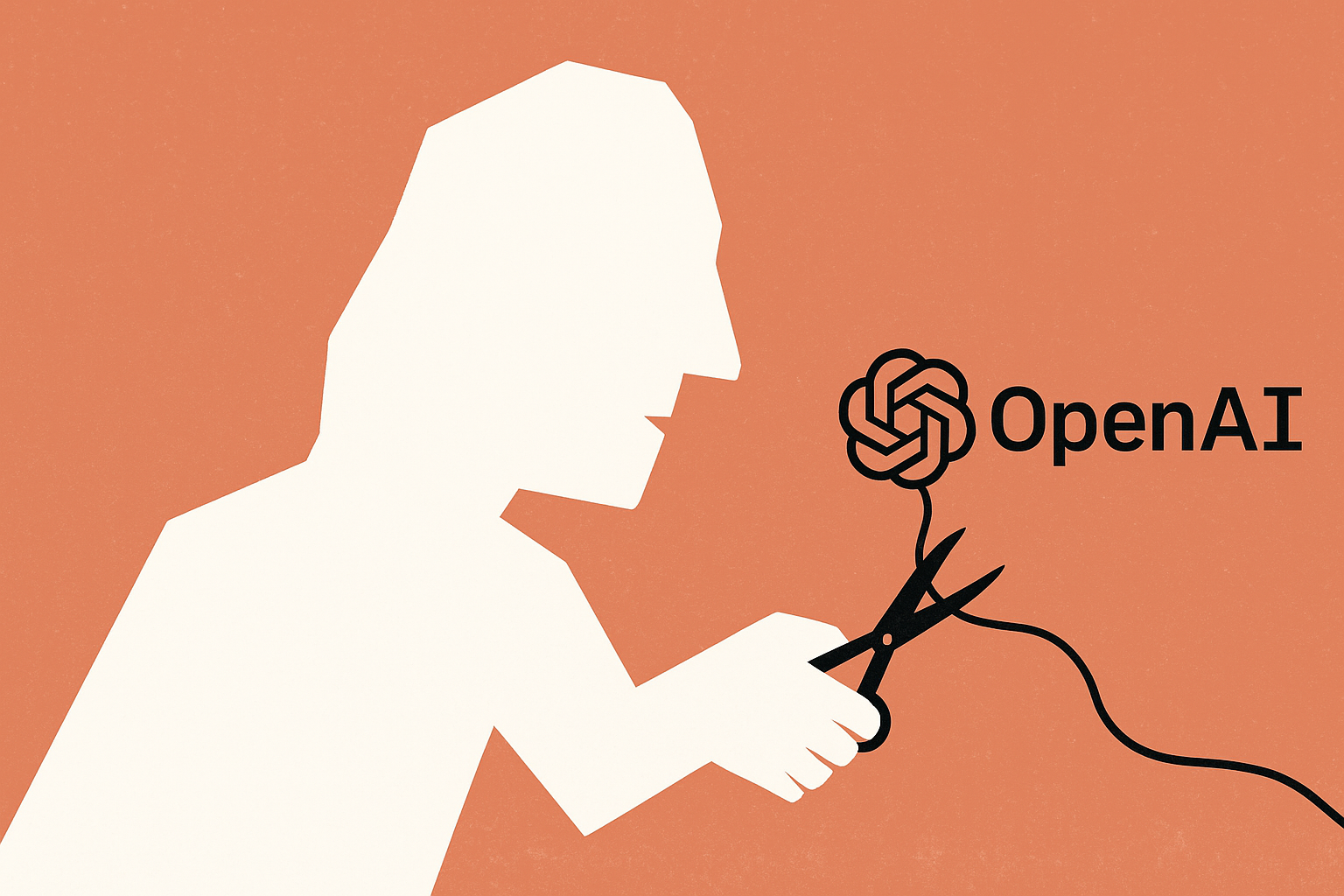
The era of OpenAI having a total monopoly on the corporate boardroom is officially over. For the better part of two years, Sam Altman’s crew held a lead that looked insurmountable. If you wanted serious AI, you went to ChatGPT. But the latest data on US business adoption shows a massive shift in the tide. Anthropic, the company founded by former OpenAI executives, isn't just a runner-up anymore. It’s breathing down the neck of the industry leader.
Business leaders are tired of the drama. Between the governance scandals and the constant pivots at OpenAI, enterprise clients want stability and safety. Anthropic’s Claude models are delivering exactly that, combined with technical performance that frequently beats GPT-4o in coding and nuanced reasoning. It’s no longer a question of if there’s a second player, but how long OpenAI can stay in the top spot.
Why the Claude 3.5 Sonnet release changed everything
When Anthropic dropped Claude 3.5 Sonnet, the industry expected a incremental update. They didn't get that. They got a model that felt faster, smarter, and remarkably more human than its predecessors. What makes this shift so aggressive is how businesses are voting with their wallets.
I've talked to developers who spent months trying to get GPT-4 to stop "hallucinating" or being overly verbose. They switched to Claude and found that the model actually follows instructions. It doesn't lecture you. It doesn't give you a moralizing speech when you ask it to analyze a complex business document. It just does the work.
This is a huge deal for US companies. Reliability isn't a "nice to have" feature. It's the only thing that matters when you're deploying code to millions of users or trusting an AI to summarize legal contracts. Anthropic understood this from day one. Their "Constitutional AI" approach isn't just marketing fluff. It's a technical framework that makes their models more predictable.
The enterprise safety advantage
OpenAI has always felt like a product company trying to be a platform. Anthropic feels like a research lab that accidentally built the world's best work tool. That distinction matters to Chief Information Officers.
Most of the surge in Anthropic's business use comes from sectors like finance, legal, and healthcare. These are industries where one mistake can cost millions in fines. Anthropic has leaned hard into the safety angle, and it’s paying off. They aren't just selling a chatbot. They're selling a version of AI that feels "safe for work."
Better context windows for bigger data
One major technical win for Anthropic is the way it handles massive amounts of information. While OpenAI has improved, Anthropic’s 200,000-token context window has been the gold standard for long-form analysis for a while.
Imagine you have a 500-page technical manual. You need to know if a specific safety protocol on page 42 conflicts with a regulation on page 380. Claude can "read" that entire book in seconds and give you an answer that's actually accurate. GPT has historically struggled with "the needle in the haystack" problem—finding small details in large data sets. Anthropic nailed it.
The Amazon and Google factor
You can’t talk about Anthropic’s rise without mentioning the massive backing from Amazon and Google. This isn't just about the billions of dollars in funding. It's about distribution.
When a company is already using Amazon Web Services (AWS), they don't have to jump through hoops to start using Claude. It’s right there in Amazon Bedrock. This integration makes the "switching cost" almost zero. For a mid-sized firm already on the cloud, trying Anthropic is as easy as clicking a button. OpenAI has Microsoft, sure. But being available on both Google Cloud and AWS gives Anthropic a reach that's hard to ignore.
Cost efficiency is the new battleground
The hype around "the most powerful model" is dying. Now, it's about the "most efficient model."
Businesses are realizing that they don't always need a massive, expensive model to do basic tasks. Anthropic’s "Haiku" model is a masterclass in this. It’s incredibly cheap, lightning-fast, and handles routine automation better than almost anything else on the market.
OpenAI responded with GPT-4o mini, but Anthropic had already captured a significant portion of the "high-speed, low-cost" market. Companies are starting to use a multi-model strategy. They might use OpenAI for one specific task and Anthropic for five others. The "winner-take-all" mentality is being replaced by a "best-tool-for-the-job" reality.
Coding and technical reasoning
If you go to any developer forum right now, the consensus is shifting. For a long time, GitHub Copilot (powered by OpenAI) was the only game in town. But Claude 3.5 Sonnet has become the secret weapon for software engineers.
It’s better at understanding complex architectures. It writes cleaner code. It catches its own errors more effectively. This isn't just anecdotal. Benchmarks show Anthropic is winning on coding tasks. In a world where every company is a tech company, the model that writes the best code is the model that wins the contract.
What this means for your AI strategy
If you're still 100% all-in on OpenAI, you're likely overpaying or missing out on better performance. The smartest move right now is diversification.
Start by auditing your current AI spend. Look at where your prompts are failing or where the model feels "lazy." These are the exact areas where Claude usually shines. Don't worry about a total migration. Most modern API setups allow you to swap models with minimal code changes.
The surge in business use isn't a fluke. It's a correction. Anthropic is proving that being "first" doesn't mean being "permanent." They've built a product that respects the user's time and the company's data.
Stop treating OpenAI as the default. Start testing Claude 3.5 against your hardest tasks. You'll likely find that the gap between the two isn't just closing—in many ways, Anthropic has already moved ahead. Get your team access to both platforms and let the results speak for themselves. The competition is good for us. It drives prices down and forces these models to actually get better instead of just getting more "marketable."
Check your cloud provider's console today. If you're on AWS, enable Bedrock. If you're on Google, look at Vertex AI. The tools are already there. You just have to use them.