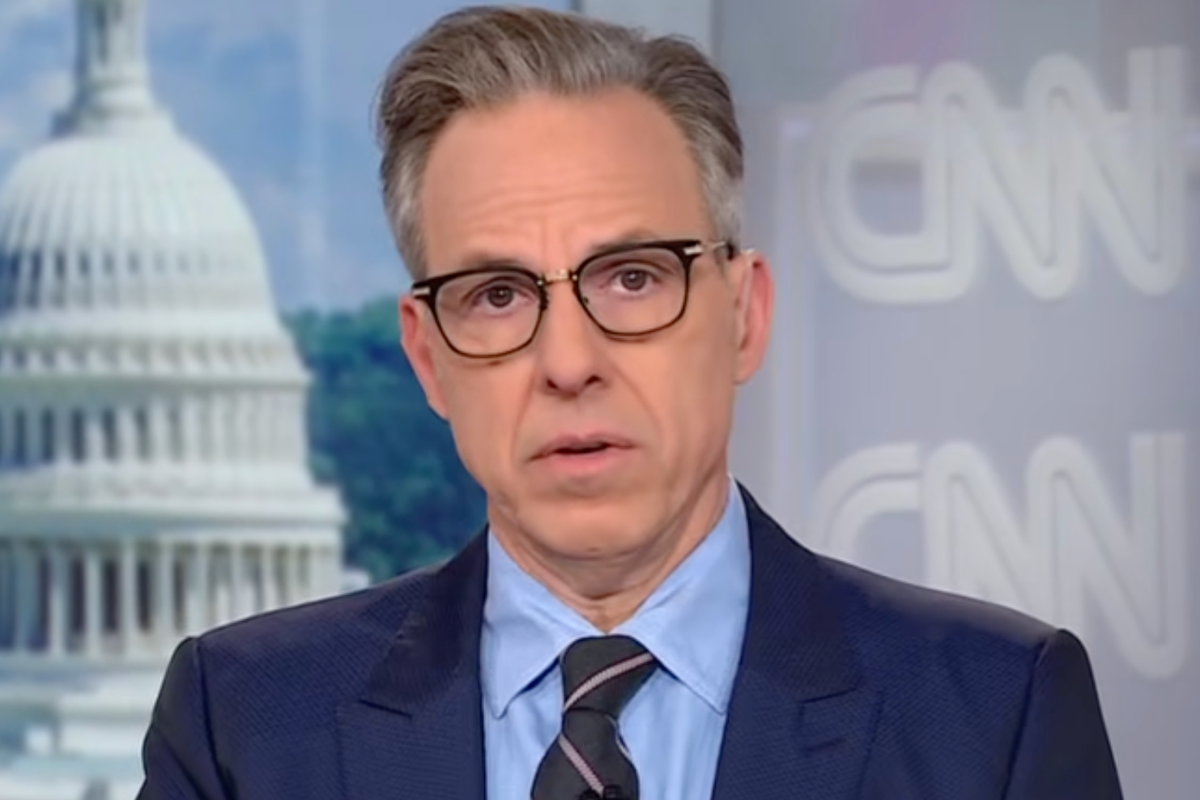
The air in a television control room doesn’t smell like democracy. It smells like ozone, lukewarm coffee, and the electric hum of a hundred monitors screaming for attention. In that cramped, darkened space, the world is reduced to a series of glowing rectangles. One screen shows a dusty street in Tehran. Another shows the frantic typing of a producer in Washington. And the largest one—the one that matters most in the heat of a broadcast—shows the face of a man trying to hold the line against a tidal wave of pressure.
Journalism is often described as the first rough draft of history. It sounds poetic, but the reality is much grittier. It is a constant, exhausting tug-of-war between the people who hold power and the people whose job it is to describe how that power is being used. When the President of the United States decides to pick a fight with a news anchor, it isn’t just a Twitter spat or a headline to be scrolled past. It is a collision between two different visions of reality.
The Sound of the Signal
Imagine a signal fire lit on a distant hill. For a citizen trying to understand the chaos of international relations—specifically the volatile, high-stakes relationship between the U.S. and Iran—that fire is the evening news. You rely on it to tell you if the smoke is a warning or just a controlled burn. But what happens when the most powerful man in the world tries to douse that fire because he doesn't like the shape of the flames?
Jake Tapper found himself in the crosshairs not because he got a fact wrong, but because he refused to make the facts feel better. Donald Trump had taken to his preferred digital soapbox to label CNN "fake news" regarding their coverage of Iran. The accusation wasn't nuanced. It wasn't a critique of a specific source or a correction of a timeline. It was a blunt instrument designed to do one thing: discredit the messenger so the message would never take root.
Tapper didn't flinch. He didn't retreat into the defensive crouch that many expect from modern media figures. Instead, he leaned into the microphone and reminded the world of a cold, hard truth that is becoming increasingly uncomfortable in the modern age.
"Our job is not to try and please the president," Tapper said.
The sentence was short. Sharp. It carried the weight of a fundamental architectural principle. In a world where the executive branch often demands loyalty as a prerequisite for access, the declaration of independence wasn't just a rebuttal. It was a manifesto.
The Weight of the Invisible Stakes
To understand why this matters, you have to look past the faces on the screen and consider the person sitting on their couch at 6:30 PM. Let's call her Sarah. Sarah isn't a political strategist. She’s a teacher in Ohio who has a nephew stationed in the Middle East. When she hears conflicting reports about Iranian aggression or diplomatic breakthroughs, she isn't looking for a "win" for her political party. She is looking for the truth because the truth has consequences that might arrive at her front door in a dress uniform.
When a government official calls a report "fake" simply because it is inconvenient, they aren't just attacking a journalist. They are attacking Sarah’s ability to make informed decisions about her life and her family. They are trying to fog the glass so she can't see the cliff's edge.
The invisible stake in the fight between Tapper and Trump wasn't "brand reputation." It was the integrity of the information pipeline. If a news organization decides that its primary goal is to stay in the good graces of the administration, it ceases to be a news organization. It becomes a PR firm with better lighting. The friction—the heat generated when a reporter asks a question that makes a politician sweat—is actually the sign that the system is working.
The Myth of the Neutral Observer
There is a common misconception that journalists should be blank slates, devoid of friction or opinion. But true objectivity isn't about having no perspective; it’s about having a rigorous method. It’s about the "discipline of verification."
When the administration accused the network of being biased or "fake" regarding Iran, they were leveraging a powerful psychological trick. If you can convince the public that the referee is rooting for the other team, you can ignore every penalty he calls. It is a masterful way to avoid accountability. By framing the news as a personal vendetta, the actual facts—the troop movements, the nuclear centrifuges, the diplomatic cables—become secondary to the drama of the feud.
Tapper’s response was a refusal to play that character. He wasn't acting as an antagonist; he was acting as an employee of the public. The distinction is vital. If the president says the sky is green and the journalist reports that the sky is, in fact, blue, the journalist isn't being "anti-president." They are being "pro-sky."
Consider the sheer volume of noise that hits a news desk every hour. Reports from intelligence agencies, leaked memos, official press releases, and the chaotic chatter of social media. The journalist’s job is to stand in that storm and act as a filter. It requires a certain kind of stubbornness—a willingness to be disliked by the most powerful people on earth.
The Architecture of Trust
Trust is a fragile thing. It isn’t built with a single broadcast, but it can be destroyed by one. In the era of "fake news" as a catch-all slur, the currency of the realm is no longer just "the scoop." It is the perceived courage to tell the truth when it hurts.
The tension between the press and the presidency is baked into the American experiment. It was never meant to be a polite conversation. It was designed to be a check. When Thomas Jefferson famously said he would rather have newspapers without a government than a government without newspapers, he wasn't being hyperbolic. He understood that power, left to its own devices, will always seek to curate its own image. It will always try to dim the lights on its failures and over-saturate its successes.
The reporter stands in the back of the room, pointing out the shadows.
When Tapper doubled down on the idea that pleasing the leader is not the mission, he was invoking the ghost of Edward R. Murrow and Walter Cronkite. He was reminding us that the press is the only profession specifically protected by the Bill of Rights. That protection exists for a reason. It isn't to protect the feelings of the news anchors; it’s to protect the ears of the citizens.
The Human Cost of the Fog
We often talk about these battles in the abstract, but the fog of misinformation has a body count. When facts about foreign policy are obscured by political theater, we lose the ability to debate the actual merits of war and peace. We stop talking about Iran’s regional influence or the efficacy of sanctions, and we start talking about whether a specific news anchor is "mean" or "biased."
The transition from policy debate to personality clash is the death knell of a functional democracy.
Imagine the hypothetical scenario of a closed-door meeting where a major policy shift is being decided. The only thing keeping that meeting from being a total vacuum of accountability is the knowledge that, eventually, someone is going to have to walk out and answer questions from a room full of people who don't work for them. If those people are intimidated or if their platform has been systematically dismantled by accusations of "fakery," the accountability vanishes.
The "fake news" label is a powerful solvent. It dissolves the shared reality that allows a society to function. If we cannot agree on a basic set of facts, we cannot have a conversation. We can only have a shouting match.
The Final Line in the Sand
The spectacle of the President of the United States attacking a journalist is a distraction. The real story is the resilience of the process. Every time a reporter asks a follow-up question after being told to sit down, a small victory is won for the person watching at home. Every time an anchor refuses to pivot to a "friendlier" topic, the signal fire on the hill burns a little brighter.
The electric hum in the control room continues. The monitors flash with the latest updates from across the globe. The coffee goes cold. But in the center of the chaos, there is a man behind a desk who understands that his loyalty isn't to the person in the Oval Office, but to the person on the other side of the glass.
It is a lonely, difficult, and often thankless position. It involves being called names by some and being idolized by others, both of which are distractions from the actual work. The work is simple, yet incredibly complex: see the world as it is, not as the powerful want it to be, and describe it accurately to the people who have to live in it.
The lights in the studio are blindingly bright. They are designed to wash out shadows. But as long as there are voices willing to speak truth to power, the shadows will always have a place to hide the facts until they are ready to be brought into the light. The fight isn't over. It never is. It’s just the next segment.
The camera tallies red. The anchor takes a breath. The truth remains, waiting to be told.



