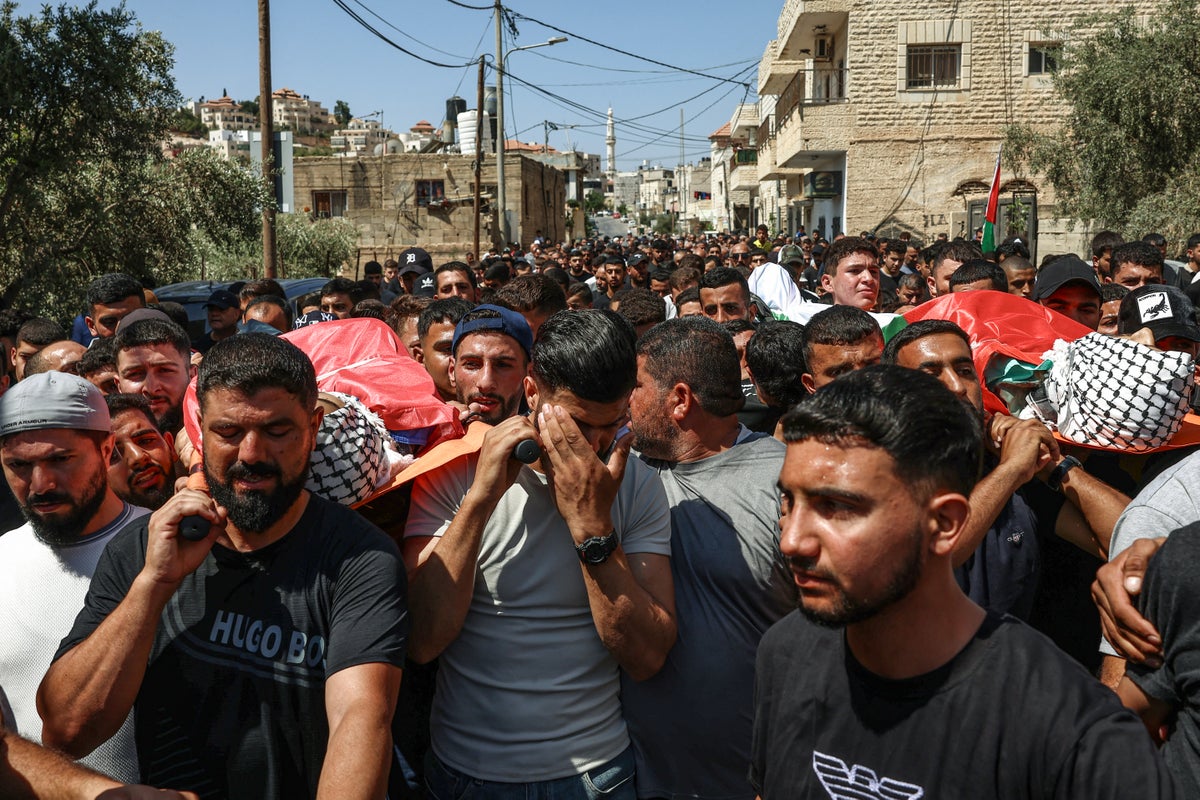
Geopolitical expansion in disputed and occupied territories rarely manifests as sudden territorial annexation; instead, it operates through a continuous calculus of attrition, resource denial, and localized friction. The fatal shootings of two teenagers, 16-year-old Khalil Abu Alia and 19-year-old Omar al-Nassan, in the West Bank village of al-Mughayyir, offer a clinical case study in how state-backed civilian encroachment interacts with military architecture to produce systematic territorial displacement. Observers frequently misinterpret these flashpoints as chaotic, spontaneous localized riots. A rigorous structural deconstruction reveals an optimized methodology of containment, economic suffocation, and physical expulsion.
The Tripartite Mechanism of Encirclement
Territorial consolidation in the occupied West Bank relies on three distinct pillars working in synchronization.
- Geographic Choke Points: Physical infrastructure is systematically deployed to isolate communities. In al-Mughayyir, military barricades restrict access to a single entry and exit corridor, surrounded by a ring of eight distinct settler outposts. This creates an artificial spatial bottleneck, severing economic lifelines and rendering external commute times volatile and unpredictable.
- State-Protected Civilian Vanguard: Civilian outposts function as an advanced operational layer. When groups enter agricultural or residential perimeters under the immediate protective escort of military and police forces, the asymmetry of power is institutionalized. The objective is not merely property retrieval, but the establishment of physical dominance over vital local assets, such as livestock and water cisterns.
- Escalatory Force Multiplication: Resistance by local inhabitants—manifested through stone-throwing or physical obstruction—triggers a disproportionate military response from embedded snipers and armed units. The deployment of lethal overwatch transforms localized property disputes into high-fatality enforcement actions, effectively penalizing community self-defense.
The Economic Attrition Cost Function
The macro-strategy relies heavily on imposing prohibitive transaction costs on civilian life. Physical safety is degraded systematically, but the secondary vector of pressure is financial and institutional starvation.
When infrastructure such as water cisterns, storage structures, and livestock pens are razed—mirroring actions documented across marginalized communities in the southern hills—the baseline cost of subsistence skyrockets. Families face immediate displacement not purely from direct expulsion orders, but because the local economy is structurally dismantled. Schools must construct higher security walls and divert intellectual capital toward crisis management rather than education. Teachers residing outside the municipal perimeter face probabilistic exclusion from their classrooms due to shifting checkpoint protocols.
This dynamic generates a compounding refugee vector. As mobility is throttled and basic sustenance becomes untenable, residents abandon ancestral land voluntarily in operational terms, relocating to urban centers like Ramallah. The strategic outcome matches the trajectory observed in dozens of completely depopulated hamlets since late 2023, achieving demographic restructuring without requiring formal mass deportation decrees.
The Mechanics of Official Justification
State communication surrounding these operations follows a highly predictable template designed to obscure systemic intent behind administrative compliance.
The institutional response to lethal enforcement typically pivots on three rhetorical maneuvers. First, ownership of contested resources—such as livestock or municipal terrain designated as training zones—is asserted via unilateral administrative fiat, bypassing standard evidentiary verification. Second, the causality chain is inverted: the initiating action of encroachment is framed as an enforcement activity, while civilian resistance is categorized as a violent disturbance. Third, lethal outcomes are attributed entirely to tactical threat elimination directed at key instigators, deflecting scrutiny from the underlying systemic framework that placed armed troops alongside civilian claimants in a residential zone.
Analyzing these events through a strictly operational lens strips away the veneer of sporadic civil unrest. The friction in al-Mughayyir and similar localized sectors represents the predictable output of a calibrated containment framework designed to maximize friction, restrict resource access, and steadily compress the spatial boundaries of Palestinian civil existence.
To alter this trajectory, external monitoring mechanisms must shift focus away from isolated tactical engagements and target the structural choke points—specifically the road closures, outpost proliferation, and administrative rezoning—that systematically manufacture these crises.
On the frontline of Israeli settler violence in the West Bank | BBC News
This video provides on-the-ground context regarding the escalating tensions and friction points between Palestinian villagers and Israeli settlers in the West Bank.
http://googleusercontent.com/youtube_content/1