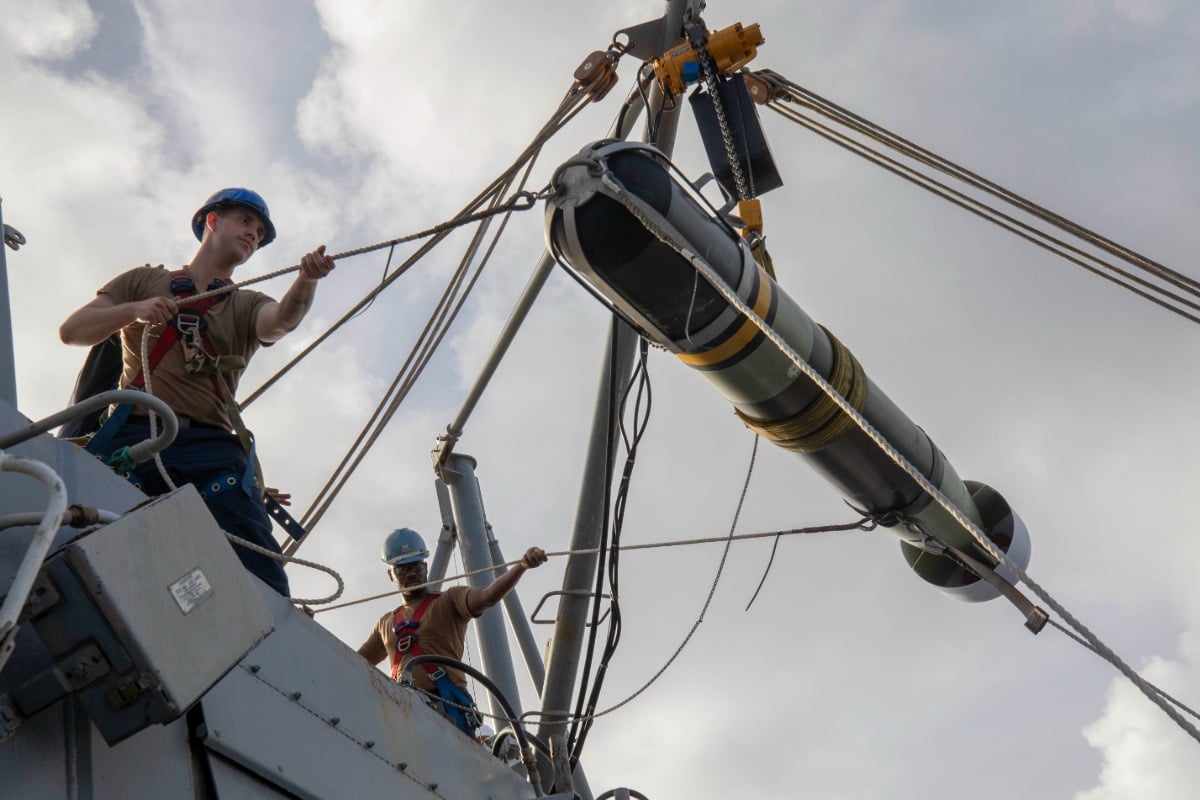
The modern undersea battle space dictates that a weapon system is only as viable as its processing architecture. When the U.S. Navy executes a $115.7 million procurement action for torpedo sonar modification kits—specifically targeting the MK 48 Mod 7 Common Broadband Advanced Sonar System (CBASS) and related lightweight variants like the MK 54 Mod 1—the financial outlay reflects a critical technological inflection point rather than a routine hardware replacement. This expenditure isolates a core defense reality: the physical dynamics of underwater propulsion have plateaued, shifting the tactical advantage entirely to signal processing velocity and acoustic bandwidth.
Naval surface vessels and submarines operate in an environment where stealth and clutter degrade weapon effectiveness. Conventional analysis evaluates naval defense through the lens of platform count or warhead payload. A rigorous capital allocation analysis reveals that the true bottleneck in undersea warfare is the target discrimination window—the brief interval where a weapon must isolate a threat from background noise and countermeasures. The $115.7 million capital deployment serves as an explicit cost function designed to compress this bottleneck.
The Architecture of Sound: The Three Pillars of Acoustic Superiority
To evaluate the operational returns on this $115.7 million expenditure, the hardware must be broken down into its three constituent functional layers. Sonar kits are not monolithic components; they are integrated modular systems engineered to alter how a torpedo interacts with hydroacoustic data.
- The Transducer Array Geometry: The physical nose cone houses a matrix of acoustic transducers. Older analog configurations relied on fixed, narrow-band mechanical arrays. The upgraded architecture utilizes a conformal or wide-band array that expands the angular searching range up to approximately 135 degrees. This geometry maximizes spatial coverage without altering the hydrodynamic resistance profile of the torpedo bow.
- The Digitization Interface: Raw pressure waves striking the transducers must be converted into digital data streams immediately. The upgrade kits insert high-speed, multi-channel analog-to-digital converters directly behind the array. Digitizing the acoustic signal at the point of ingestion eliminates line attenuation and cross-talk, preserving weak signals reflected from quiet hull designs.
- The Digital Signal Processing Engine: Once digitized, the acoustic data enters an onboard computer architecture utilizing commercial off-the-shelf components modified for military ruggedization. This hardware runs advanced processor builds that execute real-time algorithms, shifting the torpedo from a reactive tracking device to an active analytical node capable of spatial filtering and echo-location profiling.
The Littoral Bottleneck: Why Legacy Sonar Fails in Shallow Water
The primary strategic driver behind this procurement is the shift from deep-ocean blue-water operations to shallow-water littoral environments. Deep-water acoustic tracking is relatively predictable, governed by stable thermoclines and minimal geographic interference. Shallow coastal waters present a chaotic acoustic profile characterized by bottom-bouncing reflections, wave action noise, and biological clutter.
[Legacy Analog Array] ---> [Fixed Frequency Ingestion] ---> [Reverberation Blinding]
                                                                     |
                                                           (Target Lost in Clutter)

[Upgraded CBASS Array] ---> [Broadband Frequency Ingestion] ---> [Algorithmic Filtering]
                                                                     |
                                                           (Target Isolated / Tracked)
In a littoral engagement, a legacy analog sonar array suffers from reverberation blinding. When the torpedo transmits an active sonar pulse, the signal reflects off the seabed and the water surface simultaneously. This creates a cascade of return echoes that mask the actual target.
The upgraded broadband kits solve this via frequency agility. By transmitting across a wide spectrum of frequencies concurrently, the digital signal processing engine calculates the differential decay rate of the echoes. Solid metallic hulls reflect broadband signals differently than a sandy seabed or water-air interfaces. The hardware upgrade provides the computational throughput required to run these differential equations mid-flight, allowing the weapon to maintain tracking locks in high-clutter environments.
The Counter-Countermeasure Equation
The secondary variable driving the Navy's cost function is the evolution of active acoustic countermeasures. Modern hostile submarines do not merely rely on silent running; they deploy mobile acoustic emulators and static decoys. These countermeasures detect the incoming torpedo's active sonar frequency and transmit a replicated, amplified echo designed to spoof the weapon's guidance system into tracking a false target.
This dynamic establishes a strict mathematical competition between the decoy's emulation capability and the torpedo's discrimination logic. The upgrade kits counter this spoofing mechanism via two discrete operational pathways:
- Phase Incoherence Detection: Artificial decoys often fail to perfectly replicate the phase shifts that occur when a sound wave reflects off a complex, curved physical structure like a submarine hull. The increased processing capacity of the upgrade kits analyzes the phase coherence of the returning signal, rejecting echoes that exhibit perfect geometric uniformity.
- Multi-Band Processing: By implementing advanced software builds across the upgraded hardware, the torpedo can rapidly shift its transmission frequencies in a pseudo-random pattern. If a countermeasure cannot match the hopping rate or accurately predict the next operational band, its jammer output becomes irrelevant, and the torpedo isolates the true physical target.
Strategic Capital Allocation and Lifecycle Economics
From a budgetary and defense management perspective, deploying $115.7 million into modification kits represents a capital-efficient alternative to new-construction weapon procurement. Fabricating a completely new heavyweight or lightweight torpedo hull involves significant fixed industrial costs, including specialized metallurgy, propulsion casting, and fuel cell integration.
New Torpedo Procurement Cost = Propulsion + Warhead + Hull + Legacy Electronics ($$$$$)
Sonar Kit Retrofit Cost       = Advanced Electronics Array Only ($$)
Operational Output Extension  = Identical Kinematic Range + Superior Target Acquisition
By isolating the procurement strictly to the guidance and control sections, the Navy leverages existing stockpiles of propulsion systems and warhead mechanisms. This modular upgrade strategy yields a lower total cost of ownership while extending the operational relevance of the inventory by a decade.
The strategy relies heavily on open-architecture engineering. By moving away from proprietary, hardwired analog systems and toward open software standards running on commercial computing platforms, future upgrades can be implemented via software flashes rather than physical depot-level overhauls. This significantly mitigates future hardware obsolescence cycles.
Technical Vulnerabilities and Systemic Trade-offs
A complete analytical assessment requires outlining the inherent limitations of this technical approach. No defense acquisition program functions as a flawless solution, and the transition to high-density digital processing inside a torpedo hull introduces specific engineering trade-offs.
- Availability and Reliability Degradation: According to operational test and evaluation data, early increments of advanced processor builds have shown a statistical correlation with reduced system availability. The integration of high-density digital components increases the number of potential points of failure. Increased computational power generates higher thermal output, which must be dissipated within a sealed, liquid-fueled hull, occasionally leading to early system shutdowns during extended search phases.
- The Power Consumption Paradox: Running advanced digital signal processing algorithms at high sampling rates demands significant electrical power. Because a torpedo operates on a finite internal battery or alternator system, every watt diverted to the sonar processing engine reduces the total energy available to the propulsion system, subtly impacting the weapon's maximum high-speed endurance window.
The Undersea Forecast
The deployment of these upgrade kits signals a broader shift toward autonomous undersea warfare. As processing architecture becomes more compact and power-efficient, the line between an advanced torpedo and an unmanned underwater vehicle (UUV) begins to blur. The immediate strategic play for naval forces involves upgrading existing inventories to establish a baseline capability against quiet conventional submarines. Over a longer horizon, these modular digital sections will serve as the algorithmic foundation for networked underwater weapons that communicate mid-tier to execute multi-agent swarm attacks, rendering traditional acoustic countermeasures obsolete.

