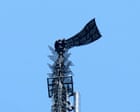
High-altitude stunts in dense urban environments operate at the intersection of acute physical risk, structural security vulnerability, and the attention economy. The incident on July 1, 2026, where two individuals bypassed security protocols to scale the transmission tower of the Empire State Building, illustrates a precise operational failure in landmark security architecture. By climbing above the public 102nd-floor observation deck to the 1,454-foot spire, unfurling a banner, and executing a calculated marriage proposal, the actors exploited physical infrastructure gaps for maximum digital amplification.
Analyzing this event requires removing the romantic narrative and examining the mechanical realities of vertical perimeter breaches, the legal liability frameworks governing urban landmarks, and the mathematical trade-offs of extreme attention-seeking behavior.
The Architecture of a Vertical Breach
Securing a supertall structure involves managing distinct zones of access Control: public common areas, ticket-validated observation decks, commercial tenant spaces, and restricted mechanical or engineering zones. The transmission tower of the Empire State Building represents the highest tier of restriction due to structural hazards and critical communications infrastructure.
The mechanism of the breach can be categorized into three structural failure points.
Unauthorized Vertical Penetration
A physical bypass occurred where public or maintenance access terminated. To reach the spire, the individuals had to transition from the secure interior or authorized exterior viewing platforms of the upper decks onto the exposed structural steel of the antenna tower. This requires circumventing physical barriers, heavy-duty locking mechanisms, or technical intrusion detection systems.
Surveillance Latency
The climbers occupied the spire for approximately 30 minutes before initiating their descent. This window indicates a lag between asset detection, verification, and physical response deployment. Because the upper limits of an antenna tower lack standard human pathways, intercepting subjects in real-time presents extreme logistical difficulty for ground security personnel.
Weaponization of Visibility
By choosing midday, the actors maximized ambient light for high-contrast digital recording and ensured a high density of ground-level eyewitnesses across midtown Manhattan. The choice of sleeveless black clothing against a metallic superstructure provided visual contrast, optimizing the legibility of the text on their banner for low-resolution smartphone cameras and media telephoto lenses.
The Economics of High-Stakes Attention
The deployment of a political or philosophical message followed by an immediate shift to a highly personal milestone (a marriage proposal) represents a strategic approach to media engineering. This dual-purpose framework maximizes the velocity of content distribution across disparate digital networks.
The strategy balances two distinct value propositions.
Mass Distribution via Controversy
The initial phase of the stunt leverages high-contrast imagery: masked figures hanging 443 meters above the pavement holding a large black banner reading, "When the power of love beats the love of power the world knows peace." The use of a quote often attributed to cultural icons guarantees indexing by search engines and immediate pickup by news syndicates covering civil disruptions or breaking urban events.
Algorithmic Humanization
The transition to a marriage proposal alters the narrative dynamic. By shifting from a potential security threat or political protest to a conventional romantic milestone, the actors mitigate immediate public hostility and tap into algorithmic feeds optimized for high-emotion, positive-sentiment content.
This structural pivot alters the economic cost-benefit equation of the stunt. The certain legal costs—including arrest, prosecution for criminal trespass, and reckless endangerment—are weighed against the projected digital equity generated by global news coverage and viral social media syndication.
Structural and Legal Liabilities of Landmark Trespass
The structural mechanics of supertall buildings introduce severe physical hazards during unauthorized ascents. The upper spires of skyscrapers are subjected to dynamic environmental forces that differ significantly from ground conditions.
- Aerodynamic Forces: Wind velocities scale with altitude. At 1,400 feet, localized wind shear and gust factors apply substantial lateral force to human bodies and unsecured textile banners, drastically increasing the probability of a fatal fall.
- Electromagnetic Radiation: Broadcast towers house high-power transmitters for television and radio signals. Prolonged close-range exposure to non-ionizing RF radiation introduces acute thermal biological hazards to unauthorized personnel.
- Structural Degradation: Handholds on engineering spires are designed for trained technicians utilizing professional fall-arrest systems. Unanchored climbing introduces structural liabilities and immediate risk to pedestrians below if debris or equipment is dropped from the apex.
From a liability perspective, New York landmarks manage strict operational legal protocols. The New York Police Department responded with aviation units and ground forces to establish a containment perimeter.
The legal consequences for the actors typically involve a combination of third-degree criminal trespass, reckless endangerment, and disorderly conduct. For the asset management company operating the structure, the financial fallout includes the direct costs of emergency service deployment, temporary operational halts for the observation decks, and the immediate requirement for capital expenditures to harden physical access points against future copycat maneuvers.
Institutional Mitigation Strategy
To prevent subsequent vertical breaches, high-profile infrastructure operators must shift from passive monitoring to automated active denial frameworks.
The primary line of defense requires installing continuous, real-time spatial analytics. Integrating LiDAR or thermal infrared cameras around the threshold of the 102nd floor creates an automated digital geofence. Crossing this boundary must trigger immediate mechanical lockdowns of lower access hatches and deploy localized acoustic or visual deterrents to disrupt the ascent before climbers reach the external superstructure. Physical barriers must also be structurally updated; smooth anti-climb cowling wrapped around the base of transmission towers eliminates manual handholds, rendering unassisted human climbing mechanically impossible.
Relying on post-incident arrest fails to protect the structural integrity of the asset or the safety of the public below. Security architectures must evolve to deny the physical possibility of the climb, thereby neutralizing the site as a viable canvas for unauthorized high-altitude attention capture.