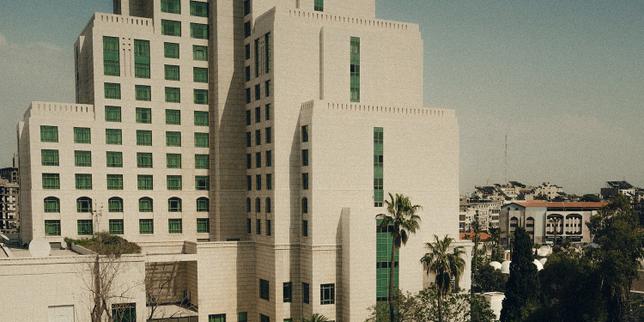
In highly sanctioned, post-conflict environments, physical infrastructure often transcends its nominal commercial utility to function as a primary mechanism for political and financial arbitrage. The Four Seasons Hotel Damascus provides an empirical baseline for this dynamic. Following the structural shift in Syrian governance in late 2024 and the establishment of the transitional authority under President Ahmed al-Sharaa in 2025, the asset has remained structurally intact. This stability persists despite decades of conflict, international sanctions, and abrupt changes in state leadership. The endurance of the asset is explained not by the persistence of luxury demand, but by its operational architecture, which serves as a critical point of convergence for international organizations, transitional technocrats, and foreign diplomatic missions.
The survival and continuous operation of this specific property can be systematized through a defined three-pillar framework: structural insulation, capital extraction via institutional capture, and the physical centralization of diplomatic capital.
The Micro-Geography of Security and Structural Insulation
The first pillar governing the asset’s persistence is its physical and operational insulation from the surrounding macroeconomic collapse. In an economy characterized by systemic capital flight and the degradation of public utilities, the hotel functions under an independent cost and utility framework.
- Autarkic Utility Infrastructure: The asset maintains continuous power generation, water filtration, and communication networks entirely decoupled from the municipal grid. This technical autonomy converts a hospitality asset into a mission-critical operations base for entities that cannot legally or operationally tolerate systemic downtime.
- The Premium of Spatial Monopolies: In a capital city transitioning between defensive political regimes, secure physical space is a finite commodity. The hotel commands a premium not for its service delivery, but for its role as a defensible perimeter. The spatial layout optimizes access control, creating an elite ecosystem where internal transactions occur with minimal exposure to broader domestic instability.
This structural insulation creates an artificial micro-climate. For international actors, the marginal cost of operating outside this insulated environment exceeds the steep premiums commanded by the property, establishing a captive market model.
The Microeconomics of Institutional Capture
The second pillar rests on the financial mechanics of humanitarian expenditure. For over a decade, international governance bodies—specifically United Nations agencies—have served as the primary underwriters of the hotel’s balance sheet. This relationship highlights a structural vulnerability in international aid delivery models.
+-----------------------------+       Hard Currency (USD)       +-----------------------------+
|    International Donors     | ------------------------------> | UN Procurement & Operations |
+-----------------------------+                                 +-----------------------------+
                                                                               |
                                                                               | Room Night Allocation &
                                                                               | Facility Rental Fees
                                                                               v
+-----------------------------+      Asset Seizure & Auditing   +-----------------------------+
|    Transitional Authority   | <------------------------------ |   The Damascus Asset Hub    |
|  (Property & Revenue Stake) |                                 |  (Formerly Foz/State JV)   |
+-----------------------------+                                 +-----------------------------+
The underlying economic model operates via a multi-stage flow:
- Hard Currency Influx: International agencies allocate humanitarian and development funding in major global currencies. Because operational guidelines require a localized footprint in the capital, these organizations must rent real estate and secure lodging capable of meeting stringent security protocols.
- The Captive Procurement Bottleneck: Due to the micro-geographic realities outlined above, the property frequently emerges as the sole compliant vendor in the region. This lack of market competition allows the asset to capture a disproportionate share of local operational budgets.
- Revenue Transmutation: Historically, the joint-venture structure of the hotel—divided between private oligarchic interests like Samer Foz's Aman Holding and the Syrian Ministry of Tourism—allowed the state apparatus to extract significant hard currency. While corporate management agreements with Western entities were terminated in 2019 due to compliance mandates, the physical infrastructure continued to collect these inflows.
Under the transitional framework initiated in 2025, this revenue pipeline faces structural reassessment. The current technocratic cabinet, led by economic and financial ministries focused on stabilizing the Syrian pound and recovering state assets, has targeted these high-yield nodes for financial auditing. The mechanism of capture remains identical; only the recipient entity changes.
Diplomatic Convergence and Informational Arbitrage
The third pillar is the hotel's utility as a neutral zone for informational and diplomatic exchange. When formal state channels are disrupted or undergoing structural reorganization, informal physical spaces absorb the transaction volume of statecraft.
The lobby, dining facilities, and secure conference zones of the property serve as a marketplace for asymmetric information. Here, three distinct actors interact:
- Transitional Technocrats: Government ministers and administrative officials utilizing the space to interface with external bodies without the administrative lag of formal state offices.
- Foreign Emissaries and Re-establishing Diplomatic Missions: Representatives from regional powers and global nations navigating newly forged bilateral agreements—such as the rapid stabilization of ties seen throughout 2025.
- International Bureaucrats: Aid directors and advisors who hold the capital resources necessary for reconstruction.
Because all three actors operate within the same physical footprint, the asset functions as an informal clearinghouse for political risk assessment, policy testing, and contract negotiation. The value of the hotel is therefore derived from its network effects: every additional high-value actor residing within the perimeter increases the informational value of the space for all other participants.
Structural Risks and Long-Term Operational Limitations
The strategy of relying on a single centralized asset to anchor international engagement carries distinct systemic risks. The primary limitation is institutional vulnerability. Because the property is explicitly tied to state visibility, it remains a primary target for regulatory scrutiny and political expropriation during phases of regime consolidation.
Furthermore, the model faces a reputational discount. Continued reliance on an asset historically tied to war-profiteering networks complicates the compliance frameworks of international donors. If the transitional government cannot successfully decouple the physical asset from its legacy ownership structures through transparent legal restructuring, international procurement offices may face internal policy mandates to divest from the venue entirely.
The operational viability of the Damascus hub will be determined by how effectively the transitional ministry of economy manages the asset's legal title. The strategic priority requires a rapid, legally binding auditing process that transitions the property from an opaque vehicle of oligarchic capital retention into a transparent, state-supervised utility. Failing to execute this transition will cannibalize its utility, shifting international presence to alternative regional hubs or decentralized secure zones, thereby deflating the asset's unique informational premium.