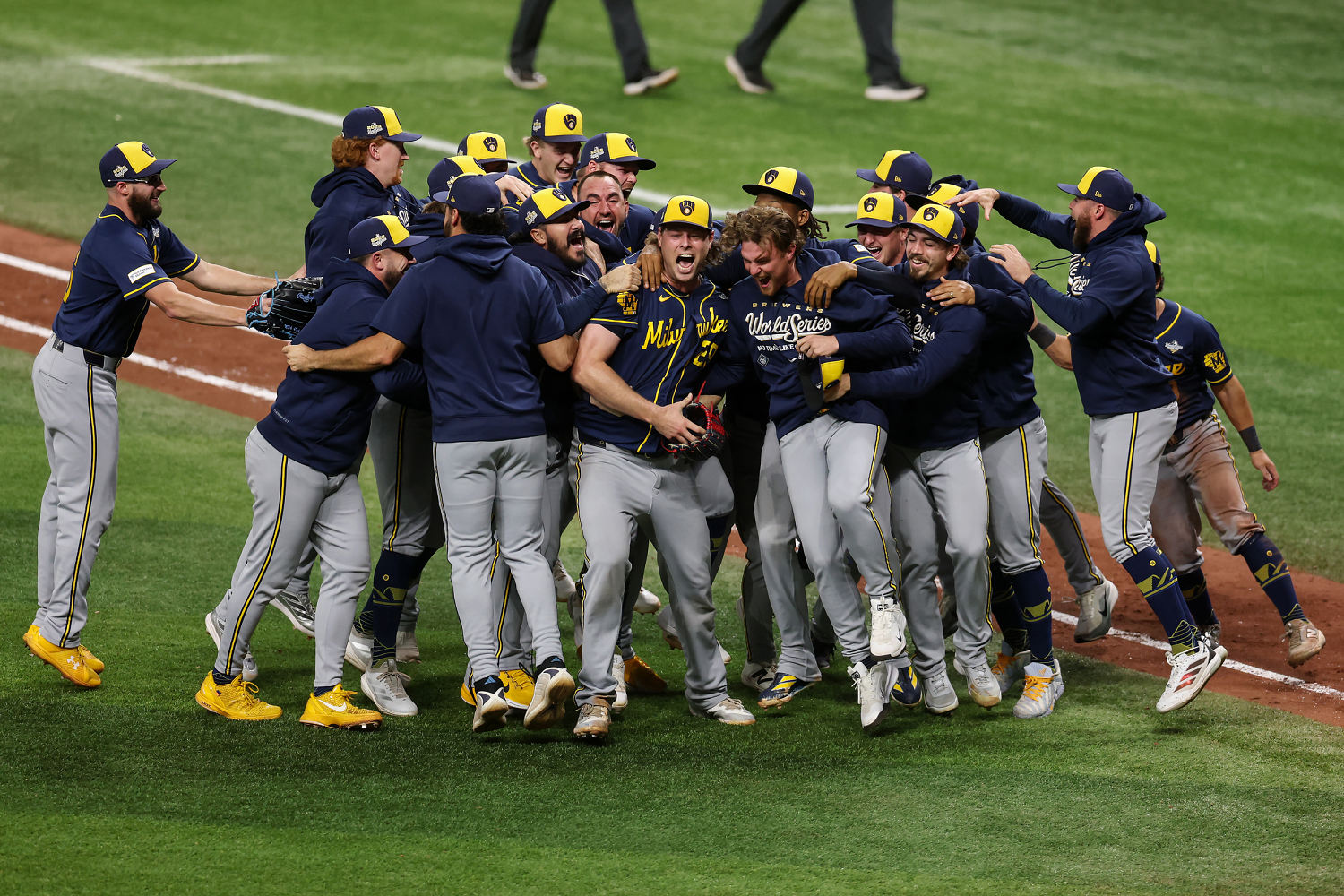
When two small-market franchises meet in the World Series—specifically a matchup resulting in a 4-1 Milwaukee Brewers victory over the Tampa Bay Rays for Milwaukee's inaugural franchise title—the outcome invalidates decades of conventional payroll-driven baseball orthodoxy. Standard sports coverage treats such a result as an emotional narrative of underdog grit or timely hitting. That framing obscures the structural mechanics at work. A five-game championship series between two resource-constrained organizations represents the ultimate stress test of modern front-office capital allocation, variance compression, and pitching-staff architecture.
To understand how a small-market club converts a regular-season playoff berth into a four-games-to-one World Series victory, one must strip away box-score anecdotes and examine the underlying operational systems. Neither Milwaukee nor Tampa Bay possesses the financial margin for error enjoyed by large-market clubs in New York, Los Angeles, or Boston. Those coastal franchises absorb bad contracts and mid-season injuries through raw payroll liquidity. Small-market organizations must instead weaponize efficiency, relying on player-development pipelines, aggressive roster churn, and asymmetric bullpen deployment to generate surplus value.
The Structural Economics of the Small-Market Matchup
A World Series pairing between the Brewers and the Rays functions as a closed-system experiment in sabermetric resource optimization. Both organizations operate in the bottom third of Major League Baseball’s revenue and payroll distributions, yet both maintain sustained competitive windows through distinct operational philosophies.
The Cost Function of Roster Construction
In traditional big-market roster construction, front offices buy established free-agent production on the open market, paying peak dollar-per-WAR (Wins Above Replacement) rates for players entering their age-30 seasons and beyond. Small-market clubs cannot compete in this auction without crippling their multi-year solvency. Instead, Milwaukee and Tampa Bay optimize a strict cost function centered on three variables:
- Pre-Arbitration Surplus Extraction: Maximizing plate appearances and innings pitched from players under team control at or near the league minimum salary.
- Distressed Asset Rehabilitation: Acquiring underperforming players with elite underlying physical traits—such as high spin rates, superior bat speed, or extreme exit velocities—and altering their mechanical or pitch-mix profiles.
- Aggressive Asset Liquidation: Trading established stars one to two years prior to free agency to replenish the minor-league talent pool before asset value depreciates to zero.
When two clubs built on these identical economic foundations clash in a best-of-seven series, payroll disparity ceases to be an explanatory variable. The decisive edge shifts entirely to tactical execution and the minimization of high-leverage variance over a compressed five-game sample.
Variance Compression in Short Series
Baseball’s 162-game regular season is designed to separate true talent from statistical noise. A best-of-seven postseason series does the exact opposite; it amplifies small-sample variance. Over five games, a single poorly timed defensive misplay, a cluster of low-exit-velocity singles, or an umpire's inconsistent strike zone can swing championship probability by more than thirty percentage points.
Winning a World Series in five games requires active variance compression. The victorious club systematically removes high-risk events from the game environment. In a Brewers-Rays matchup, this compression occurs primarily through run prevention rather than offensive slugging. Home runs are the most efficient scoring mechanism in baseball, yet relying exclusively on multi-run homers introduces extreme offensive volatility against elite postseason pitching. The team that captures a 4-1 series victory succeeds by suppressing the opponent's power output while manufacturing runs through contact quality, baserunning pressure, and platoon advantage exploitation.
Pitching Architecture and the Death of the Traditional Starter
The defining tactical battleground in any modern series featuring Milwaukee and Tampa Bay is the deployment of the pitching staff. Both franchises pioneered the systematic dismantling of the traditional starting pitcher role, replacing it with modular, matchup-driven bullpen ecosystems.
The Times-Through-the-Order Penalty
Decades of empirical tracking data confirm the existence of the times-through-the-order penalty (TTOP). A pitcher’s effectiveness degrades measurably the second and third time they face the same batting order within a single game. Hitters adjust to release points, velocity differentials, and tunnel trajectories.
During the regular season, managers tolerate this degradation to preserve bullpen health across 162 games. In the World Series, off-days between Games 2 and 3, and again between Games 5 and 6, eliminate the need for long-term bullpen conservation. A winning 4-1 series strategy treats every inning after the third as a high-leverage fire drill. By pulling starting pitchers before they face the top of the opposing order a third time, a manager denies hitters the familiarity required to square up high-velocity pitches.
Asymmetric Bullpen Deployment
When Milwaukee defeats Tampa Bay in five games, the separation rarely comes from the starting rotation's total innings. It stems from superior bullpen sequencing and pitch-shape diversity.
- Velocity and Plane Disruption: Effective postseason bullpens do not simply throw hard; they alter the hitter's visual plane from batter to batter. Following a high-spin, four-seam fastball pitcher who works at the top of the strike zone with a low-slot sinkerballer who induces ground balls forces opposing hitters to constantly recalibrate their swing paths.
- The High-Leverage Fireman Model: Traditional bullpen management saves the best reliever for the ninth inning, regardless of the game state. Modern championship architecture deploys the premier relief arms in the sixth, seventh, or eighth innings whenever the opponent's highest-OPS hitters come to the plate with runners on base. If the game is lost in the seventh inning, the ninth inning never occurs.
- Platoon Neutralization: Both the Brewers and the Rays construct lineups heavily reliant on platoon splits, stacking left-handed hitters against right-handed pitchers and vice versa. Countering this requires relievers with reverse splits—pitchers whose primary secondary offering (such as a changeup or cutter) neutralizes opposite-handed batters—thereby rendering the opposing manager's pinch-hitting bench ineffective.
Offensive Micro-Adjustments Against Elite Velocity
In a hypothetical or historical World Series clash between these two pitching factories, runs are scarce. League-average postseason fastball velocity consistently sits above 95 mph, accompanied by wipeout sliders and sweepers that break across multiple planes. Standard regular-season hitting approaches collapse under these conditions.
Strike-Zone Discipline and Chase-Rate Reduction
Against elite relief pitching, expanding the strike zone is fatal. Pitchers in October rarely throw strikes when ahead in the count; they throw competitive pitches designed to look like strikes out of the hand before diving beneath the barrel or running off the outer edge.
The offensive unit that prevails in a five-game series demonstrates superior chase-rate discipline. By refusing to swing at pitches outside the shadow of the zone, hitters force pitchers back into hitter's counts (1-0, 2-0, 3-1). In these counts, pitchers must throw fastballs over the heart of the plate to avoid issuing free passes. Even a modest reduction in team chase rate across five games yields three to five additional walks and forces opposing starters out of the game an inning earlier, accelerating exposure to the middle tiers of the opponent's bullpen.
Situational Contact and Baserunning Pressure
When home runs are suppressed by cold October air and elite pitching, the marginal value of a single increases dramatically—provided the offense can convert singles into scoring opportunities without relying on three consecutive hits.
- Two-Strike Approach Modifications: Elite postseason hitters shorten their swing paths with two strikes, sacrificing maximum exit velocity to prioritize ball-in-play contact. Putting the ball in play forces the defense to execute cleanly under maximum psychological pressure.
- Stolen Base Efficiency: Under modern rule sets featuring larger bases and pickoff limitations, aggressive baserunning is a high-expected-value play against pitchers with slow deliveries to home plate. Turning a walk or single into a runner on second base with fewer than two outs fundamentally alters the defensive alignment, pulling infielders out of optimal positioning and opening up ground-ball lanes.
- First-to-Third Advancement: Exploiting average or below-average outfield throwing arms on single-to-right or single-to-center situations puts runners ninety feet from scoring, enabling sacrifice flies, wild pitches, or productive groundouts to generate runs.
Defensive Run Prevention and Positioning Geometry
In low-scoring championship environments, a single defensive failure often represents the exact margin of victory. Both Milwaukee and Tampa Bay treat defense not as an afterthought, but as a primary driver of pitching efficiency.
Outfield Catch Probability and Framing Value
Modern defensive metrics quantify far more than fielding percentage, which penalizes range and rewards stationary players. Championship-caliber run prevention relies on two hidden pillars:
- Catcher Framing and Blocking: Over a five-game series, a catcher who steals three to four borderline strike calls per game alters the outcome of dozens of plate appearances. Turning a 2-1 count into a 1-2 count drops the batter's expected weighted on-base average (wOBA) by over one hundred points. Equally critical is blocking balls in the dirt with runners on base, which allows pitchers to throw breaking balls below the zone with full conviction.
- Outfield Route Efficiency: Using Statcast tracking data, front offices position outfielders based on individual batter spray charts, pitch type, and velocity. A center fielder who takes an optimal first step and converts a 35-percent catch-probability line drive into an out saves two runs in a single play—often matching the entire offensive output of the opposing team for that night.
Tactical Leverage Points in a 4-1 Series Outcome
A 4-1 series victory appears decisive in the historical ledger, yet in baseball, a five-game triumph rarely reflects sheer dominance. More often, it indicates superior execution in the three or four high-leverage inflection points that define the series.
Game 1 Tone-Setting and Bullpen Exposure
Winning Game 1 on the road or at home immediately shifts the strategic burden onto the losing manager. When the Brewers capture the opener, they force the Rays into a reactive posture for the remainder of the series. More importantly, if the Game 1 victor forces the losing team to deploy its top three high-leverage relievers in a losing effort, those arms suffer physical fatigue and batter familiarity before Game 2 even begins.
The Game 3 and Game 4 Pivot
In a 1-1 series split after two games, Games 3 and 4 become the structural fulcrum. Because teams typically start their third and fourth rotation options in these contests, pitching depth is tested. The franchise with superior multi-inning bulk relievers—pitchers capable of throwing three to four scoreless innings in a piggyback role—gains a massive structural advantage. Winning both middle games transforms a competitive series into a 3-1 stranglehold, allowing the leading manager to deploy their absolute best pitching matchups in Game 5 with zero need to hold arms in reserve for a hypothetical Game 6.
Operational Limitations of the Small-Market Blueprint
While a Brewers World Series victory validates the small-market analytical model, treating this framework as an infallible formula ignores severe structural vulnerabilities. Front offices attempting to replicate this success must account for three inherent limitations.
The Fragility of Thin Depth Charts
Small-market contenders operate without high-priced veteran bench depth. Their 26-man playoff rosters rely heavily on optimal health across their core contributors. If two primary starting pitchers or a middle-of-the-order hitter suffer late-season injuries, the drop-off to the Triple-A replacement level is steep. Unlike large-market clubs that can acquire an All-Star rental at the trade deadline to patch a hole, small-market teams must rely on internal variance, which frequently fails under postseason scrutiny.
The Diminishing Returns of Roster Churn
Constant turnover keeps payroll low, but it also erodes institutional cohesion and clubhouse stability. Trading away beloved franchise cornerstones every two to three years alienates the local fanbase and puts immense pressure on the scouting and player-development departments to hit on an unrealistic percentage of draft picks and international signings. A single drafting drought of two consecutive years can collapse a small-market competitive window for half a decade.
Postseason Sample-Size Roulette
Even the most analytically optimized roster remains subject to the brutal math of short-series baseball. The exact same operational process that yields a 4-1 World Series triumph in one October can easily produce a 3-0 Wild Card sweep the following year if opposing hitters string together a few 75-mph bloop singles with runners in scoring position. Analytical rigor maximizes the probability of winning; it never guarantees the outcome.
Replicating the Championship Architecture
For front-office executives operating within strict budgetary constraints, the lesson of a Brewers championship over the Rays is clear: do not attempt to outspend large-market competitors at their own game. Instead, reallocate capital away from aging free-agent contracts and invest heavily in biomechanics labs, pitch-design infrastructure, and predictive defensive positioning. Build a pitching staff composed of interchangeable, high-velocity, multi-plane relievers capable of neutralizing platoon advantages, and prioritize high-contact, low-chase hitters who can manufacture runs without relying on three-run homers. When October arrives, abandon traditional starter workloads immediately, deploy your highest-leverage arms in the sixth and seventh innings, and compress game variance until the opponent's offensive margin disappears entirely.