A courtroom is never truly quiet. Even when the gallery holds its collective breath, when the stenographer's fingers pause above the keys, and when the judge's gavel rests motionless on the mahogany bench, the air hums with a heavy, invisible weight. It is the sound of time folding back onto itself. It is the sound of memory trying to outrun grief.
On a stark Tuesday in an Australian court, that silence cracked open.
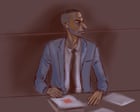
The trial of Beau Lamarre-Condon, a former police officer accused of the murders of Jesse Baird and Luke Davies, pressed forward into territory that no human being should ever have to traverse by choice. The jurors—ordinary citizens pulled from the rhythm of ordinary lives, handed a stack of juror badges and an unimaginable burden—were shown a photograph.
Not just any photograph. An image of an alleged execution-style gunshot wound.
Pause for a second. Think about your own Tuesday morning. Perhaps you were waiting for a kettle to boil, or arguing gently with a child about mismatched socks, or glancing at your phone while the morning commute crawled forward. Now, imagine staring at a high-definition, clinical projection of the exact moment a human life was violently, irreversibly unstrung.
That is what a trial demands. It strips away the comforting distance of headlines. It drags us down into the mechanical, brutal reality of human destruction.
To understand why this matters—why we subject twelve strangers to the darkest corners of the human psyche—we have to look past the cold police blotters and the sensational blur of breaking news alerts. We have to look at the mechanics of accountability.
In legal proceedings of this magnitude, the prosecution does not merely tell a story. They build a fortress of facts, brick by merciless brick. Forensic pathologists do not speak in poetry; they speak in trajectories, stippling, powder burns, and terminal ballistics. They translate the unspeakable chaos of murder into coordinates on a grid. When the jury looked at that photograph of the gunshot wound, they were not looking at a picture for the sake of shock value. They were looking at corroboration. They were looking for the truth that refuses to stay buried.
The accused stood trial under the heavy shadow of a uniform once worn with authority. That detail alone twists the knife a little deeper into the public consciousness. We grant immense power to those we arm and authorize to keep the peace. When that contract is shattered—when the shield becomes a weapon—the betrayal echoes far beyond a single crime scene in Sydney. It shakes the foundational trust between the citizen and the state.
Consider what happens next in a courtroom when such evidence enters the record. The defense shifts, recalculating angles of intent, timeframes, and psychological state. The judge leans forward, eyes narrowed, ensuring every procedural safeguard is locked tightly in place. Because if a trial is messy, if due process bends even an inch under the pressure of public outrage, justice itself collapses.
Trials are agonizingly slow by design. They force us to crawl through the wreckage rather than fly over it.
During the presentation of the forensic evidence, the courtroom atmosphere shifted. The air grew thin. In cases involving high-profile allegations against law enforcement officers, the public narrative often races ahead of the legal reality. People want immediate catharsis. They want closure wrapped neatly with a bow. But the wheels of justice do not turn on emotion. They turn on exhibits like Exhibit A, Exhibit B, Exhibit C. They turn on hard, stubborn, unyielding physical evidence.
A gunshot wound tells a story that the living can no longer voice. It speaks of distance, of angles, of the exact fraction of a second between breathing and stillness. For the families of Jesse Baird and Luke Davies sitting in that gallery, hearing those medical details must have felt like standing barefoot on broken glass. Every technical term uttered by the pathologist is a fresh reminder of an absence that can never be filled.
Yet, we must bear witness.
We live in an era where violence is routinely sanitized for entertainment. We consume fictional murders on streaming platforms by the dozen, turning suspense into a casual pastime before sleep. But real murder is devoid of cinematic redemption arcs. There is no clever one-liner before the screen fades to black. There is only the sterile hum of fluorescent lights in a morgue, the meticulous notes of forensic investigators, and the quiet, agonizing wait for a verdict that can never truly fix what was broken.
When the jurors filed back out of the courtroom, their faces etched with the unmistakable fatigue of secondary trauma, they carried a piece of that room with them. They carry the weight of the state's most solemn duty.
Justice is not an abstract concept floating somewhere in the clouds above the courthouse steps. It is forged right there, in the uncomfortable, suffocating spaces where ordinary people are forced to look directly at the worst of humanity, and still refuse to look away.
The photograph on the screen is gone now. The projector has been turned off. The transcript is logged, indexed, and filed away. But the resonance remains, lingering in the quiet spaces between heartbeats, waiting for the gavel to fall.