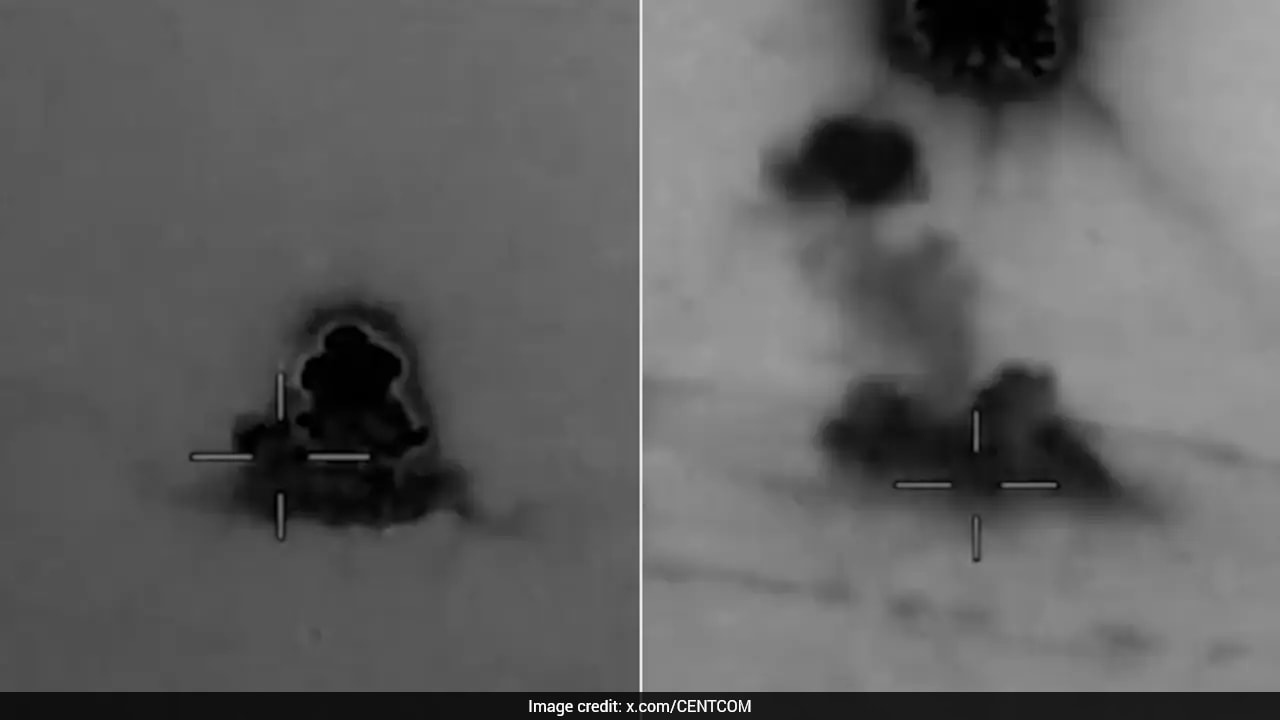
The visual confirmation of kinetic operations in the southern port town of Sirik by US Central Command (CENTCOM) exposes the structural fragility of the current interim ceasefire framework. On June 26, 2026, six American aircraft engaged four distinct military targets inside sovereign Iranian territory, focusing explicitly on coastal radar installations and unmanned aerial vehicle (UAV) and anti-ship cruise missile (ASCM) storage nodes. This deployment of precision strike assets followed a June 25 one-way attack drone strike on the Singapore-flagged container vessel M/V Ever Lovely as it exited the Strait of Hormuz along the Omani coast.
This kinetic exchange highlights the limits of informal Memorandums of Understanding (MoUs) lacking enforceable dispute-resolution mechanisms. The confrontation reveals a complex cost-benefit calculus where both state actors leverage calculated violence to alter the terms of a shaky, short-term maritime truce.
The Cost Function of Retaliatory Signals
The decision by CENTCOM to rapidly release weapon systems video footage represents a deliberate informational strategy designed to alter the target's risk calculus without initiating full-scale war. This strategic messaging operates on three specific variables:
- Target Isolation: By striking Sirik, the US military selected a localized logistical node rather than a high-density naval command hub like Bandar Abbas. This limits the collateral costs and allows Iran a path to de-escalate if it chooses.
- Capability Demonstration: The video documentation verifies the penetration of Iran’s coastal air defense network, signaling a high level of operational readiness and the vulnerability of its early-warning radar systems.
- Political Attribution: Publicly linking the strikes directly to the targeting of the M/V Ever Lovely establishes a firm precedent of immediate, proportional retaliation for any disruption to merchant shipping.
This calibrated response exposes a fundamental strategic friction. The current US administration aims to protect global commercial shipping corridors while simultaneously working to finalize long-term diplomatic negotiations. By treating the drone strike on the M/V Ever Lovely as a clear breach of the agreed-upon ceasefire, Washington used kinetic force to reinforce its deterrence framework. However, this relies on the assumption that the adversary views the threshold for escalation the same way.
Defensive Posturing and Regional Leverage
The response from the Islamic Revolutionary Guard Corps (IRGC) Naval Branch reveals how Tehran interprets the boundaries of the interim agreement. The IRGC claimed its subsequent missile strikes against regional US deployment sites were authorized counter-actions to a prior American breach of commitments. This counter-narrative points to an asymmetric strategy built on two main pillars:
The Transit Control Dilemma
Iran uses its geographic position along the Strait of Hormuz to assert oversight over all maritime traffic passing through the chokepoint. By signaling a willingness to disrupt commercial shipping despite a signed memorandum, Tehran treats freedom of navigation as a conditional bargaining chip rather than an absolute rule of international law.
Regional Threat Projection
Statements broadcast on Iranian state television by former diplomatic officials warn that any US operation launched from outside the immediate theater will trigger retaliatory strikes against neighboring Gulf cooperation states. This threat structure attempts to split Washington from its regional partners by raising the potential security costs for host nations providing logistical support to American forces.
The Broken Mechanics of the Interim Ceasefire
The swift return to kinetic action less than two weeks after extending the 60-day ceasefire reveals a significant structural flaw in the US-Iran memorandum. The current framework lacks a direct, reliable communication link or formal mediation channel capable of handling disputes before they escalate into violence.
While the administration points to the agreement as a tool to restore shipping traffic to historical baselines, Iran has attempted to tie the maritime truce directly to separate regional conflicts, particularly the ongoing friction involving Israel and Hezbollah in Lebanon.
[Regional Proxies & Connected Fronts]
       │
       ▼
[Strait of Hormuz Truce] ──(No Formal Hotline)──> [Miscalculation / Kinetic Escalation]
       ▲
       │
[US Freedom of Navigation]
This spillover effect severely undermines the stability of the maritime agreement. When non-party dynamics influence the behavior of the primary signatories, a localized breakdown in deterrence can rapidly spread across the entire theater. This risk is further heightened by the absence of a military hotline to de-conflict operations during upcoming mine-clearing initiatives in the strait, significantly increasing the probability of mid-tier operational miscalculations.
Strategic Realities and Maritime Security
The current escalatory cycle challenges the long-term viability of relying on short-term maritime truces without explicit enforcement protocols. For international shipping companies and regional security planners, the theater now presents several distinct operational realities:
- Escalating Insurance Premiums: The International Maritime Organization's decision to pause evacuation plans for trapped vessels following the hit on the M/V Ever Lovely, combined with sudden spikes in Brent crude prices, demonstrates that the energy corridor remains highly sensitive to localized combat.
- Asymmetric Risk Dispersion: Iran’s focus on civilian container ships like the M/V Ever Lovely shows that commercial shipping will continue to bear the immediate tactical risks of these broader political disputes.
- Diminishing Diplomatic Returns: Continuous cycles of strike and counter-strike run the risk of empowering hardline factions within Tehran, making it increasingly difficult to transition the temporary memorandum into a durable, multi-party treaty.
The immediate operational priority for coalition forces must shift toward establishing the proposed maritime de-confliction hotline with Tehran. This mechanism is essential to prevent unintended engagements during upcoming mine-clearing activities. Concurrently, US regional strategy must decouple the freedom of navigation framework in the Strait of Hormuz from wider diplomatic negotiations regarding Levantine security architectures.
Failing to establish these clear operational boundaries ensures that commercial transit through the global energy chokepoint will remain vulnerable to a continuous loop of tactical miscalculations and retaliatory strikes.
For an operational assessment of the initial maritime strike and a breakdown of the naval systems deployed in the chokepoint, see the reporting on the US Strike on Iran Targets. This analysis details the strategic context of the initial drone engagement in the Strait of Hormuz.