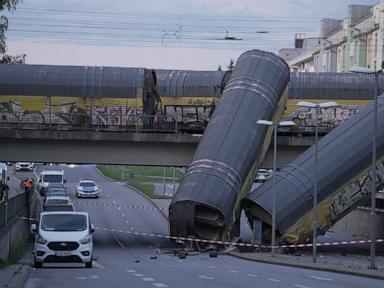
A fatal collision between two freight trains on a railway bridge in Munich’s northern district of Milbertshofen exposes systemic vulnerabilities in modern rail transport networks. The incident, occurring at approximately 1:40 a.m. local time on June 20, 2026, resulted in one fatality and caused two cargo wagons to derail and plunge onto the public roadway below. Beyond the immediate tragedy, this event underscores structural issues regarding rail safety mechanisms, structural loading of bridge infrastructure during derailments, and the systemic risks embedded within high-density freight corridors.
Understanding how a dual-train freight collision occurs on elevated infrastructure requires breaking down the event into three discrete operational phases: signal failure or human error, kinetic impact mechanics, and structural containment limitations.
The Tri-Focal Engineering Vulnerabilities of Rail Infrastructure
Analyzing rail accidents requires looking past simple causality to evaluate how multiple independent systems fail simultaneously. The Munich Milbertshofen incident highlights critical friction points across track telemetry, locomotive kinetic energy management, and secondary infrastructure containment.
+------------------------+      +--------------------------+      +--------------------------+
|  1. Signaling & Track  | ---> |  2. Kinetic Impact and   | ---> | 3. Structural Integrity  |
|  Telemetry Separation  |      |   Deceleration Energy    |      |    and Containment       |
+------------------------+      +--------------------------+      +--------------------------+
1. Signaling and Track Telemetry Separation
Modern rail networks utilize advanced train control systems designed to enforce spatial separation. In Europe, the European Train Control System (ETCS) and localized legacy frameworks like Germany’s Punktförmige Zugbeeinflussung (PZB) or Linienzugbeeinflussung (LZB) act as the primary defense against head-on or rear-end collisions.
The primary failure mechanism in track separation typically stems from one of three bottlenecks:
- Interlocking Software Errors: Misallocations in the central signaling matrix that permit two distinct train profiles into the same block block concurrently.
- Balise Transponder Malfunctions: Faults in the physical track-mounted transponders that communicate positioning data back to the train cab.
- Override Protocols: Manual operator interventions that bypass automated braking systems under mistaken assumptions of clear trackage during maintenance or off-peak hours.
2. Kinetic Impact and Deceleration Energy
When two freight trains collide on an elevated structure, the dissipation of kinetic energy behaves according to the conservation of momentum. Freight locomotives and laden wagons carry massive inertia due to their high mass, even at moderate switching speeds.
Upon impact, if the energy cannot be absorbed by the rolling stock crash zones, it transfers laterally and vertically. This sudden lateral energy vector causes wheel flanges to climb the rails, leading directly to derailment.
3. Structural Integrity and Containment
Bridges and overpasses are designed primarily for vertical dead loads and dynamic live loads from passing trains. They are rarely engineered to act as rigid catch-basins for multi-ton runaway rolling stock during a high-energy kinetic event.
The fact that two wagons broke through or cleared the bridge barriers and fell onto the street below demonstrates a distinct failure in secondary containment structures. Guard rails (or check rails) installed parallel to the running rails are intended to keep derailed wheels inline and prevent vehicles from turning sideways or leaving the track bed. If the lateral force exceeds the shear strength of these components, containment drops to zero.
Evaluating the Cost Function of Freight Network Disruptions
The economic consequences of a major freight derailment on a primary European line extend far beyond vehicle replacement costs. Rail operators must account for a complex cost function that dictates the total financial damage of an infrastructure failure.
$$C_{total} = C_{assets} + C_{infrastructure} + C_{logistics} + C_{liability}$$
Asset Liquidation and Recovery Costs
A derailed freight wagon that falls from an elevated bridge is generally a total structural loss. The cost includes not only the rolling stock itself but also specialized heavy cranes, recovery crews, and environmental mitigation teams required to clear hazardous or non-hazardous cargo from public roads.
Infrastructure Refurbishment
Bridges require rigorous non-destructive testing (NDT), such as ultrasonic or radiographic testing, following a severe impact to verify that the structural steel, concrete piers, and abutments have not suffered fatal micro-fractures. The time required to assess and repair structural concrete or steel creates a long-term network bottleneck.
Supply Chain Logistics Penalties
Munich serves as a critical junction for trans-European freight corridors connecting Central Europe to Southern European ports. A line closure requires rerouting high-tonnage freight trains through alternative, lower-capacity branch lines. This creates severe scheduling conflicts, increased fuel consumption, crew expiration issues, and contractual late-delivery penalties for rail logistics providers.
Technical Mitigation and Operational Realities
Preventing future elevated freight failures requires upgrading physical infrastructure and safety protocols. Implementing these improvements involves balancing substantial upfront costs against predictable long-term safety benefits.
- Reinforced Concrete Parapets: Installing high-containment barriers along rail bridges capable of absorbing heavy lateral impacts from derailed cargo cars.
- Dual-Check Rail Configurations: Mandating continuous inner guard rails on all elevated spans over public roads to mechanically lock derailed wheelsets onto the bridge deck.
- Redundant Telemetry Loops: Layering satellite tracking over traditional track-circuit signaling to provide an independent, fail-safe layer of situational awareness for regional rail dispatch centers.
The ultimate limitation of these technologies remains the financial reality of retrofitting thousands of kilometers of historical European rail infrastructure. Prioritizing sections requires calculating a precise risk index based on traffic density, proximity to urban centers, and the age of the elevated structural assets.
Rail infrastructure networks must transition from reactive incident management to predictive, automated containment. Operators should prioritize installing high-containment check rails on all elevated bridges over urban roads, while standardizing digital train control systems across public and private freight carriers. Implementing these physical and digital guardrails is essential to ensure that an isolated track failure cannot escalate into a catastrophic structural collapse over public spaces.