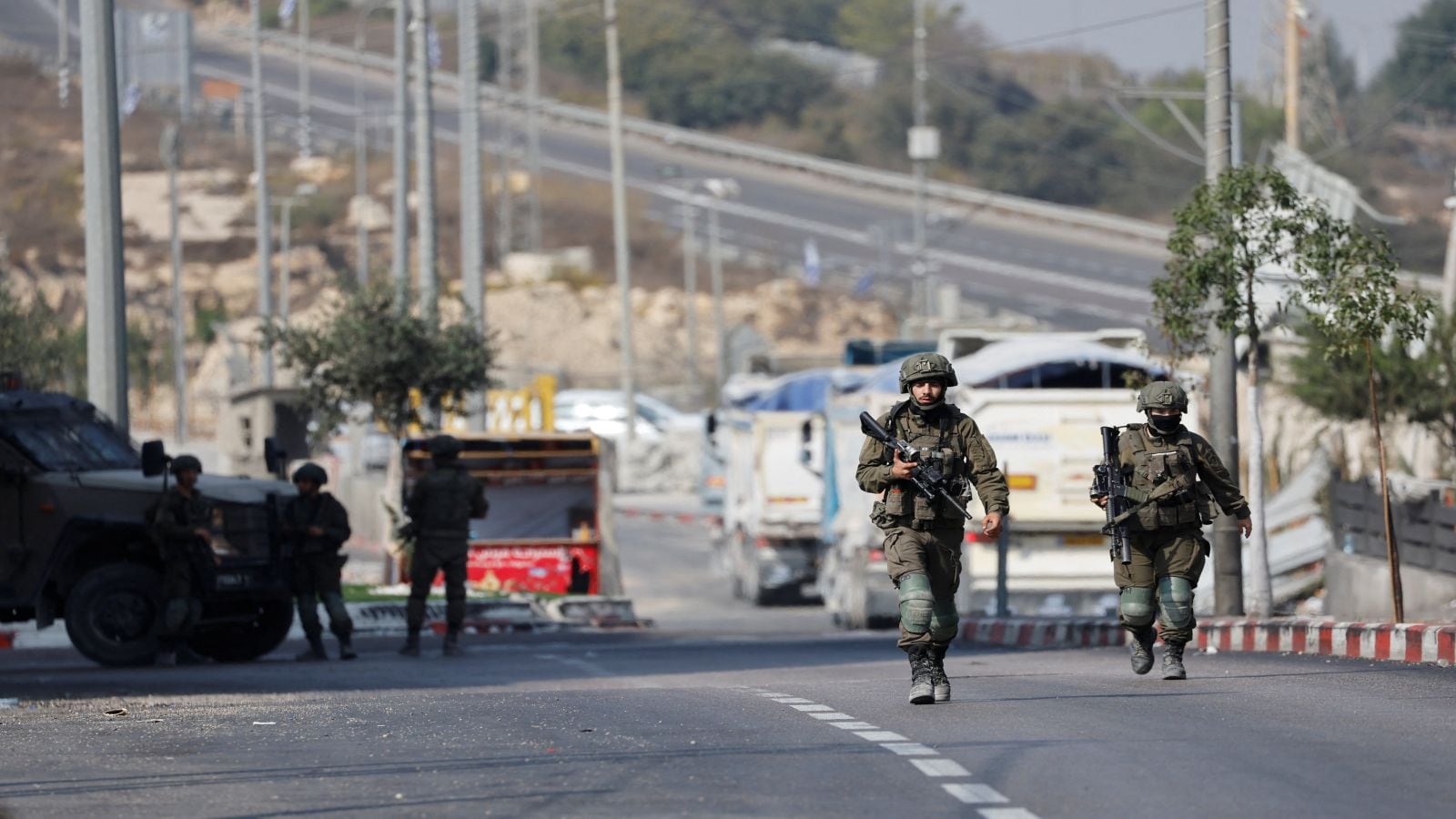
Military operations launched days before a national election are rarely purely tactical; they represent an intersection of kinetic security objectives and domestic political signaling. Following the October 23, 2026 shooting attack in Hebron that killed two Israeli soldiers—Staff Sgt. Ron Yonatan Roytman and Sgt. Yuval Shai Svilem—and wounded three others, the Israel Defense Forces (IDF) initiated a multi-day operation across the occupied West Bank that displaced over 2,000 Palestinians and placed severe movement restrictions on an urban population of 200,000. Standard news coverage frames this event as a linear sequence of attack, retaliation, and electoral timing. A rigorous strategic breakdown reveals a far more complex operational mechanism: the simultaneous execution of spatial sanitization, collective deterrence, and coalition consolidation just days before the October 27 Knesset election.
The Operational Mechanics of Spatial Sanitization
To understand the scale of the Hebron operation, analysts must separate standard counterterrorism raids from territorial restructuring. Traditional search-and-arrest operations in Area H2 of Hebron—where roughly 540,000 Israeli settlers across the broader West Bank and a smaller enclave inside Hebron live under direct IDF protection amid three million Palestinians—typically involve temporary curfews lasting hours. In contrast, the October 2026 offensive introduced structural urban clearance. Discover more on a similar topic: this related article.
The IDF concentrated its heavy engineering assets on the Ein Deir Baha (Deir Bahha) and Farsh al-Hawa neighborhoods, as well as the Al-Jalda district. Rather than merely extracting suspects, military bulldozers flattened entire street corridors and marked residential, commercial, and industrial structures for demolition across an estimated 0.35 square kilometers of dense urban terrain.
This operational shift rests on three distinct tactical pillars: Additional reporting by NPR explores similar perspectives on the subject.
- Line-of-Sight Clearance: By demolishing structures adjacent to the site of the shooting attack and along major transit arteries, military planners eliminate urban cover used by irregular fighters for ambushes and rapid exfiltration.
- Punitive Home Sealing and Demolition: Troops immediately sealed the residences of the two deceased gunmen, Mohammad Jaaba and Firas Jaaba, as a precursor to full demolition. In Israeli security doctrine, this targets the economic and familial support networks of attackers, attempting to raise the personal cost of militancy above the ideological or financial incentives offered by factions like Hamas or Palestinian Islamic Jihad.
- Distributed Sweeps: Simultaneously, the IDF conducted raids across more than 400 locations throughout the West Bank, detaining 40 individuals suspected of militant affiliation. This prevents localized unrest in Hebron from metastasizing into a coordinated, multi-city uprising during the electoral window.
The Economic and Humanitarian Cost Function
When a military apparatus seals all entrances and exits to a major commercial hub for a projected 12-day window, the resulting disruption operates as a systemic economic shock. Hebron is the industrial engine of the southern West Bank, accounting for a disproportionate share of Palestinian manufacturing, stone quarrying, and commerce.
The imposition of a total vehicular blockade forces a reversion to manual logistics. Residents evacuating the 0.35-square-kilometer exclusion zone were barred from taking vehicles, forcing over 2,200 people—including nearly 300 children—to exit on foot. Supply chains for basic commodities immediately fractured; essential goods such as semolina flour and cooking gas canisters had to be manually passed through gaps in closed military gates.
This creates a compounding bottleneck across four civilian systems:
- Labor Immobilization: With arterial roads severed, daily wage laborers and industrial workers cannot reach factories or agricultural plots, halting income generation overnight.
- Commercial Liquidation: Small businesses and industrial workshops within the cordoned zones face both physical destruction from engineering operations and total revenue loss from the blockade.
- Healthcare Friction: Critical medical transit is reduced to pedestrian navigation through checkpoints, delaying acute care and routine treatments for chronic conditions.
- Shelter Deficit: Rapid evacuation orders issued without pre-arranged municipal housing force displaced families into makeshift arrangements or outdoors, straining local municipal capacities already degraded by closed revenue streams.
The Political Economy of Pre-Election Deterrence
Evaluating the timing of this operation requires distinguishing between known operational triggers and educated political hypotheses. The immediate catalyst is an established fact: the October 23 ambush killed two IDF soldiers, bringing the 2026 toll in the West Bank to six Israelis killed alongside 112 Palestinians. Furthermore, imposing a general closure on West Bank crossings during Israeli national elections is standard protocol designed to prevent attacks that could disrupt voting.
The hypothesis among political analysts centers on the intensity and public framing of the response four days prior to the October 27 vote. Prime Minister Benjamin Netanyahu’s governing coalition—anchored by Defense Minister Israel Katz, National Security Minister Itamar Ben-Gvir, and Finance Minister Bezalel Smotrich—entered the final stretch of the campaign facing a referendum on wartime leadership and internal security.
In electoral systems characterized by high security anxiety, incumbent right-wing coalitions face an asymmetric political risk:
- The Cost of Restraint: A measured, covert intelligence response yields low immediate visibility. To a voter base prioritizing deterrence, restraint reads as hesitation, risking voter defection to hardline rivals or abstention among the settler constituency.
- The Yield of Visible Force: High-visibility deployments, rapid infrastructure demolition, and immediate on-site appearances by cabinet ministers at the attack scene generate undeniable proof of executive action. When ministers publicly frame the clearance of neighborhoods as "just the beginning," they convert a tactical military setback into a demonstration of sovereign resolve.
This dynamic aligns with classic diversionary and signaling theories in political science. The military operation satisfies the IDF's tactical requirement to neutralize immediate threats in Hebron while simultaneously fulfilling the political leadership's need to reassure its core electorate that the state will aggressively defend settler communities and project dominance.
Strategic Limitations and Second-Order Risks
While high-intensity urban clearance and collective closures achieve short-term tactical suppression and immediate electoral signaling, they carry severe structural limitations over a medium-to-long-term horizon. Practitioners of counterinsurgency recognize that kinetic dominance rarely resolves underlying operational vulnerabilities.
First, deterrence exhibits diminishing marginal returns. Punitive demolitions and mass displacement inflict acute material pain, yet empirical studies of asymmetric conflicts consistently show that collective economic hardship and property destruction accelerate radicalization among unaligned youth. By flattening commercial districts and displacing thousands of non-combatants, the state expands the recruitment pool for militant factions, trading short-term quiet for long-term insurgency regeneration.
Second, the Hebron friction model is structurally unstable. Hebron remains the only West Bank city where Israeli settlers reside directly inside a dense Palestinian urban core under military guard. Maintaining security in this environment requires continuous, manpower-intensive troop deployments. Expanding buffer zones through demolition temporarily widens the defensive perimeter, but it simultaneously increases the surface area that IDF units must patrol and defend against future infiltration.
Third, economic asphyxiation erodes institutional stability. Prolonged closures paralyze the Palestinian Authority’s local administrative and security capacities in the southern West Bank. When municipal governance collapses under the weight of a 12-day blockade and business closures, informal militant networks step into the vacuum to provide basic aid and social order, further weakening the institutional interlocutors required to maintain baseline stability.
Operational Trajectory Post-Election
Once the October 27 election concludes and the immediate requirement for high-visibility political signaling subsides, the operational posture in the West Bank will undergo a predictable recalibration. Regardless of the final Knesset coalition arithmetic, security planners will transition away from broad, resource-draining urban blockades toward targeted, intelligence-driven raids to conserve troop readiness for multi-front commitments.
In Hebron specifically, the physical alterations to the urban grid in Ein Deir Baha and Farsh al-Hawa will become permanent features of the security architecture. The cleared corridors will be converted into militarized buffer zones and restricted access routes, permanently shrinking the contiguous urban space available to the Palestinian population while institutionalizing the heightened friction between the two communities.