The Structural Shift in Cross-Strait Indirect Fire
The People’s Liberation Army (PLA) Ground Force has historically occupied a secondary role in Beijing’s Taiwan Strait contingency planning. Traditional invasion calculus assigned the primary fires responsibility to the PLA Rocket Force (PLARF) for short-range ballistic missile strikes, complemented by the PLA Navy (PLAN) and PLA Air Force (PLAAF) for littoral blockade and air superiority. This operational dynamic changed fundamentally with the operational fielding of the PCH191 (PHL-16) modular multiple rocket launcher (MRL) system.
The integration of long-range, high-precision rocket artillery into the PLA Ground Force's 72nd and 73rd Group Armies alters the cost-per-round equation, the density of saturation fires, and the survivability of Taiwanese defensive infrastructure. Rather than relying on expensive, production-constrained ballistic missiles to suppress point targets, Beijing now possesses a high-volume, low-unit-cost strike engine capable of blanketing Taiwan’s western coast directly from China's mainland. Recently making waves lately: The Silent War on the World Table.
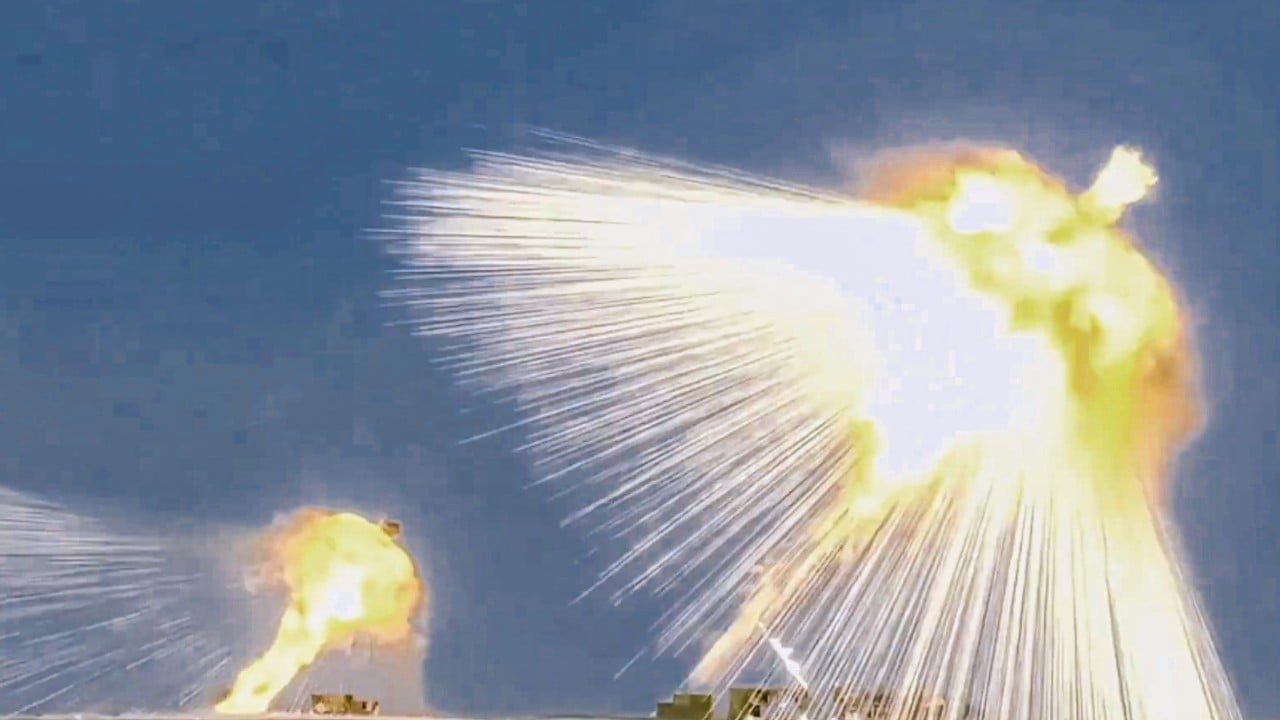
Understanding the operational threat posed by these systems—specifically their deployment with airburst and submunition warheads, frequently referenced in military disclosures as "Steel Rain"—requires deconstructing the mechanics of the platform, the physics of its munitions, and its place within the PLA's joint kill chain.
Technical Deconstruction: The PHL-191 Platform
The PHL-191 represents a shift from fixed-tubed, single-caliber launch systems like the legacy PHL-03 to a modular, rapidly reconfigurable truck-mounted architecture. Mounted on an $8\times8$ heavy off-road chassis, the platform combines rapid maneuverability with multi-caliber strike capabilities. Further details on this are detailed by The New York Times.
                                [ PHL-191 Base Chassis ]
                                           │
                    ┌──────────────────────┴──────────────────────┐
                    ▼                                             ▼
       [ 2 x 5-Cell 300mm Pods ]                     [ 2 x 4-Cell 370mm Pods ]
                    │                                             │
      Range: ~130-150 km                             Range: ~280-350+ km
   Payload: HE / Cluster / Airburst              Payload: "Fire Dragon 280" Guided
The core operational advantage of the system stems from its two interchangeable launch pods:
- 300mm Guided Rockets: Configured in two five-cell pods (10 rockets total), offering effective engagement ranges between 130 km and 150 km.
- 370mm Guided Rockets: Configured in two four-cell pods (8 rockets total), such as the "Fire Dragon 280," extending the operational range to between 280 km and 350+ km.
- 750mm Tactical Ballistic Missiles: Configured in two single-cell pods, capable of deploying platforms like the Fire Dragon 480 for operational-depth strikes exceeding 400 km.
By operating from firing positions in Fujian province, such as Pingtan Island, the 370mm configuration allows the PLA Ground Force to strike deep into Taiwanese territory without deploying launcher units off the mainland. The geographic width of the Taiwan Strait varies between 130 km at its narrowest point to roughly 180 km. Consequently, the entire western coastline of Taiwan—containing its highest concentration of air defense batteries, radar stations, staging areas, and command nodes—falls well within the engagement envelope of 370mm strike units.
Mechanics of "Steel Rain": Airburst Fragmentation vs. Hardened Enclosures
The term "Steel Rain" refers to the operational deployment of specialized warhead payloads designed for wide-area lethality rather than point penetration. These warheads utilize dual-mode fuze systems—combining millimeter-wave radar altimetry with satellite-assisted inertial navigation—to detonate at predetermined altitudes above target arrays.
Dispersion Dynamics and Target Optimization
Upon reaching a pre-programmed altitude (typically 15 to 30 meters above ground level), the warhead casing ruptures. It disperses thousands of high-density tungsten-alloy sub-projectiles or pre-formed fragments across a wide horizontal footprint.
$$\text{Kill Area} \propto h \cdot \tan\left(\frac{\theta}{2}\right)$$
Where $h$ represents detonation altitude and $\theta$ represents the spread angle of the fragmented casing. By calibrating $h$, the system optimizes fragment density per square meter relative to the target type.
                     [ Warhead Airburst Detonation ]
                                  │  (Altitude: ~15-30m)
            ┌─────────────────────┼─────────────────────┐
            ▼                     ▼                     ▼
     [ Dense Fragment ]    [ Dense Fragment ]    [ Dense Fragment ]
            │                     │                     │
            ▼                     ▼                     ▼
  [ Soft Targets / Radar ]  [ Light Armor / C2 ]  [ Exposed SAM Sites ]
This warhead configuration enforces a strict functional specialization:
- Optimized Against Unshielded Infrastructure: Mobile radar arrays (e.g., AN/TPS-117, Patriot radar sets), exposed communication nodes, soft-skinned transport vehicles, and unarmored fuel or ammunition staging points.
- Ineffective Against Deep Enclosures: Underground command centers, reinforced concrete aircraft shelters, and deeply buried communications lines.
The PLA's strategy does not rely on these airburst rockets to destroy hardened bunkers. Instead, the objective is rapid operational degradation: stripping away the delicate sensor suites, radar dishes, and communication masts that allow hardened facilities to direct air defenses or coordinate ground maneuvers.
The Economics of Fires: Rocket Artillery vs. Ballistic Missiles
Strategic analysis frequently conflates long-range rocket artillery with tactical ballistic missiles. However, the operational distinction lies in the economic cost function of volume fires.
+------------------------+-----------------------+------------------------+
| Metric                 | PLARF Ballistic       | PLAGF PHL-191          |
|                        | Missiles (DF-11/15)   | 370mm Guided Rocket    |
+------------------------+-----------------------+------------------------+
| Est. Unit Cost         | $1.0M - $2.5M         | $100K - $250K          |
| Reload Time            | High (Hours)          | Low (Modular Swaps)    |
| Volumetric Rate        | Low (Single/Dual)     | High (8 Rounds/Vehicle)|
| Interception Difficulty| High (Exo/Endo-Atmo)  | Moderate (Saturation)  |
| Primary Role           | High-Value Deep Strike| Soft-Target Area Deny  |
+------------------------+-----------------------+------------------------+
The fundamental bottleneck in any missile-driven suppression campaign is inventory depletion. Ballistic missiles like the DF-11A or DF-15B possess heavy warheads and high terminal velocity, but their replacement rate is throttled by high production costs and complex manufacturing processes.
The PHL-191 solves this inventory constraint. By leveraging solid-propellant artillery rockets guided by Beidou satellite navigation combined with onboard inertial guidance, the PLA achieves near-ballistic precision at a fraction of the cost per launch. This economic efficiency enables the PLA Ground Force to execute high-volume saturation strikes, forcing defensive surface-to-air missile (SAM) batteries to either deplete high-cost interceptors (e.g., PAC-3, TK-3) or absorb widespread fragment damage to their primary sensors.
Sensor-to-Shooter Integration: The Networked Kill Chain
A long-range rocket system is only as effective as its target acquisition architecture. The operational threat of the PHL-191 does not exist in isolation; it is integrated into a multi-domain intelligence, surveillance, and reconnaissance (ISR) loop.
  [ Overhead Satellites / High-Alt UAVs ]
                    │
                    ▼
       [ Real-Time Target Data ]
                    │
                    ▼
     [ PHL-191 Battery Fire Command ] ──(Shoot-and-Scoot)──► [ Immediate Relocation ]
                    │
                    ▼
        [ Mid-Flight Guidance ]
     (Inertial + Beidou Correction)
                    │
                    ▼
     [ Target Area Airburst Detonation ]
                    │
                    ▼
  [ Medium-Altitude BDA Drone Relay ] ──(Feedback Loop)───► [ Retargeting / Fire Adjustment ]
- Target Acquisition: High-altitude, long-endurance (HALE) reconnaissance drones (e.g., WZ-7) and satellite constellations feed real-time coordinates of mobile Taiwanese radar installations to mainland fire-control nodes.
- Firing Sequence: A PHL-191 battery fires a coordinated salvo of 370mm rockets utilizing composite Beidou/INS guidance. The launcher vehicles utilize automated pod loading, allowing rapid setup, launch, and stowage sequences.
- Survivability Mechanics: Operating on an $8\times8$ wheeled chassis with road speeds between 60 to 80 km/h, the battery executes a shoot-and-scoot maneuver immediately post-launch. This compresses the window for Taiwanese counter-battery fire to near zero.
- Terminal Adjustment & Battle Damage Assessment (BDA): Tactical drones operating in the littoral zone transmit live video feeds back to battery commanders, allowing real-time assessment of warhead dispersion and rapid decisions regarding re-engagement.
Defensive Countermeasures and Systemic Vulnerabilities
While the PHL-191 expands the PLA's strike capabilities, it introduces operational trade-offs and remains vulnerable to specific asymmetric countermeasures.
Physical and Electronic Limitations
- GPS/GNSS Jamming: The precision of Beidou-guided rockets degrades when subjected to dense electronic warfare (EW) environments. If satellite link signals are blocked or spoofed, the rocket falls back on its internal inertial navigation system (INS), causing circular error probable (CEP) values to drift significantly over a 200 km+ trajectory.
- Logistical Vulnerability: Podded launcher reloading requires specialized crane-equipped resupply vehicles. Resupply convoys moving along coastal highways in Fujian present recognizable heat and optical signatures for standoff reconnaissance assets.
- Terrain Masking: Taiwan’s Central Mountain Range creates significant elevation shading. Low-altitude airburst weapons fired from the mainland operate on flat ballistic trajectories, preventing them from effectively hitting targets entrenched on the eastern slopes of the island without high-angle terminal trajectories.
Strategic Mitigation Framework for Defensive Forces
To counter high-volume rocket saturation, defensive doctrine must shift away from static interception and focus on structural resilience:
- Passive Decoys and Radar Signature Spoofing: Deploying low-cost inflatable radar reflectors and radio-frequency emitters creates false target arrays, forcing the PLA to waste rocket salvos on non-critical targets.
- Hardened Mobility Systems: Transit routes for mobile SAM radars must incorporate rapid, overhead reinforced shelters along patrol corridors to protect sensor arrays from overhead fragment showers.
- Distributed Sensor Architectures: Replacing large, centralized long-range radar arrays with networked networks of smaller, low-cost sensors ensures that the destruction of a single node does not blind the entire air defense sector.
The Strategic Playbook
The deployment of long-range modular rocket artillery fundamentally shifts the initial phases of a cross-Strait conflict. Defensive forces can no longer treat mainland artillery as a secondary threat confined to close-support operations.
To survive the opening hours of an indirect-fires campaign, defensive force postures must adapt along three operational lines:
- Divorce Air Defense from Fixed Radar Assets: Transition immediately to passive infrared, passive coherent location, and distributed off-board radar emitters. An air defense system reliant on high-power emission from a static location will be targeted by 370mm airburst saturation within minutes of activating its radar.
- Amplify Electronic Warfare along the Coastline: Deploy high-power, broadband directional jammers targeted at the Beidou satellite frequencies along the western ridge lines. Forcing PLA rockets onto pure INS guidance degrades their accuracy enough to reduce the lethality of airburst fragment patterns against point targets.
- Prioritize Mobile Counter-C2 Assets: Allocate long-range precision fires specifically to target the command-and-control nodes and reload vehicles supporting PLA MRL units. Suppressing the reloading logistics cycle restricts PHL-191 batteries to a single salvo, eliminating their ability to maintain continuous saturation fire over critical littoral zones.

/https://i.s3.glbimg.com/v1/AUTH_e84042ef78cb4708aeebdf1c68c6cbd6/internal_photos/bs/2026/g/B/3vpkvHQKizRKAfzDxjXA/vini-jr-antes-e-depois.jpg)