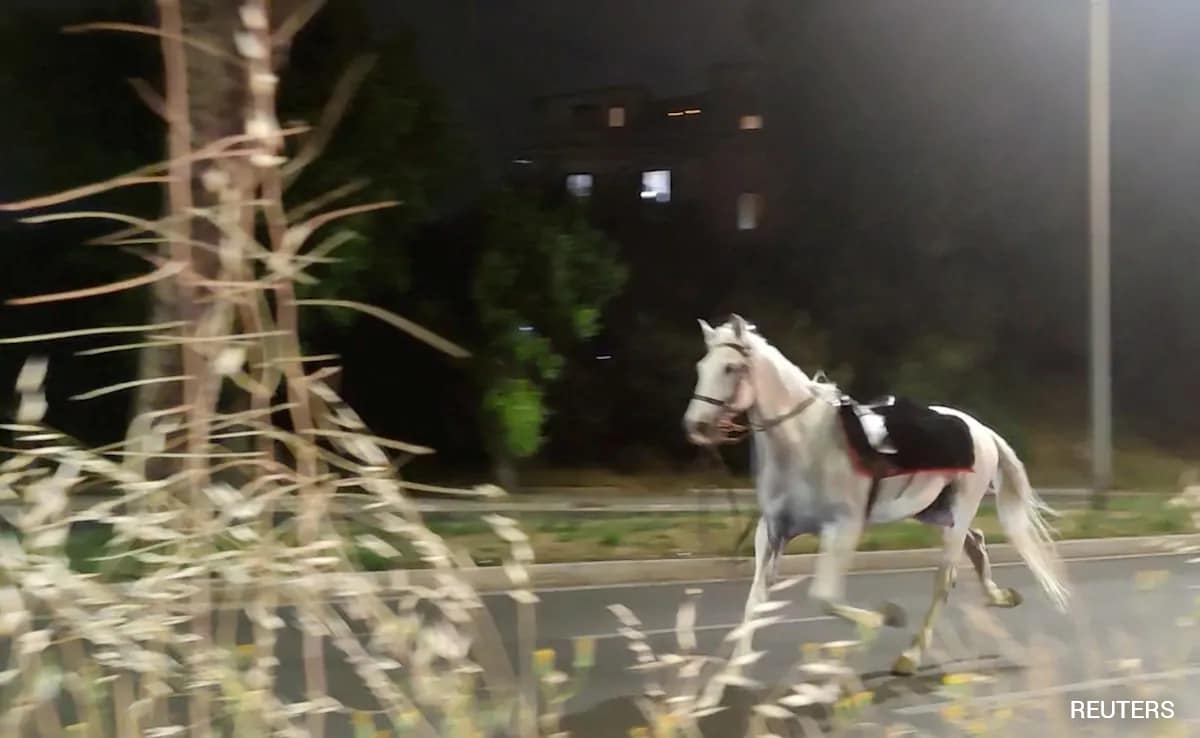
A high-reliability organizational structure fails not when an individual commits an error, but when institutional safeguards fail to isolate that error. The late-night stampede of approximately 35 ceremonial military and police horses through central Rome on May 29, 2026, exposes a critical vulnerability in the coordination of large-scale civic events. While initial public accounts focused heavily on the sensational nature of animals galloping down Via Cristoforo Colombo, a rigorous operational audit reveals a multi-tiered failure in risk mitigation, proximity zoning, and chain-of-command enforcement.
The incident occurred at approximately 11:30 p.m. near the ancient Baths of Caracalla during a rehearsal for the June 2 Republic Day parade, marking the 80th anniversary of the Italian Republic. The acute trigger was a battery of fireworks ignited by an off-duty municipal traffic policeman roughly 200 meters from the mounted units. The resulting cascade of kinetic energy—spanning a 14-kilometer flight path that lasted until dawn—provides a clear case study in how uncoordinated actions within parallel state agencies can bypass established safety protocols.
The Cascading Vulnerability Framework
Equestrian assets in urban environments operate under a continuous baseline of managed stress. While ceremonial mounted units from the Italian Army, Carabinieri, and municipal police undergo desensitization training, their behavioral psychology remains governed by a prey-animal survival mechanism. When analyzing this systemic failure, the events must be categorized into three distinct operational phases: the proximity breach, the formation rupture, and the containment lag.
1. The Proximity Breach
The primary failure occurred at the boundary layer of the rehearsal perimeter. A municipal traffic officer, operating entirely outside his authorized mandate, ignited a commercial fireworks battery 200 meters from the staging grounds. In urban acoustics, a 200-meter radius offers zero structural dampening for explosive concussions. The baseline decibel level of standard commercial fireworks ranges between 150 and 175 decibels ($dB$). For context, acoustic trauma in equines can be triggered by sudden impulses exceeding 140 dB.
Because the ignition point occurred inside a dense urban corridor, the sound waves reflected off nearby stone structures, amplifying the perceived intensity and neutralizing the directional orientation of the animals. This represents a failure in perimeter sterilization; parallel state agencies operating in the same geographic quadrant lacked a unified command structure to restrict hazardous activities in adjacent zones.
2. The Formation Rupture
The second failure point lies within the handling mechanics during non-active rehearsal phases. At the moment of detonation, some horses were mounted, while handlers held others by hand near temporary stables at the Imperial Forums. This created a dual failure mode:
- Mounted Uncoupling: The sudden acoustic shock induced immediate panic. Several riders were unseated instantaneously by lateral horse movements. A 22-year-old soldier suffered a punctured lung and broken ribs from the kinetic impact of the fall. Once a rider is unseated, the horse transitions from a guided asset to an autonomous hazard.
- Manual Tether Failure: Handlers holding horses by lead ropes face an impossible mechanical disadvantage when an 1,100-pound animal shifts into flight mode. The sudden jerk easily overcomes human grip strength, leading to a chain-reaction stampede as loose horses triggered the flight instinct in nearby tethered animals.
3. The Containment Lag
Once the herd breached the immediate perimeter, they entered Via Cristoforo Colombo, a major arterial highway leading toward Ostia. The spatial dispersion of the animals highlights a major gap in contingency planning: the absence of secondary containment barriers. The herd traveled a total distance of 14 kilometers, with the final animal not secured until dawn.
The duration of this recovery phase indicates that municipal police and military handlers lacked a pre-staged, mobile containment strategy for loose animals. Recovery relied on reactive roadblocks and ad-hoc tracking by law enforcement vehicles, prolonging public risk and increasing the duration of exposure for the animals.
Quantification of the Damage Matrix
While the event yielded no human fatalities, the operational and material toll was substantial. Evaluating the incident requires examining the specific data points of the fallout:
| Impact Metric | Quantified Asset Toll | Operational Implication |
|---|---|---|
| Human Casualties | 4 wounded (1 severe: punctured lung/broken ribs) | Loss of active-duty military personnel; immediate medical liability. |
| Equine Casualties | 15 horses injured (lacerations, soft-tissue trauma) | Temporary decommissioning of 43% of the active rehearsal herd; extensive veterinary intervention required. |
| Spatial Footprint | 14-kilometer flight corridor | Extended disruption of municipal infrastructure; multiple civilian vehicle impacts. |
| Temporal Duration | ~6.5 hours (11:30 p.m. to dawn) | Prolonged deployment of emergency services and Special Investigations units (Digos). |
The fact that 15 horses suffered injuries without requiring euthanasia is an indicator of favorable road conditions and low late-night traffic density, rather than an effective containment design. The economic cost of veterinary rehabilitation, damaged civilian vehicles, and lost operational hours represents a significant unbudgeted deficit for the municipal and military departments involved.
Institutional Fallout and Governance Erosion
The strategic consequence of this incident extends beyond physical asset damage. Mario De Sclavis, commander of Rome's police force, explicitly noted that the event discredits the operational integrity of the municipal corps. This acknowledgment highlights a deeper governance issue: the breakdown of internal discipline within public safety agencies.
When an officer from a traffic emergency unit operates with such complete disregard for ongoing military rehearsals in the immediate vicinity, it uncovers a dangerous silo effect. The Italian Special Investigations unit (Digos) immediately assumed jurisdiction over the case, identifying the responsible individuals and initiating disciplinary and criminal reviews.
This level of investigation indicates that the state is treating the event not as a minor nuisance, but as a serious breach of public safety protocol. The core issue is an absence of cross-agency communication; the traffic department had no real-time operational visibility into the high-risk military staging occurring just meters away, allowing a single actor to disrupt a national holiday preparation.
Structural Safeguards for Ceremonial Operations
To prevent a recurrence of the Rome system failure, future high-profile civic events involving livestock must implement a zero-trust staging protocol. Relying on an animal's desensitization training is a flawed strategy when faced with uncoordinated human variables.
First, tactical perimeters must be established using a multi-tiered zoning model. The inner tier, where animals are staged or rehearsed, requires a 500-meter acoustic buffer zone. This buffer must be legally cleared and actively patrolled by joint military-municipal security teams to prevent the unauthorized use of pyrotechnics, construction equipment, or loud machinery. Parallel agencies operating in the municipality must submit all local deployment plans to a centralized command unit to eliminate conflicting operations.
Second, the structural design of temporary stables must change. Open-air tethering lines or flimsy temporary pens provide insufficient containment during an acoustic panic. Staging areas require perimeter fencing capable of breaking the kinetic momentum of a fleeing herd. If a horse breaks free from its handler, it must be contained within a secondary secure compound rather than having immediate access to open public highways.
Finally, mobile containment teams equipped with tranquilization assets, trailer transport, and specialized herding vehicles must be stationed at key choke points along the parade route. Relying on standard patrol cars to chase loose horses down an open highway introduces severe risks to civilian drivers and worsens the animals' panic. Secure, pre-planned intercept zones must be mapped out before any animal sets foot on the pavement. The Rome stampede should serve as a clear warning to city planners worldwide: without strict cross-agency coordination and rigid containment architecture, ceremonial traditions can instantly transform into severe public safety liabilities.