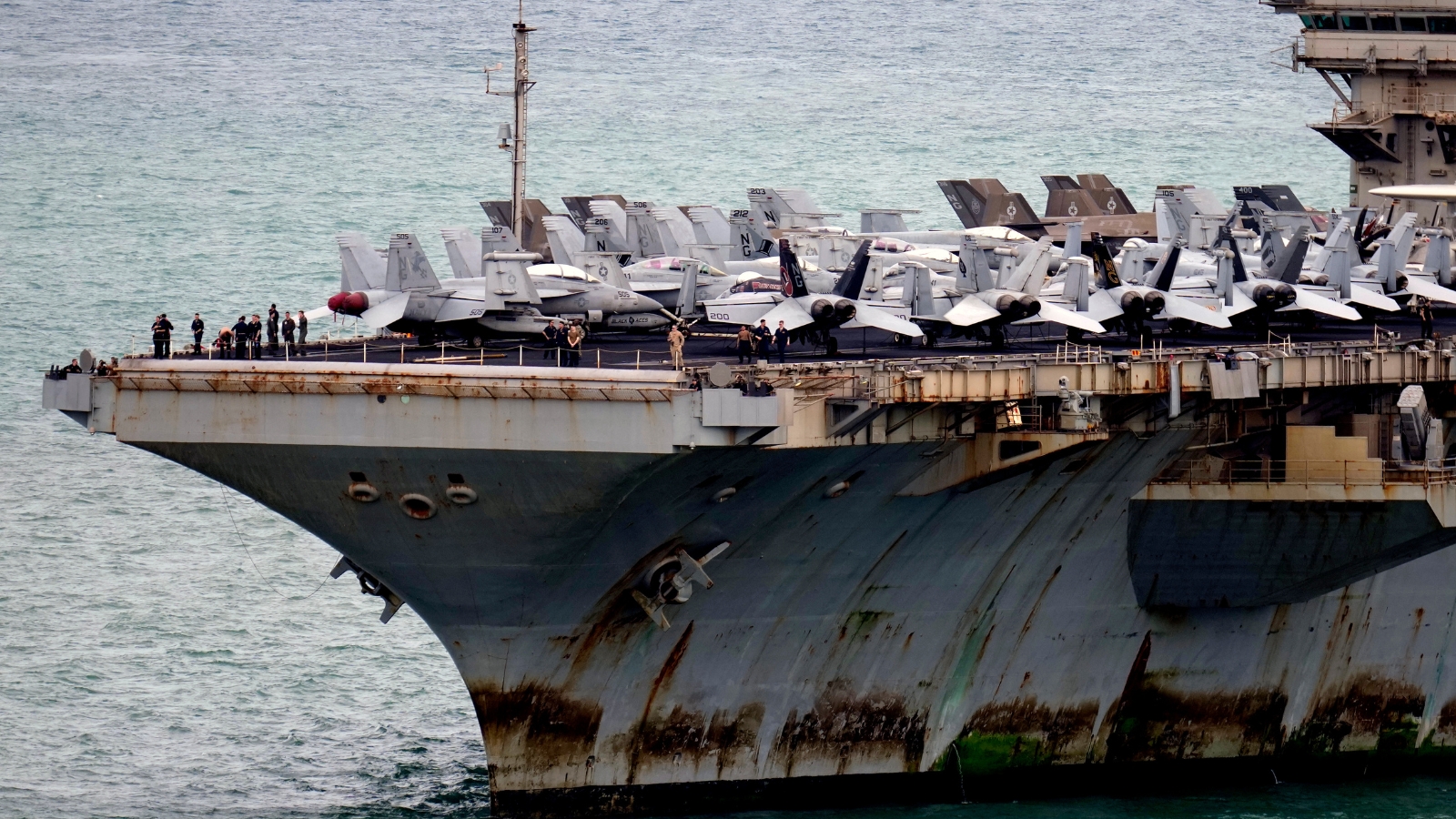
Extended aircraft carrier deployments do not merely strain military budgets; they alter the structural integrity of strategic assets. When the USS Abraham Lincoln completed an unprecedented operational cycle spanning nearly ten months away from homeport, mainstream reporting focused heavily on visible corrosion and the immediate psychological fatigue of the crew. Observers expressed shock at rusted flight decks and oxidized hull plating, treating these symptoms as anomalies.
This surface-level assessment misses the core operational reality. Visible rust and extended timelines are symptoms of a systemic mismatch between force demand and industrial capacity. To understand why modern nuclear-powered aircraft carriers experience accelerated material degradation during prolonged deployments, one must analyze the intersection of marine environmental chemistry, maintenance deferral economics, and force generation mathematics. For another view, consider: this related article.
The Marine Environment and Material Degradation Mechanics
Saltwater environments present a relentless corrosive challenge to high-strength naval steels. The rate of structural oxidation on a Nimitz-class carrier is a function of exposure time, surface coating integrity, and localized galvanic activity.
The Chemistry of Oxidation
When ferrous metals encounter aqueous sodium chloride environments, an electrochemical cell forms. Iron acts as the anode, losing electrons, while dissolved oxygen at the cathode facilitates reduction reactions. The presence of marine salts accelerates this process by increasing electrolyte conductivity. During standard operational tempos, routine maintenance windows allow crews to apply preservative coatings, wash down superstructures with fresh water, and spot-treat localized corrosion before it compromises structural margins. Related analysis regarding this has been published by Al Jazeera.
The Maintenance Deficit
When a deployment stretches past traditional six-month thresholds, preventive maintenance routines defer. The shipboard engineering department shifts from proactive corrosion mitigation to reactive damage control and critical system preservation.
- Coating Degradation: Epoxy and polyurethane paint systems degrade under constant ultraviolet radiation, thermal cycling, and high-velocity salt spray. Once a coating breaches, sub-surface creep corrosion undermines adjacent paint layers.
- Mechanical Stress: Flight deck operations subject structural steel to continuous thermal shocks from jet engine exhaust and high mechanical impact from arrested landings. Without scheduled touch-ups, micro-fissures widen.
- Anodic Protection Failures: Sacrificial zinc anodes, designed to corrode preferentially and protect the hull, exhaust their mass far ahead of scheduled dry-dock intervals during extended deployments.
The Economic Cost Function of Extended Rotations
Military planners weigh the financial cost of extended deployments against the political cost of generating fewer carrier strike groups overseas. However, standard accounting fails to capture the non-linear cost escalation associated with pushing hardware past design thresholds.
Deferred Liabilities versus Immediate Savings
Keeping a single strike group on station avoids the massive transit fuel and operational overhead required to execute a relief-in-place rotation. On paper, extending a deployment reduces near-term deployment frequency and saves transit capital.
Yet, this creates a severe capital liability downstream. Deferred maintenance compounds exponentially. A minor coat-and-paint job neglected at sea transforms into a structural plate replacement evolution during a depot-level maintenance availability.
The Depot Bottleneck
Naval shipyards operate under strict scheduling and workforce constraints. When a vessel returns from an extended deployment with compounded material damage, it occupies dry-dock space longer than planned. This delays the maintenance start dates for subsequent hulls in the fleet rotation, creating a cascading bottleneck. The United States Navy's public shipyards face documented backlogs, meaning that unexpected hull repairs caused by extended deployments directly cannibalize the schedule of the entire fleet.
Force Generation Mathematics and Operational Burnout
The deployment length of a capital ship is governed by a strict lifecycle model known as the Optimized Fleet Response Plan. This framework balances maintenance, basic training, integrated phase, deployment, and sustainment.
The Breakdown of the Cycle
The fundamental equation of naval readiness relies on predictable periodicity. When a deployment is extended from six months to nine or ten months, the subsequent reset and training phases are compressed to maintain the overarching rotational schedule.
- Training Compression: Crews returning late from extended deployments miss vital joint-exercise windows and advanced certification milestones.
- Equipment Overuse: Mechanical components, from catapult steam valves to nuclear reactor secondary systems, accumulate run-hours beyond manufacturer-recommended overhaul thresholds.
- Personnel Retention Loss: Predictability drives military retention. Unannounced extensions disrupt family planning, leading to a loss of experienced mid-grade technicians and officers whose specialized skills cannot be rapidly replaced.
The Strategic Trade-Off
Deploying a carrier for 286 days signals resolve to allies and adversaries alike, but it sacrifices future capability for present visibility. The strategic cost is measured in reduced surge capacity. If multiple hulls are tied up in extended refits due to accelerated wear, the total number of operational platforms available for a sudden crisis shrinks.
Strategic Recommendation
To arrest the degradation of naval operational capacity, military leadership must decouple political signaling from hardware management. The solution requires institutionalizing hard caps on deployment lengths that account for material degradation limits rather than diplomatic convenience.
Procurement strategies must also adapt by integrating advanced autonomous corrosion-monitoring sensors and robotic hull-maintenance systems capable of performing preservative upkeep while the vessel remains underway. By shifting from reactive structural remediation to continuous automated sustainment, naval forces can preserve capital integrity without compromising global presence.


