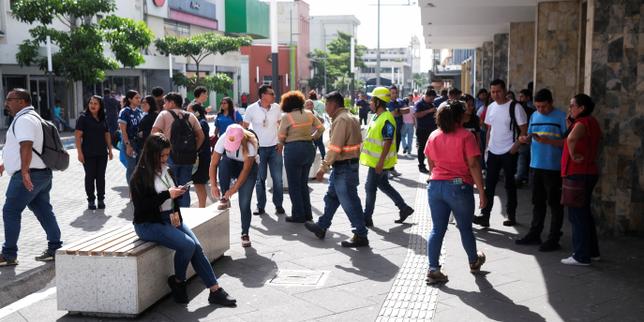
Seismic risk mitigation is dictated by a brutal mathematical reality: a major earthquake's destructive capacity is governed not just by its raw magnitude, but by the precise intersection of focal depth, tectonic geometry, and regional structural engineering standards. The 7.3 magnitude earthquake that struck off the Pacific coast of Chiapas, Mexico, serves as a textbook study of this structural framework. Located near the town of Aquiles Serdán, approximately 48 kilometers offshore, the event triggered immediate tsunami alerts and widespread panic across southern Mexico, Guatemala, and El Salvador. Yet, despite the formidable energy release inherent to a 7.3 magnitude event, initial assessments reported zero fatalities and negligible structural failures.
Understanding this paradox requires moving past superficial media descriptions of "violent shaking." The survivability of this specific event is explained through the mechanics of subduction zone physics and the operational execution of modern early warning systems. In other updates, we also covered: The Gilded Cage in New Delhi and the Long Memory of Dhaka.
The Tectonic Triumvirate: Cocos, Caribbean, and North American Plates
Mexico sits atop a highly volatile tectonic junction where five major lithospheric plates interact. The southern region, specifically off the coast of Chiapas, represents a high-velocity convergence zone where the dense oceanic Cocos plate subducts beneath the continental North American and Caribbean plates.
                       [North American Plate] / [Caribbean Plate]
                                     ^
                                     |  (Overriding Continental Crust)
=====================================|====================================
    \  (Subduction Trench)
     \
      \   <- 18 km Hypocenter (Focal Depth)
       \
        v  [Cocos Plate] (Oceanic Crust - Downgoing Slab)
The July 2026 event was characterized by an shallow thrust fault mechanism along this subduction interface. The dynamics of this rupture are defined by three distinct physical parameters: The Washington Post has provided coverage on this critical issue in great detail.
- Hypocentral Depth constraints: The United States Geological Survey (USGS) localized the hypocenter at a shallow depth of approximately 15 to 18 kilometers. While shallow earthquakes typically maximize ground acceleration at the surface, an offshore location shifts the peak acceleration away from highly populated municipal centers.
- The Logarithmic Scale of Energy: A 7.3 magnitude rupture is not a linear increase from lower-magnitude tremors. The moment magnitude scale ($M_w$) is logarithmic; a 7.3 event releases roughly 32 times more energy than a 6.3 earthquake, and 1,000 times more than a 5.3 event. The mainshock generated an energetic displacement that was felt over an 800-kilometer radius, extending all the way to Mexico City.
- Aftershock Frequency Decay: In accordance with Omori’s Law, the primary rupture was followed by an immediate sequence of over 30 aftershocks, with the largest registering magnitudes between 5.3 and 6.8. These secondary events represent the lithospheric stress redistribution along the damaged fault plane.
Hydrodynamic Displacement: Dissecting the Tsunami Threat Matrix
The immediate secondary threat of any marine megathrust event is the vertical displacement of the water column. Because the earthquake ruptured shallowly beneath the ocean floor, the National Oceanic and Atmospheric Administration (NOAA) and the U.S. Tsunami Warning System instantly activated a hazard advisory for coastlines within a 300-kilometer radius of the epicenter.
The physics of tsunami generation depend heavily on vertical seafloor displacement. Horizontal strike-slip faults rarely trigger massive tsunamis because they slide laterally. Thrust faults, however, physically thrust the ocean floor upward or downward.
The Chiapas event presented a specific hydrodynamic profile:
$$Tsunami\ Wave\ Amplitude \propto \Delta z_{seafloor}$$
The local Civil Protection authorities in Chiapas warned of sea-level fluctuations of roughly 0.3 to 1.1 meters above normal tide levels. Mexico’s Navy Secretary, Raymundo Morales, confirmed that the measured surge did not exceed 0.5 meters in critical port areas. Because the vertical slip component ($\Delta z$) of the fault rupture was constrained, the energy was insufficient to generate a destructive deep-ocean wave train. The tsunami threat was officially terminated within three hours of the mainshock.
The Early Warning Arbitrage: Decoupling Wave Velocities
The absence of mass casualties during a major seismic event in a developing economy is rarely a matter of luck. It is an engineering achievement rooted in the physics of wave propagation and the exploitation of electronic communication speeds.
Earthquakes release energy through different types of seismic waves. The primary waves (P-waves) are compressional waves that travel the fastest through the Earth's crust, but carry relatively little destructive energy. The secondary waves (S-waves) and surface waves travel much slower but cause the severe horizontal and vertical ground displacements responsible for structural collapse.
[ Epicenter ] -----------------------------> ( Seismic Sensors )
                    P-Wave: Fast / Low Energy
                    S-Wave: Slow / High Energy  ==========> [ Destructive Front ]

                    Data Transmission: Speed of Light ====> [ SASMEX Alerts Population ]
Mexico's seismic alert system, SASMEX (Sistema de Alerta Sísmica Mexicano), utilizes a network of sensors along the Pacific coast to detect the initial, non-destructive P-waves of an offshore event. Because electronic data travels at the speed of light, the system transmits a digital warning to major urban centers well ahead of the arriving S-wave front.
For residents in Tuxtla Gutiérrez (the capital of Chiapas) and neighboring Oaxaca, this alert provided a vital window of several seconds to a minute to evacuate high-rise structures via emergency stairwells. In Mexico City, located hundreds of kilometers away, the buffer window extended even further, allowing precautionary evacuations of high-density commercial office buildings before the low-frequency surface waves could induce resonance in tall structures.
Structural Resilience Limits and Institutional Protocols
The minimal damage reported by President Claudia Sheinbaum’s administration highlights a significant divergence from historic disasters, such as the catastrophic 1985 and 2017 Mexican earthquakes. This resilience is due to strict evolutionary updates made to the Mexican building codes (Reglamento de Construcciones para el Distrito Federal and regional equivalents) over the past four decades.
Modern Mexican engineering mandates:
- Ductility Requirements: Structures must be engineered to deform plastically and absorb seismic energy without sudden brittle failures of load-bearing columns.
- Soil-Structure Resonance Mitigation: Foundation designs must account for localized soil profiles, particularly the soft lacustrine clay beds of Mexico City, to prevent the soil from amplifying incoming seismic frequencies.
The primary vulnerability during the Chiapas event was confined to psychological panic and non-structural damage, such as broken glass, fallen ceiling tiles, and superficial masonry cracking in older, unreinforced adobe or brick structures common near the Guatemala-Mexico border.
The ultimate strategic reality revealed by the Chiapas event is that seismic defense cannot rely on a single defensive layer. Total resilience requires a tightly linked triad consisting of real-time sensor arrays, strict enforcement of geotechnical building regulations, and institutionalized public evacuation protocols. Municipalities operating near active subduction zones must view this event not as a lucky escape, but as a validation of rigorous physical engineering over passive crisis management.