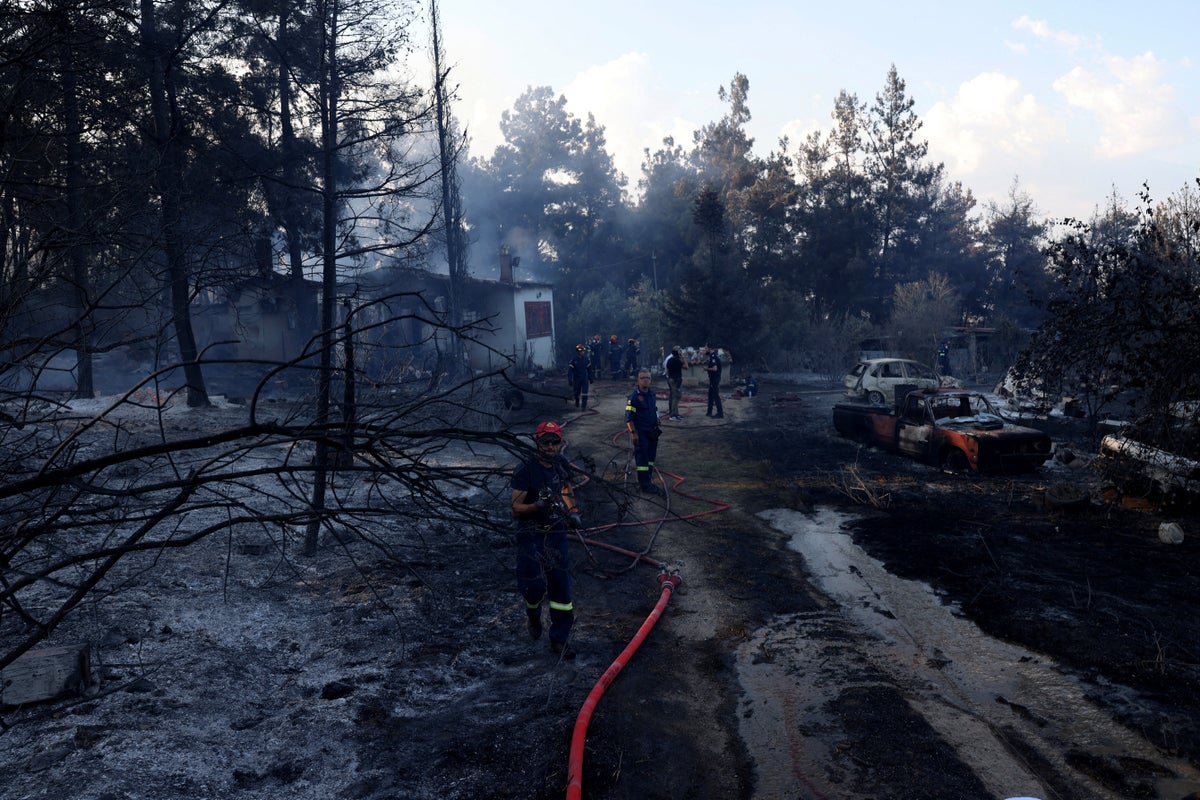
The escalating wildfire crisis in Greece and across southern Europe is fundamentally an optimization failure in landscape management, colliding with an exponential shift in thermodynamic atmospheric demand. Media narratives framing these disasters as localized "weather chaos" obscure the systematic drivers behind them. Wildfires are governed by precise, reproducible physics. By evaluating the European fire surge through the structural lenses of atmospheric moisture deficits, fuel accumulation dynamics, and early-detection latency, the underlying mechanics of this environmental crisis become clear.
The Tri-Factor Formula of Modern Ignition
The initiation and subsequent runaway velocity of a wildfire depend on three interlinked environmental variables. When these variables breach critical thresholds simultaneously, standard suppression strategies fail.
- Vapor Pressure Deficit (VPD): This metric measures the difference between the amount of moisture the air holds and the maximum moisture it can retain when saturated. Extreme summer heatwaves—such as those pushing temperatures above 40°C across France, Spain, and Greece—cause an exponential surge in VPD. The atmosphere acts as a sponge, stripping moisture directly from live and dead vegetation.
- The Daily Severity Rating (DSR): A structural component of the Fire Weather Index, the DSR weighs wind speed and fuel dryness to model the effort required to contain a blaze. In today’s climate, which has warmed by roughly 1.3°C relative to pre-industrial baselines, the probability of high-DSR anomalies in the Mediterranean has increased by a factor of five.
- Fuel Bed Continuity: Decades of rural land abandonment in Mediterranean Europe have driven passive vegetation succession. Once-heterogeneous mosaics of cultivated farmland and grazed pastures have converted into continuous, unmanaged biomass. This eliminates natural firebreaks and provides uninterrupted pathways for rapid fire propagation.
The intersection of these three factors transforms routine agricultural accidents—such as sparks from harvesting machinery—into large-scale convective blazes.
The Economics of Suppression Latency
The critical failure point in modern wildfire management is containment latency: the time elapsed between initial ignition and the deployment of suppression assets. The relationship between latency and burned area is non-linear; once a fire establishes a self-sustaining convective column, the required suppression capacity increases exponentially.
[Ignition] ──> (Detection Latency) ──> [Initial Attack] ──> (Convective Escape Threshold) ──> [Runaway Fire]
To disrupt this curve, operational frameworks are shifting from reactive suppression to automated, predictive interception. Greece has begun deploying integrated networks combining EU-funded nanosatellites with ground-based computer vision sensors.
This infrastructure addresses the detection bottleneck by processing real-time multispectral imagery to isolate thermal anomalies before visible smoke plumes breach the canopy. By lowering detection latency from hours to single-digit minutes, the initial attack phase can occur while the fire's energy output remains within the containment capacity of standard ground teams and water-dropping aircraft.
Atmospheric Feedback Loops and Air Quality Degradation
The impacts of these extreme burn events extend far beyond immediate geographic boundaries. The macro-scale atmospheric consequences are defined by two distinct operational regimes determined by fire intensity.
Near-Surface Trapping
Data analyzing long-term smoke-plume dynamics indicates that the vast majority of smoke injection heights remain concentrated below 1.5 kilometers. This traps fine particulate matter ($PM_{2.5}$), black carbon, and carbon monoxide within the planetary boundary layer, causing severe, localized air quality degradation and acute respiratory strain across regional population centers.
Convective Long-Range Transport
During high-DSR anomalies, extreme fires generate sufficient heat to break through the boundary layer, injecting plumes between 3 and 6 kilometers into the atmosphere. At these altitudes, high-velocity upper-level winds facilitate the long-range transport of pyrogenic emissions across national borders, transforming localized blazes into transcontinental environmental hazards.
Furthermore, the volume of greenhouse gases released during peak fire years introduces a severe feedback loop. In intense fire seasons, wildland carbon dioxide emissions in Greece have surged to match 15% to 17% of the nation's total annual anthropogenic emissions. This pulse of non-anthropogenic carbon accelerates regional warming, directly driving the elevated VPD thresholds that ensure future fire seasons begin earlier and burn with greater intensity.
Systemic Limitations of Modern Suppression Frameworks
Deploying more personnel and aircraft provides diminishing returns if the underlying landscape remains highly volatile. Resource allocation during multi-front escalations faces structural bottlenecks.
First, aerial suppression assets face strict environmental operating envelopes. High-velocity winds, which accelerate fire spread, frequently ground the water-bombing helicopters and fixed-wing aircraft tasked with containing them.
Second, the reliance on a mobilized workforce is limited by human endurance and logistical friction. When multiple blazes break out simultaneously across islands and mountainous terrain, transport logistics fracture, forcing commanders to make zero-sum decisions on which assets to protect.
The strategic imperative demands a pivot from reactive suppression to aggressive, automated fuel-load management. Mitigating the Mediterranean pyro-crisis requires deploying targeted mechanical thinning and prescribed burning programs to break fuel continuity before the season begins. Automated satellite detection networks must be explicitly paired with localized, pre-positioned suppression teams to guarantee that the time to initial attack approaches zero. Without restructuring the landscape to withstand high-VPD environments, expanding suppression infrastructure merely delays the transition to unmanageable, large-scale burn events.