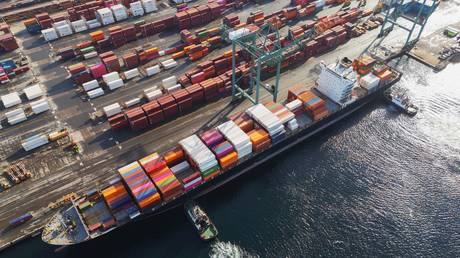
Geopolitical coercion relies on the manipulation of logistical friction. When state actors exert pressure through economic sanctions or naval blockades, the objective is not simply to inflict financial loss, but to distort the risk calculations of commercial operators until transit becomes economically untenable. The ongoing friction in the Strait of Hormuz represents a textbook intersection of state-level economic warfare and tactical maritime disruption. Standard reporting treats these incidents as isolated security anomalies. A rigorous structural breakdown reveals them as predictable outputs of a classic deterrence failure, where escalating financial penalties trigger asymmetrical kinetic responses along vital global trade corridors.
The Structural Mechanics of Maritime Chokepoints
A maritime chokepoint operates as a structural bottleneck where global supply elasticity drops to near zero. The Strait of Hormuz handles roughly a fifth of the world's petroleum consumption, making it a critical node in global energy architecture. When access to this node is constrained, the impact is not linear; it is exponential, governed by the availability of spare pipeline capacity and the spot-rate elasticity of global shipping insurance.
[State Economic Pressure]
       │
       ▼
[Increased Shipping Risk / Insurance Premium Spike]
       │
       ▼
[Commercial Hesitation & Vessel Targeting]
       │
       ▼
[Logistical Friction & Global Price Volatility]
State actors utilizing economic pressure attempt to force an adversary's economic contraction without triggering open kinetic conflict. However, economic sanctions create severe asymmetry. When an exporter's revenue streams are systematically strangled through international banking restrictions and embargoes, the target state's opportunity cost for disruption approaches zero. The strategic calculus shifts from compliance to escalation dominance.
The Cost Function of Retaliation
To understand why maritime vessels become targets during diplomatic standoffs, one must analyze the cost function governing irregular naval operations.
- Asymmetric Deterrence: Conventional naval supremacy is expensive to maintain but vulnerable to low-cost, high-disruption tactics deployed in confined waters.
- Signalling Mechanisms: Kinetic actions against commercial shipping serve as non-verbal communication channels, transmitting domestic pain back to international markets.
- Insurance Arbitrage: Every reported attack recalibrates underwriters' risk models, driving up hull and machinery war-risk premiums across the entire Persian Gulf operating theater.
Commercial shipping companies operate on razor-thin margins dictated by daily vessel charter rates and fuel efficiency. When war-risk insurance premiums escalate from fractions of a percent to multi-percentage points of a ship's total insured value, the financial burden forces charterers to either pass costs downstream to energy consumers or suspend operations entirely. This creates the exact leverage targeted by state-level actors seeking to disrupt international trade networks.
The Dual-Track Failure of Escalation Dominance
Diplomatic signaling often suffers from a fundamental calibration error: the belief that incremental economic pressure will induce policy reversal without inviting pushback. Historical precedent demonstrates that targeted economic penalties frequently produce the opposite effect, hardening political resolve while driving tactical innovation among proxy or state-backed naval forces.
When major powers announce intensified economic restrictions, the targeted administration faces severe domestic political incentives to demonstrate active resistance. If compliance guarantees national economic ruin, defiance becomes the rational survival strategy. The escalation ladder then moves past diplomatic channels into the gray zone of maritime harassment.
The Limits of Naval Escorts
Deploying naval task forces to protect commercial shipping introduces its own operational complexities. While naval escorts provide physical defense against direct surface attacks, they cannot eliminate the underlying threat environment.
- Resource Allocation: Protecting every commercial transit requires a disproportionate concentration of high-value naval assets in a geographically restricted zone.
- Response Latency: Defensive reactions against asymmetric threats—such as fast attack craft or loitering munitions—test the reaction times of modern integrated air and missile defense systems.
- Strategic Vulnerability: Concentrating naval power in a narrow maritime corridor creates high-value targets for anti-ship cruise missiles and coastal defense batteries.
Consequently, military protection acts as a palliative rather than a cure. It manages symptoms while the root cause—an unresolvable economic standoff—continues to fester.
The Macroeconomic Transmission Mechanism
The disruption of traffic through Hormuz transmits shocks through three distinct economic channels: direct physical scarcity, derivative market speculation, and freight rate inflation.
Market participants often overreact to initial security incidents, pricing in worst-case supply shocks before physical inventory has actually been lost. This speculative premium adds unnecessary volatility to global energy markets. Simultaneously, shipowners demand higher hazard pay for crews and steeper capital reserves, embedding a permanent risk premium into maritime logistics even during lulls in active hostilities.
Assessing the Vulnerability Matrix
Evaluating systemic exposure to Hormuz disruptions requires measuring three variables across any given importing economy:
- Strategic Petroleum Reserve (SPR) Depth: The volume of state-controlled emergency reserves available to bridge short-term supply deficits.
- Alternative Transit Infrastructure: Access to operational bypass pipelines that route crude around the chokepoint entirely.
- Import Dependency Ratios: The percentage of domestic energy consumption sourced directly from Persian Gulf exporters.
Economies with low SPR depth and high import dependency absorb the primary shock of maritime disruptions. Their industrial base experiences immediate margin compression, forcing central banks to balance inflationary pressures against slowing economic growth—a classic stagflationary trap triggered entirely by regional logistics failure.
Strategic Forecast and Operational Adjustment
Navigating sustained friction in critical maritime corridors requires a fundamental pivot from reactive crisis management to structural risk engineering. Commercial operators can no longer treat war-risk assessment as an occasional compliance check; it must be integrated into real-time operational routing models.
Energy importers must accelerate infrastructural diversification, prioritizing the expansion of overland transport corridors that bypass narrow maritime bottlenecks. Meanwhile, policymakers must recognize that economic coercion unaccompanied by a credible, off-ramp diplomatic framework will invariably generate kinetic blowback in the physical domains where global commerce remains most vulnerable. The stabilization of trade through Hormuz will not be achieved through intensified threats of financial penalties, but through the systematic reduction of the underlying economic desperation that makes maritime disruption a rational instrument of statecraft.