Large-scale international sporting events create brief, intense macroeconomic anomalies within localized geographies. When the FIFA World Cup 2026 brings an estimated 600,000 to 650,000 visitors to the Kansas City metropolitan area, local small businesses encounter an immediate shifting of the demand curve. However, the common assumption that aggregate visitor volume translates directly into proportional revenue growth across all sectors is economically flawed.
Capitalizing on a major regional event requires understanding microeconomic capacity limits, inventory velocity, and geographic distribution bottlenecks. The 2023 NFL Draft in Kansas City generated a reported $164 million in economic impact, yet subsequent analysis revealed that these gains bypassed a significant portion of local small businesses, concentrating wealth within primary event footprints and multinational hospitality chains. To capture residual tourist spend, independent operators must transition from passive participation to hyper-localized, operationally optimized strategies. For an alternative perspective, read: this related article.
The Tri-Partite Framework of Event-Driven Demand
To effectively monetize a transient surge in consumer traffic, a business must categorize its operational approach into three structural pillars: geographic proximity engineering, cultural product alignment, and capacity elasticity.
1. Geographic Proximity Engineering
Consumer spending during a major tournament is strictly constrained by transportation friction and event geography. The primary fan density anchors in Kansas City are structural: Arrowhead Stadium (the match venue), the National World War I Museum and Memorial (the site of the official FIFA Fan Festival with a capped capacity of 25,000 concurrent attendees), and the designated team base camps housing squad delegations from Argentina, Algeria, England, and the Netherlands. Related reporting on this matter has been shared by Forbes.
The velocity of tourist capital decreases exponentially as distance from these anchors increases. Operators outside the immediate walking zones face a structural bottleneck. Businesses located along secondary corridors, such as Troost Avenue or the Northeast cultural district, cannot rely on organic foot traffic. They must actively engineer proximity through third-party integrations, hotel-concierge partnerships, and short-term rental supply networks to intercept visitors along their transit paths.
2. Cultural Product Alignment
Monolithic inventory fails in an international marketplace. The influx of specific traveler demographics—specifically from Argentina, Algeria, England, and the Netherlands—demands targeted SKU diversification. Local firms are attempting to solve this via rapid product iteration:
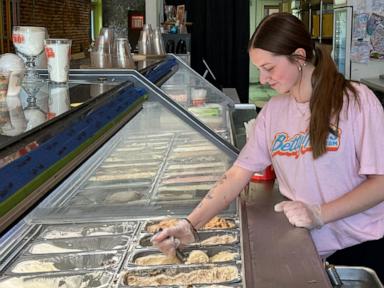
- Flavor Arbitrage: Adapting existing product bases to international profiles reduces manufacturing friction while capturing novelty spend. For instance, Betty Rae’s Ice Cream and Shatto Milk Company are altering their standard dairy production lines to introduce specialized flavors, such as a dulce de leche and pastry mixture replicating Argentine alfajores, a honey-and-almond formulation mimicking Algerian baklava, and a tea-infused formulation for English demographics. This shifts the product from a generic commodity to a localized cultural experience.
- Aesthetic Alignment: Apparel manufacturers like Sandlot Goods and Charlie Hustle are utilizing existing manufacturing patterns but swapping local branding elements for international team colorways and flag graphics. This creates a low-risk, high-margin souvenir product that captures the immediate sentiment of the visiting fanbase.
3. Capacity Elasticity
A localized demand shock places extreme stress on existing labor and inventory infrastructure. If a business lacks the operational elasticity to scale its throughput, higher demand simply results in long queues, lost conversions, and reputational degradation. Firms must front-load their variable costs by advancing their summer hiring schedules by 60 to 90 days, executing workforce stress tests to simulate high-velocity service environments, and deploying tech-enabled throughput accelerators such as QR-code menus and pay-at-the-table hardware.
The Production Function of Temporary SKUs
Introducing limited-run, event-specific merchandise or menu items introduces substantial supply chain risk. The lifecycle of a World Cup-themed product is rigid; the day after the final match, the economic value of tournament-specific inventory depreciates toward zero. Operators must balance inventory depth against the risk of stockouts using a basic cost function:
$$C_{total} = C_{production} + C_{holding} + C_{stockout} + C_{liquidation}$$
Where:
- $C_{production}$ represents the variable cost of manufacturing the specific SKU.
- $C_{holding}$ is the storage and preservation cost over the tournament's duration.
- $C_{stockout}$ is the opportunity cost of missed revenue due to premature inventory depletion.
- $C_{liquidation}$ is the net loss incurred when discounting unsold dead stock post-event.
To mitigate $C_{liquidation}$, businesses like Café Corazón are pursuing cross-distribution models. Instead of relying solely on their brick-and-mortar storefronts, they are placing co-branded products into localized high-velocity nodes, such as Kansas City International Airport retail shops and short-term vacation rentals. This distributes inventory risk across multiple independent geographic channels, flattening the potential downside if foot traffic patterns shift unpredictably.
Operational Constraints and System Failures
While optimistic projections dominate public discourse, a rigorous strategy requires acknowledging severe systemic limitations. Small businesses operating during a regional demand shock face three clear operational vulnerabilities.
Labor Market Distortions
The sudden demand for temporary, high-velocity customer service labor creates intense regional competition. Monopolistic event entities, official stadium concessionaires, and large hospitality groups aggressively bid up the shadow wage for seasonal workers. Small independent businesses frequently find themselves priced out of the premium labor pool, leading to understaffed operations exactly when peak throughput is mandatory.
Transit and Municipal Infrastructure Degradation
Mass transit adjustments can have severe unintended consequences on local commerce. The allocation of municipal resources to support tournament infrastructure often starves standard local networks. For example, planned reallocations of transit assets in Kansas City post-event point to a projected 25% reduction in standard daily bus routes. During the event, traffic re-routing and perimeter security zones around fan hubs create physical barriers that discourage the core local customer base from entering commercial districts, replacing predictable, long-term local revenue with highly volatile tourist capital.
The Illusion of Uniform Distribution
Economic impact models frequently utilize aggregate multipliers that obscure granular realities. A visitor spending money at an official FIFA Fan Festival or inside a stadium envelope contributes to the city's macro data point, but that capital rarely moves past the primary security perimeter. For a neighborhood merchant located three miles away, the net economic effect of the tournament can actually be negative if local residents choose to stay home to avoid the congestion, a phenomenon known in urban economics as the crowding-out effect.
The Decentralized Distribution Strategy
The optimal strategic play for an independent business located outside primary event zones is to decouple revenue generation from physical storefront locations. If consumers face high transit friction to reach a business, the business must shift its inventory to the consumer's point of rest or transit.
Implement a decentralized distribution model by forming immediate, legally bound B2B partnerships with boutique hotels, corporate event sponsors, and short-term rental management companies within a five-mile radius of downtown hubs. Secure dedicated shelf space, in-room placement, or exclusive catering contracts for specialized SKUs before the tournament begins. This locks in wholesale revenue targets, eliminates dependence on erratic tourist foot traffic along secondary corridors, and transforms a highly volatile macroeconomic shock into a structured, predictable corporate procurement play.