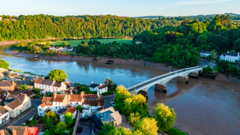
Civil infrastructure engineered in the pre-industrial era faces an unquantified operational bottleneck as global baseline temperatures fluctuate beyond historical boundaries. The partial reopening of the 210-year-old Old Wye Bridge connecting Chepstow, Wales, and Tutshill, England, exposes a critical vulnerability in heritage asset management: the thermal boundary limits of structural cast iron. Closed to vehicular traffic since October after structural beam fractures were discovered, and briefly closed to pedestrians, the bridge now operates under strict environmental constraints. Specialists have mandated absolute closure if ambient temperatures exceed 30°C or drop below -3°C. This operational threshold is not an arbitrary safety margin; it is determined by the fundamental physics of materials, structural fatigue mechanics, and the limits of real-time digital risk mitigation.
Understanding the threat to such crossings requires separating historical engineering intent from modern structural realities. When completed in 1816 as a five-arch cast iron structure—now the oldest of its type globally—the bridge was designed for dynamic loads vastly different from modern transport networks. The current operational crisis highlights a predictable collision between 19th-century metallurgy and 21st-century environmental realities.
The Dual Variables of Thermal Material Failure
The vulnerability of the Old Wye Bridge stems from two distinct physical mechanisms that govern cast iron under temperature extremes. Asset managers face a compounding risk profile where structural capacity diminishes as environmental stress accelerates.
Linear Expansion and Structural Restraint
Every material expands or contracts in direct proportion to temperature shifts, governed by its coefficient of linear thermal expansion. For structural cast iron, this value is approximately $0.000011$ per degree Celsius ($11 \times 10^{-6}/^\circ\text{C}$). In a multi-arch configuration like the Wye Bridge, the total change in span length over a 30-degree variance becomes highly problematic.
$$ \Delta L = \alpha \cdot L_0 \cdot \Delta T $$
Where:
- $\Delta L$ is the change in structural length.
- $\alpha$ is the material coefficient of thermal expansion.
- $L_0$ is the original span length.
- $\Delta T$ is the temperature differential.
When a bridge is unconstrained, this expansion occurs without generating internal stress. The Old Wye Bridge features a fixed geometry where adjacent arches abut masonry piers. When ambient temperatures rise toward 30°C, the cast iron members attempt to expand but are physically restrained by the surrounding structural mass. This constraint converts thermal expansion directly into compressive stress. If the structural elements contain pre-existing micro-fractures or cast defects, this internal pressure can induce sub-critical crack propagation, threatening catastrophic structural buckling.
The Low Temperature Ductile to Brittle Transition
The lower operating limit of -3°C introduces a different, more acute failure mode. Cast iron possesses a high carbon content—typically between 2% and 4%—which gives it excellent compressive strength but severely limits its tensile ductility. At lower temperatures, the material undergoes a subtle phase behavior variation known as the ductile-to-brittle transition.
As temperatures drop toward the freezing mark, the fracture toughness of the iron decreases. The energy required to initiate a fracture drops significantly. Under these conditions, the structural iron becomes highly sensitive to impact loads and cyclic stress. A sudden drop in temperature combined with pedestrian load cycles can cause a sudden, brittle fracture without warning. This contrasts with modern structural steel, which deforms plastically before structural failure occurs.
The Cost Function of Structural Fatigue
The structural integrity of heritage cast iron degrades over time through a compounding process of metallurgical fatigue and environmental oxidation. The decision to restrict vehicular traffic indefinitely reflects a calculated risk-reduction strategy based on asset life extension models.
[Dynamic Traffic Loads] ---> [Micro-Crack Initiation] ---> [Thermal Stress Amplication] ---> [Catastrophic Component Failure]
The historical loading profile of the bridge shifted significantly over its two centuries of operation. Designed for horse-drawn carriages, it eventually carried heavy goods vehicles until the opening of the nearby A48 Wye Bridge in 1988. This history of high-amplitude stress cycles left a legacy of micro-structural damage within the cast iron girders.
Fatigue damage is cumulative and irreversible. Each load cycle advances existing cracks by microscopic increments. When structural beams exhibit visible cracking, as identified during the October inspection, the remaining fatigue life of the component approaches zero. At this stage, the material can no longer tolerate the intersection of dynamic live loads and thermal environmental stress.
Restricting the bridge to pedestrians and cyclists alters the load equation. A standard passenger vehicle can exert a concentrated axle load of over 1.5 metric tons, whereas a pedestrian exerts a nominal localized load of less than 0.1 metric tons. By removing the high-amplitude stress spikes caused by cars, engineers reduce the mechanical fatigue rate, allowing the bridge to function as a footway, provided environmental variables stay within safe bounds.
Digital Monitoring and the Category III Assessment Framework
The current operational protocol relies on continuous digital monitoring paired with an impending Category III structural check. This combination represents the highest tier of engineering scrutiny available for infrastructure asset management.
+-----------------------------------------------------------------+
|               Category III Structural Assessment                |
+-----------------------------------------------------------------+
                                 |
        +------------------------+------------------------+
        |                                                 |
        v                                                 v
+-------------------------------+                 +-------------------------------+
|     Independent Analytical     |                 |  Metallurgical Degradation   |
|            Modeling           |                 |           Analysis            |
+-------------------------------+                 +-------------------------------+
        |                                                 |
        +------------------------+------------------------+
                                 |
                                 v
+-----------------------------------------------------------------+
|               Real-Time Digital Sensor Network                  |
+-----------------------------------------------------------------+
                                 |
        +------------------------+------------------------+
        |                                                 |
        v                                                 v
+-------------------------------+                 +-------------------------------+
|    Acoustic Emission Sensors   |                 |    Fiber-Optic Strain Gauges  |
+-------------------------------+                 +-------------------------------+
A Category III check requires an independent engineering body to build a structural model from first principles, completely separate from any original design documents or previous evaluations. This process involves two core investigative tracks:
- Independent Analytical Modeling: Developing full three-dimensional finite element analysis models to simulate stress distribution across the five cast iron arches under varying thermal and load conditions.
- Metallurgical Degradation Analysis: Assessing historical metal fatigue at critical connection points, pins, and structural flanges to calculate actual load-bearing capacity.
To manage risk while these long-term calculations occur, Monmouthshire Council has implemented a real-time digital monitoring network across the bridge structure. This sensor array serves as an early warning system designed to detect structural movement before visible deformation occurs.
- Acoustic Emission Sensors: These micro-sensors are calibrated to detect high-frequency elastic waves generated by micro-cracking or structural shifts within the cast iron. When a crack expands, it releases a burst of acoustic energy that the sensors register, pinpointing the location of structural distress.
- Fiber-Optic Strain Gauges: Affixed to the critical structural beams, these gauges measure real-time mechanical deformation caused by temperature fluctuations and pedestrian distribution. If strain levels deviate from predicted thermal baselines, asset managers receive automated alerts to close the crossing.
This digital safety net has clear limitations. Sensors measure degradation as it happens; they do not restore structural capacity. If the underlying material has reached its fatigue limit, digital monitoring simply documents the progression toward a mandatory closure.
The Policy Trade-Off: Preservation Versus Utility
The prolonged closure and restricted reopening of the Old Wye Bridge highlight a difficult balancing act for local authorities between historic preservation, community connectivity, and financial realities. The alternative route via the modern A48 bridge requires a five-minute detour for motorists. While minor for long-distance transport, this diversion splits a highly integrated local economy that spans the national border.
The debate among residents highlights conflicting priorities in modern infrastructure management. One segment of the population values the return to a quiet, pollution-free pedestrian space, viewing the vehicular closure as a localized environmental improvement. Conversely, local business operators and commuter groups experience a measurable economic hit from disrupted traffic patterns and reduced access.
Forcing ancient infrastructure to serve modern transportation needs is no longer viable. Local authorities face a choice with three potential paths forward:
- Permanent Adaptive Reuse: Committing the bridge entirely to pedestrian and active travel networks. This eliminates heavy vehicle fatigue cycles, lowers maintenance costs, and preserves the historical asset, though it permanently alters regional traffic patterns.
- Structural Reconstruction: Replacing the damaged cast iron internal girders with hidden structural steel supports. This approach restores full vehicular access and maintains the historic exterior profile, but requires significant capital investment and introduces complex engineering challenges regarding material interfaces.
- Variable-Load Operational Schemes: Using automated smart gates tied directly to environmental sensors and weight-restricted tolling systems. This allows light passenger vehicles to cross only when ambient temperatures sit within an optimal buffer zone (e.g., 10°C to 20°C), minimizing structural risk while preserving partial utility.
Strategic Forecast
The thermal restrictions placed on the Old Wye Bridge represent an early indicator of a wider systemic challenge. Civil engineering assets built across Europe and North America during the 19th and early 20th centuries are operating well beyond their intended design lives, under climatic conditions their creators never anticipated.
As extreme weather events increase in frequency and intensity, temperature-driven infrastructure closures will shift from isolated incidents to recurring operational line items. Municipalities can no longer rely on retrospective maintenance strategies. Asset managers must systematically re-evaluate heritage bridges using advanced thermal-mechanical modeling to establish realistic operational boundaries before material failures dictate sudden closures. The future of historic infrastructure relies on proactive load reduction and data-driven climate adaptation, or these assets will face permanent closure.
This video analysis details how thermal expansion forces structural engineers to implement emergency hosing and cooling measures on iron and steel crossings when ambient temperatures exceed safe operating limits: Great Bridge reopens to traffic after heat-related malfunction. It provides a direct visual case study of how extreme heat physically halts transport infrastructure by causing critical components to seize and pop out of alignment.