Bystander interventions during high-altitude residential emergencies follow a predictable sequence of structural failures, rapid risk assessments, and improvised mechanical stabilization. When a child becomes trapped in exterior security grilles twelve stories above ground, survival depends on the intersection of architectural geometry, human physiology, and uncoordinated group mechanics before municipal emergency services can establish a perimeter.
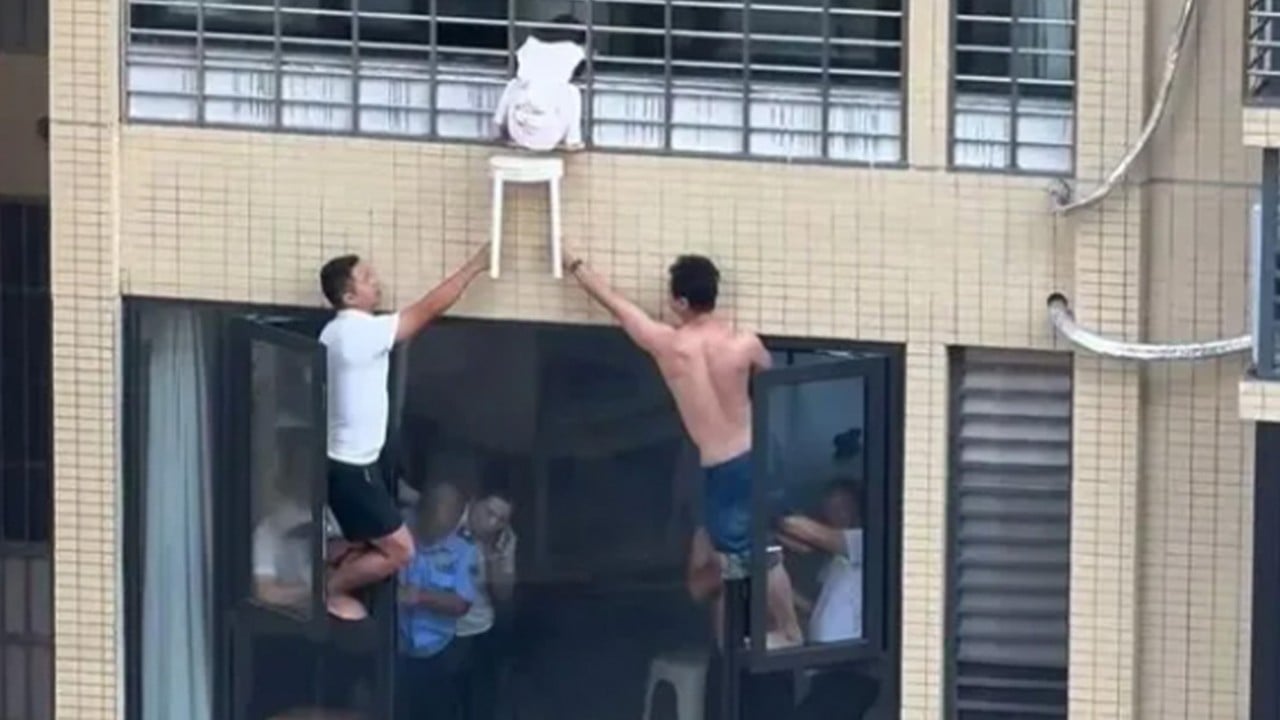
Standard news coverage of these events treats them as isolated acts of heroism, stripping away the physical and behavioral variables that dictate whether a rescue succeeds or ends in multiple fatalities. Analyzing the incident involving men scaling an exterior facade to support a girl wedged between twelfth-floor window bars requires breaking the event down into its underlying engineering and behavioral mechanics.
The Structural Paradox of Residential Security Grilles
High-rise residential architecture in dense urban environments frequently incorporates aftermarket or developer-installed exterior window cages, commonly referred to as anti-theft grilles or security bars. Designed to prevent unauthorized entry from the outside and accidental falls from the inside, these structures introduce a distinct set of mechanical hazards when improperly spaced or corroded.
The primary failure mode occurs when bar spacing exceeds the cranial or thoracic width of a small child. Standard building codes in many jurisdictions stipulate a maximum gap of 10 to 11 centimeters (approximately 4 inches) to prevent a child's torso from passing through while retaining the head. In older installations or unregulated retrofits, gaps frequently reach 15 centimeters or wider.
Once a child slips feet-first through the vertical bars, gravity pulls the torso downward until the zygomatic arches (cheekbones) and occipital bone (base of the skull) catch on the horizontal or vertical steel members. This creates an immediate, life-threatening mechanical suspension:
- Positional Asphyxiation: The weight of the suspended body exerts downward traction on the cervical spine and compresses the trachea and carotid arteries against the rigid steel bars.
- Vascular Occlusion: Restricted venous return from the head leads to rapid cerebral hypoxia, reducing the window of consciousness to minutes.
- Structural Fatigue: Exterior grilles are typically anchored into exterior masonry or concrete via expansion bolts. Over years of exposure to moisture and thermal expansion, galvanic corrosion weakens these anchor points. The dynamic load of a struggling child, compounded by the sudden weight of one or more adult rescuers, risks catastrophic shear failure of the mounting bolts.
The Mechanics of Improvised Facade Escalation
When bystanders observe a suspended child at a twelfth-floor elevation—roughly 36 to 40 meters above street level—the response time of municipal fire and rescue units becomes the critical bottleneck. Even in dense metropolitan areas with rapid dispatch, vertical access via aerial ladder trucks or interior stairwell breaches requires four to eight minutes. Against the timeline of positional asphyxiation, this delay is often fatal.
Bystanders who initiate an immediate exterior climb bypass institutional response times by trading professional fall-arrest systems for immediate physical proximity. This intervention relies on the architectural features of the building's exterior envelope:
- Vertical Progression: Rescuers typically access the exterior from an adjacent apartment or a floor immediately below the incident. Using neighboring security cages as a makeshift ladder, they ascend by gripping horizontal steel crossbars.
- Load Distribution: Because a single window grille is not rated to support the combined static and dynamic load of an adult male (70 to 90 kilograms) plus a child, effective rescuers distribute their weight across multiple structural elements. A common technique involves bracing one foot on the concrete window ledge or air-conditioning unit bracket of the eleventh floor while gripping the steel bars of the twelfth floor.
- Counter-Traction: Once within reach, the rescuer's primary objective is not to pull the child inward—which is physically impossible if the head is wedged—but to apply upward force beneath the child's feet or torso. Relieving the downward gravitational pull immediately restores airway patency and prevents cervical spine injury.
Behavioral Economics of Extreme Altruism
From a decision-theory perspective, scaling the outside of a twelve-story building without a harness represents an extreme outlier in human risk tolerance. Under standard rational-choice models, the expected utility of the action is heavily negative due to the high probability of fatal fall trauma.
However, acute emergencies involving children trigger a specific cognitive shift known as hyperbolic discounting of personal risk, paired with acute empathy-induced arousal. Several environmental factors accelerate this decision-making process:
- Visibility and Acoustic Cues: Unlike an interior medical emergency, a child dangling from an exterior facade creates an unmistakable visual and auditory signal that collapses bystander apathy. The clarity of the threat eliminates the ambiguity that normally stalls group action.
- Tangible Agency: In many crises, bystanders lack the tools or knowledge to intervene. An exterior window grille presents a clear, albeit hazardous, physical pathway. The problem appears mechanically solvable through basic climbing and lifting.
- Social Proof and Coordination: When a primary actor initiates a high-risk climb, it alters the perceived feasibility for secondary actors. A second rescuer frequently follows to provide stabilization, hand-holds, or interior coordination, forming an ad-hoc human chain that compensates for the lack of equipment.
The Multi-Tiered Stabilization Protocol
Successful outcomes in these scenarios rely on an implicit division of labor across three distinct spatial zones. Without simultaneous execution across all three zones, the rescue stalls or fails.
Zone 1: Exterior Load-Bearing Support
The primary rescuer operates on the exterior facade. Their sole function is mechanical upward displacement. By positioning themselves directly beneath or beside the child, they absorb the child's body weight through their shoulders, arms, or hands. Maintaining this posture requires intense isometric muscular endurance, as the rescuer cannot easily shift their grip without compromising their own balance on narrow concrete ledges.
Zone 2: Interior Breach and Extraction
While the exterior rescuer buys time, a secondary group must gain access to the interior of the twelfth-floor apartment. If the apartment is locked and unoccupied, this requires forced entry through reinforced steel security doors—a frequent obstacle in urban high-rises. Once inside, interior rescuers cannot simply pull the child back through the bars if the head is the point of obstruction. They must either widen the gap using hydraulic spreaders, crowbars, or car jacks, or carefully angle the child's head to align the narrowest cranial dimension with the bar spacing while the exterior rescuer guides the body upward.
Zone 3: Ground-Level Impact Mitigation
Simultaneously, bystanders at street level establish a secondary containment perimeter. Recognizing that both the child and the exterior rescuers face imminent fall risk, ground teams deploy improvised deceleration barriers—such as heavy blankets, mattresses, or tarpaulins held taut by multiple individuals. While a fabric barrier held by bystanders cannot safely absorb the kinetic energy of a fall from 36 meters (where impact velocity reaches approximately 26 meters per second), it serves to disrupt terminal posture and marginally reduce peak deceleration forces in a worst-case scenario.
Limitations and Systemic Vulnerabilities
Relying on bystander intervention as a de facto safety net exposes severe systemic vulnerabilities in urban housing design and emergency preparedness.
First, the survival rate of improvised exterior rescues is heavily skewed by survivorship bias in media reporting. Unsecured climbers face a high probability of muscle fatigue, slippage on smooth concrete sills, or sudden failure of rusted grille welds. A single structural failure turns a single-victim incident into a multi-fatality event.
Second, the physical geometry of modern high-rises increasingly limits exterior escalation. Newer developments utilize smooth curtain-wall glass and flush facades without protruding ledges or exterior cages. While these designs eliminate the specific hazard of bar entrapment, they render exterior bystander rescue physically impossible if a window is left unlatched.
Third, forced entry into locked apartments during emergencies is frequently delayed by high-security multi-point locking doors. Without specialized breaching tools on site, interior rescuers are forced to wait for fire services, leaving exterior bystanders suspended in isometric strain for prolonged periods.
Infrastructure and Regulatory Interventions
Eliminating the conditions that necessitate twelve-story bystander rescues requires shifting focus from reactive heroism to preventative engineering and rapid-access protocols.
- Mandatory Retrofitting with Quick-Release Mechanisms: Building codes for residential high-rises must mandate that all exterior security grilles incorporate an interior, child-resistant quick-release latch. This allows emergency responders or neighbors who breach the apartment to swing the entire cage open within seconds, eliminating the need to cut or bend steel bars under tension.
- Standardized Window Limiter Hardware: For modern curtain-wall buildings and unbarred windows, passive safety relies on mechanical window opening control devices (WOCDs) that restrict sash openings to less than 10 centimeters. Unlike full cages, limiters prevent egress entirely while maintaining exterior facade integrity.
- Decentralized Breaching Equipment in High-Density Complexes: Property management entities in high-rise residential complexes should maintain locked, alarm-monitored emergency cabinets on every fifth floor containing basic forcible-entry tools (Halligan bars, sledgehammers, and heavy-duty bolt cutters). Reducing interior breach time from ten minutes to ninety seconds removes the primary bottleneck in vertical rescue operations and eliminates the need for untrained civilians to scale exterior walls.