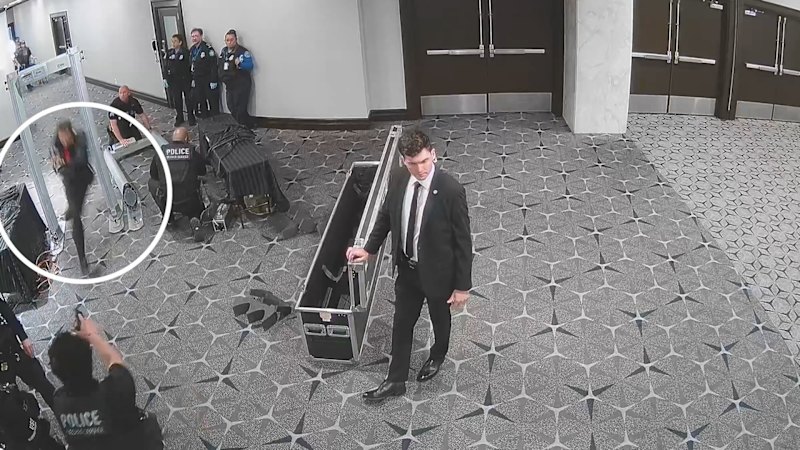
The release of closed-circuit television (CCTV) footage detailing the security breach at the White House Correspondents’ Dinner (WHCD) serves as a diagnostic roadmap for modern protective failure. While media narratives focus on the sensationalism of the "intruder," a rigorous structural analysis reveals that the breach was not a statistical anomaly but a predictable outcome of a degraded "Security Bubble" architecture.
In high-stakes executive protection, the effectiveness of a perimeter is governed by the Probability of Detection (P_d) and the Time to Respond (T_r). When these two variables are out of sync, the result is a system-wide collapse of the sterile zone.
The Triad of Protective Failure
The breach at the Washington Hilton can be categorized into three distinct failure domains that bypassed the United States Secret Service (USSS) and private security layers.
1. Perimeter Elasticity and the Crowd-Dynamic Trap
A National Special Security Event (NSSE) like the WHCD relies on a "Quarantine Zone" meant to be sterile and risk-free (Wander, 2009). However, the WHCD presents a unique tactical paradox: the requirement for a high-density, high-flow environment in a confined subterranean space.
The CCTV footage highlights a breakdown in Access Control Integrity. In protective theory, every person crossing a threshold must be inspected, cataloged, and watched (Wander, 2009). The "Elasticity" failure occurred when the volume of authorized guests—journalists, celebrities, and diplomats—saturated the throughput capacity of the magnetometers. This creates a "Pressure Valve" effect where security personnel, pressured to maintain the event’s schedule, default to visual screening over technical verification, lowering the $P_d$ to near zero for non-obvious threats.
2. Behavioral Obfuscation as a Passive Weapon
The intruder did not use "Cloaking" technology; they used Social Camouflage. By adopting the specific dress code and non-verbal cues of the attendee demographic (black-tie attire, purposeful movement), the individual exploited the "Heuristic Bias" of the security detail.
- Recognition Lag: Guards are trained to look for "deviant" behavior (Perreault et al., 2019).
- The In-Group Fallacy: Because the individual appeared to belong to the "In-Group" of the press or elite guests, the physiological "Threat Trigger" in the guards’ brains never fired.
- Tactical Pacing: CCTV shows the individual moving at the same velocity as the crowd, preventing the "Visual Friction" that usually alerts a trained agent to a tailing or intercepting subject.
3. Latency in Post-Detection Protocols
The most damning metric revealed by the footage is the Detection-to-Action Latency. There is a visible gap between the moment the intruder crosses the final physical barrier and the deployment of a "Stop-Move" response.
In a robust security framework, the protection of the "Presidential Body" involves an adaptive, mobile fortress (Wander, 2009). When the intruder successfully entered the "Inner Shell," the failure was no longer a perimeter issue but a communication bottleneck. The footage indicates that while the individual was captured on camera, the information did not reach the ground agents in a timeframe shorter than the intruder’s transit time to the target area. This is a classic "Sensor-to-Shooter" gap, where the surveillance system functions as a digital witness rather than a preventative tool.
The Cost Function of Symbolic Security
The WHCD exists at the intersection of "Presidential Spectacle" and "Constitutional Openness" (Wander, 2009). This creates a Security Debt—a situation where the political need for visibility forces the Secret Service to ignore established principles of close protection in favor of maintaining the "pleasing public persona" of the office (Wander, 2009).
- The Optical Tax: To ensure the event doesn't look like a "siege," physical barriers are minimized or disguised.
- The Protocol Compromise: The adversarial role of the press is theoretically set aside for the night (Perreault et al., 2019), leading to a dangerous "relaxation of vigilance" among security staff who perceive the environment as a "friendly" zone rather than a combat theater.
Strategic Recommendations for High-Density Protective Environments
To mitigate a repeat of the Hilton breach, the operational logic must shift from "Point Screening" to Continuous Verification.
- Algorithmic Behavior Analysis: Moving beyond static CCTV, the integration of real-time gait analysis and "Flow Anomaly Detection" would flag individuals whose movement patterns deviate from the authorized crowd, regardless of their attire.
- Biometric Tethering: Physical credentials (badges) are easily spoofed or bypassed in high-flow environments. Implementing a "Zero-Trust" architecture—where every individual's location is tracked via low-energy Bluetooth (LEB) or similar signals—would allow a central command to identify "Un-tethered" bodies in real-time.
- The "Hardened Buffer" Requirement: The footage proves that a single line of magnetometers is insufficient. Protective details must implement a "Two-Stage Sterilization" process where the distance between the first screening and the final entry exceeds the maximum possible sprint speed of a human, providing the necessary $T_r$ for intervention.
The breach was not a failure of individual agents but a failure of the Protective Geometry. As long as the "Executive Bubble" is forced to overlap with un-vetted social spaces for the sake of political tradition, the probability of a "Terminal Penetration" remains a statistical certainty. The final strategic play is not more guards, but a total decoupling of the President's physical presence from high-variance, high-density public events.
References
Perreault, G., Stanfield, K., & Luttman, S. (2019). “Why the h**l is There a White House Correspondents’ Dinner?” Boundary Work in Political Journalism. Journalism Practice, 14(9), 1142–1158. https://doi.org/10.1080/17512786.2019.1685901
Cited by: 37
Wander, E. (2009). Presidential security: Bodies, bubbles, & bunkers. [Doctoral dissertation, Virginia Tech]. VTechWorks. https://vtechworks.lib.vt.edu/bitstream/handle/10919/77042/etd-04182009-110718_Presidential_ewswander_ETD.pdf



