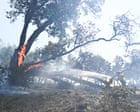
The convergence of peak regional tourism and active wildfire propagation along the California coast exposes structural vulnerabilities in how localized emergency responses interact with linear transportation corridors. When the Timber Fire breached containment thresholds in Monterey County, expanding across thousands of acres within the Los Padres National Forest, it triggered a cascading failure of regional logistics.
Understanding this event requires moving past standard journalistic accounts of displaced vacationers. The situation represents a classic stress test of a geographically constrained ecosystem where a single arterial highway serves simultaneous evacuation, suppression, and economic functions.
The Structural Mechanics of Coastal Fire Propagation
Wildfire behavior in the Santa Lucia range is governed by three primary variables: topography, fuel load, and atmospheric friction. Unlike flatland grassfires, the steep canyons characteristic of the Big Sur coastline create localized wind eddies and chimney effects that accelerate convective heat transfer.
- Topographic Amplification: Slopes exceeding forty degrees increase radiative heat transfer efficiency toward uphill fuels, allowing fire fronts to outpace standard ground crew suppression rates.
- Inaccessible Fuel Beds: Decades of accumulated organic matter beneath oak woodland and dense brush provide high thermal energy release per square meter upon ignition.
- Diurnal Wind Shifts: Offshore movements from the Salinas Valley introduce hot, desiccated air masses during overnight hours, neutralizing the dampening effects typically provided by nocturnal marine layer descents.
These factors explain why the initial footprint scaled exponentially over a forty-eight-hour window. The fire did not simply burn outward in a concentric circle; it tracked along micro-drainages where fuel density and oxygen availability reached optimal combustion ratios.
The Highway 1 Bottleneck and Evacuation Friction
The economic and logistical anatomy of Big Sur relies on a single continuous thread: the Pacific Coast Highway. When mandatory evacuation orders affect zones spanning Partington Ridge and coastal segments near Loma Vista, the transport network experiences immediate gridlock due to its lack of redundancy.
[Active Fire Front] ---> [Steep Canyon Terrain] ---> [Highway 1 Single Corridor] ---> [Evacuation Bottleneck]
This linear geometry creates severe evacuation friction.
- Zero Egress Redundancy: Inland lateral routes do not exist. Every resident and visitor must move either north or south along the identical coastal artery.
- Visitor-Resident Demographic Clash: Peak seasonal tourism introduces transient populations unfamiliar with local topography, delaying reaction times and increasing vehicular abandonment risks on narrow shoulders.
- Suppression Counter-Flow: Heavy tactical apparatus, water tenders, and personnel carriers must utilize the exact same finite road space moving inward that evacuees use to move outward.
Emergency management agencies attempt to mitigate this through zoning designations, separating immediate evacuation orders from peripheral warnings. However, the sheer volume of transient traffic heading toward regional attractions, such as Monterey car week events or coastal state parks, complicates baseline clearance calculations.
Economic Interruption Dynamics in Monoculture Economies
The temporary closure of commercial anchors like the Alila Ventana resort, Nepenthe restaurant, and the Henry Miller Memorial Library highlights the fragility of tourism-dependent micro-economies. In a region where annualized revenue must offset months of potential weather-related road closures, an August interruption targets the highest-yield margin window of the fiscal year.
The economic cost function incorporates several distinct loss categories:
- Direct Revenue Cessation: Total loss of daily transactional volume across hospitality, food service, and retail sectors during mandatory closure mandates.
- Asset Protection Overhead: Private deployment of defensive hardening assets, including fire-resistant gel applications and private structural defense contractors.
- Reputational Churn: Cancellation cascades extending weeks past containment dates as prospective visitors misinterpret localized closures as regional destruction.
Unlike urban centers where commerce diversifies across multiple districts, Big Sur operates as a single experiential product. If access to the corridor is restricted, the product is entirely offline.
Resource Allocation and Suppression Economics
Deploying nearly five hundred personnel into the rugged terrain of the Los Padres National Forest underscores the immense fiscal requirements of wildland urban interface defense. Ground crews operating in vertical terrain face strict physiological limitations regarding shift lengths, hydration needs, and extraction safety.
Aerial suppression assets provide temporary cooling of active flanks, but their efficacy remains bound by atmospheric visibility and marine layer density. When smoke inversions settle into coastal canyons, fixed-wing aircraft and rotorcraft are frequently grounded, shifting the entirety of the containment burden back to hand crews cutting line through dense chaparral.
Containerized tactical staging along Highway 1 demonstrates the tactical necessity of converting a scenic highway into an industrial logistics staging zone. Fire lines constructed directly adjacent to the corridor serve as the final defensive threshold preventing upslope runs from crossing the asphalt and jumping toward the marine terrace.
Maintain staging perimeter integrity along the Highway 1 corridor to secure structural assets while shifting incoming visitor traffic patterns entirely north of Carmel and south of San Luis Obispo before transit permissions reset.