The suspension of the European Union’s entry-exit system biometric processing protocol by French border authorities at the Port of Dover exposes a critical vulnerability in modern border architecture: technological systems designed for steady-state data aggregation fail when subjected to peak-demand, multi-variable capacity constraints. Rather than a localized customer-service issue or a routine seasonal transport delay, the operational failure at Dover represents an explicit collision between post-Brexit regulatory demands, infrastructure-to-volume mismatch, and extreme environmental variables.
To analyze why this failure occurred—and why the invocation of Article 9 of the Entry-Exit System (EES) regulations became structurally inevitable—the border must be analyzed as an integrated supply chain. The throughput of a border checkpoint is governed by a strict cost function where processing time per unit directly dictates systemic backlog. When a new biometric layer multiplies processing times by a factor of three or four, the capacity of the geographic bottleneck vanishes.
The Microeconomics of Border Throughput
The structural mechanics of a vehicle-based international border depend entirely on transaction velocity. In a post-Brexit configuration, the Port of Dover operates under juxtaposed controls, meaning French border police (Police Aux Frontières) conduct passport and security checks on British soil prior to embarkation. This setup shifts the entire burden of regulatory compliance to a concentrated geographic choke point.
The operational baseline can be modeled through a standard queueing theory framework. Prior to the full implementation of the digital registration system, a standard manual passport verification for a non-EU vehicle required a predictable processing time ($T_{base}$). The introduction of the EES added biometric registration parameters ($T_{bio}$), including digital facial capture and ten-fingerprint scanning for first-time entries.
$$\text{Total Processing Time } (T_{total}) = T_{base} + T_{bio}$$
The core systemic vulnerability stems from the physical configuration of the Port of Dover. Unlike an airport terminal, where passengers are decoupled from heavy machinery and can be queued in dense, serpentine foot lines inside climate-controlled structures, a roll-on/roll-off (RoRo) ferry port queues passengers inside vehicles. Vehicles possess a fixed, non-negotiable physical footprint.
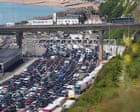
When $T_{total}$ scales upward, the arrival rate of vehicles ($\lambda$) quickly exceeds the service rate ($\mu$). Because the physical space within the eastern docks is finite, any sustained state where $\lambda > \mu$ causes the queue to spill backward out of the port gates and onto the domestic highway network (the A2 and A20 corridors).
The problem is compounded by a technological deficit. At the Port of Dover, the specialized French self-service biometric kiosks and hardware designed to register vehicle passengers in situ have not achieved full operational deployment. Consequently, French border police have been forced to create traveler data records manually at the booths. This operational workaround shifts the biometric data collection burden directly onto the front-line officer, driving $T_{bio}$ to its absolute theoretical maximum and crippling the service rate ($\mu$).
The Coincident Multi-Variable Shock
The severe congestion observed during the late-May bank holiday weekend was not caused by a single operational failure, but by the simultaneous convergence of three independent variables.
[Systemic Surge: 8,000+ Vehicles] + [EES Manual Processing Workaround] + [Amber Heat Alert (30°C+)]
                                                │
                                                ▼
                             [Critical Capacity Failure Threshold]
                                                │
                                                ▼
                             [Emergency Invocation of Article 9]
The Demand Shock
The bank holiday weekend combined with the start of the school half-term holiday generated a predictable, yet extreme, demand spike. The port projected over 18,000 travelers across the weekend, with a concentrated peak of 8,000 travelers arriving within a highly narrow temporal window on Saturday morning, specifically between 06:00 and 13:00. This highly concentrated arrival rate instantly overwhelmed the reduced throughput capacity caused by the manual digital registrations.
The Environmental Shock
Concurrently, the United Kingdom experienced an unseasonable meteorological anomaly, with temperatures climbing to 30°C (86°F), triggering official amber heat health alerts from the UK Health Security Agency. This introduced an acute safety risk. In a standard queue, passengers can be sustained with minimal intervention; in a vehicular queue on unshaded tarmac during an amber heat event, stationary vehicles become highly efficient heat traps. The risk of heat exhaustion, vehicle cooling system failures, and medical emergencies escalated the operational delay from a commercial inconvenience to a severe public safety liability.
The Policy Fallback Trigger
Faced with a six-hour compounding backlog and escalating environmental risks, the port authority and French border officials reached the critical capacity failure threshold. The remedy was not an optimization of the existing process, but a total systemic rollback.
By invoking the Article 9 clause of the EES regulations, the French authorities utilized an explicit legal safety valve designed for emergency scenarios. Under this clause, the exhaustive biometric data acquisition protocols are temporarily suspended. Border officers revert to conventional, non-biometric validation checks. The impact on processing speed was immediate: by removing $T_{bio}$ from the equation, the service rate ($\mu$) was restored to historical baselines, converting a stagnant gridlock into free-flowing traffic.
Institutional Fragility and Strategic Remediation
The necessity of abandoning the biometric registration protocol during its first major peak demand period reveals a profound structural flaw: the system cannot handle reality-based peak scaling. If a border security framework must be deactivated every time a predictable holiday volume coincides with clear summer weather, the framework itself is structurally unviable in its current operational configuration.
This operational fragility carries severe commercial consequences. Airlines and ferry operators alike have noted that extended processing friction acts as a direct disincentive to international travel. The threat of multi-hour delays in volatile conditions actively degrades consumer confidence and suppresses regional tourism economies.
Resolving this systemic bottleneck requires structural adjustments across three distinct horizons:
- Decoupled Pre-Registration Infrastructure: Biometric data collection must be entirely decoupled from the physical border booth. Travelers must be empowered or legally required to complete facial and fingerprint registration via decentralized mobile applications or regional domestic enrollment centers well in advance of reaching the port jurisdiction.
- Dynamic Hardened On-Site Technology: If on-site registration remains mandatory, the physical infrastructure must match the environment. This requires the immediate installation of automated, weather-hardened biometric extraction gantries capable of scanning multi-passenger vehicles simultaneously without forcing drivers to interact with manual, booth-bound police interfaces.
- Mathematical Trigger Standardization: The invocation of Article 9 safety valves must move away from reactive crisis management and toward predictive algorithms. Automated triggers should automatically relax data collection parameters the moment regional approach roads hit defined volume thresholds, preventing backlogs from locking local infrastructure.
Without these systemic interventions, the Dover corridor will remain trapped in a cyclical loop of structural failure, forcing operators to repeatedly choose between total infrastructure paralysis or the complete abandonment of modern border security protocols.
Critical Operational Context
New biometric checks at EU border in Dover will cause 'miles of traffic jams'
This archival analysis details the long-standing structural warnings issued by port officials regarding the specific logistical vulnerabilities of implementing biometric data collection at the unique, constrained physical layout of the Dover ferry terminal.