The Russo-Ukrainian war has moved entirely away from rapid territorial maneuvers toward a highly calculated war of attrition, where geographic gains are poor indicators of systemic endurance. Traditional war reporting fixes its attention on frontline updates, yet daily territorial exchange yields little strategic insight. To evaluate the trajectory of the conflict, analysts must dissect the mathematical realities governing the front: tactical consumption rates, industrial production bottlenecks, and deep-strike geographic asymmetric systems. The war will not be settled by sudden breakthroughs, but by the structural decay of one side's economic and military infrastructure under sustained pressure.
Understanding this conflict requires evaluating three distinct strategic pillars: the operational mechanics of the active frontline, the logistics of industrial munitions replacement, and the economic toll of deep-strike campaigns against critical infrastructure.
The Mass-Efficiency Bottleneck on the Frontline
The current operational front spans over 1,000 kilometers, creating an immense demand for defensive density and troop rotation. The tactical environment is characterized by absolute battlefield transparency, driven by dense deployments of first-person view (FPV) drones and reconnaissance unmanned aerial vehicles (UAVs). This transparency eliminates the element of tactical surprise, transforming large-scale mechanized offensives into high-casualty maneuvers with minimal geographic return.
The frontline operates under a strict cost function where infantry mass and armor deployments face diminishing returns due to defensive precision.
Frontline Progress = (Artillery Volumetric Superiority + Electronic Warfare Domination) / (Reconnaissance Transparency * Drone Interception Density)
The primary constraint on Ukrainian operational maneuvers is the asymmetric balance of available manpower and artillery volumes. Russian forces have consistently relied on high-volume artillery bombardment to suppress defensive fortifications before advancing infantry detachments. To counter this, Ukrainian forces rely on elastic defense principles—trading non-strategic territory to preserve personnel while inflicting maximum hardware attrition on advancing Russian units.
The tactical bottleneck is defined by three variables:
- Electronic Warfare (EW) Saturation: The side that successfully jams tactical radio frequencies locally can temporarily disable enemy FPV drone corridors, enabling localized advances.
- Fortification Depth: Linear trenches are obsolete; modern defense requires dispersed, deeply dug networks capable of surviving thermobaric munitions and heavy glide-bomb strikes.
- Artillery Ammunition Ratios: The baseline operational requirement to hold a defensive sector requires a minimum consumption ratio of 1:3 against attacking artillery. When the ratio drops to 1:5 or worse, defensive structures inevitably suffer structural failure.
The systemic challenge for both forces is the attrition of experienced mid-level tactical commanders. As casualty rates persist, the reliance on rapidly mobilized, less-trained personnel slows down complex operational planning, binding both armies to localized, incremental actions.
The Industrial Production Function and Munitions Asymmetry
Victory in an attritional model depends directly on the industrial production function. The conflict has exposed a structural imbalance between Western defense-industrial capacity and the Russian war economy, which has shifted toward a total mobilization state.
The Western military supply model has operated on a just-in-time logistics philosophy, optimized for short, high-intensity interventions rather than protracted, heavy-artillery industrial warfare. This creates an immediate structural bottleneck when attempting to scale up production of 155mm artillery shells, air defense interceptors, and armored replacement parts.
The Western industrial production pipeline faces specific physical limitations:
- Chemical Precursor Scarcity: Production lines for modern propellants and explosives, such as nitrocellulose, have fixed capacities with multi-year lead times for infrastructure expansion.
- Machine Tool Bottlenecks: High-precision automated machinery required for shell casing manufacturing cannot be procured rapidly, limiting factory scaling.
- Supply Chain Fragmentation: Unlike a centralized state-run apparatus, Western defense procurement relies on private contractors distributed across multiple nations, each with independent regulatory and financial constraints.
Conversely, Russia has reorganized its domestic economy around defense output. By converting civilian manufacturing assets and operating production plants on round-the-clock shift schedules, Moscow has maintained a high baseline of artillery shell production and tank refurbishment. However, this production model has an operational shelf life.
The Russian defense output is highly dependent on Soviet-era legacy stockpiles. While Russia can refurbish thousands of older T-72 and T-80 tanks from open-air storage facilities, these hulls represent a non-renewable resource. Once these physical reserves are depleted, the production function will drop sharply to match only new hull manufacturing, which is significantly lower than current replacement requirements.
The Strategic Geometry of Long-Range Attrition
Beyond the immediate tactical line, both states are engaged in a long-range strategic campaign targeting the economic and energy infrastructure of the adversary. This aspect of the war operates on a completely different set of principles, where the geographic location of the front line is largely irrelevant.
Deep-Strike Efficiency = (Payload Mass * Penetration Probability) / Cost per Intercepted Unit
The Ukrainian strategy relies heavily on asymmetric, low-cost long-range strike systems. By deploying locally designed long-range attack drones alongside Western-supplied cruise missiles, Kyiv aims at high-value economic bottlenecks inside Russia. The primary targets include oil refineries, fuel distribution hubs, military airfields, and rail junctions.
The objective is not to capture territory, but to reduce Russian export revenues and disrupt the internal logistics lines feeding the front. For instance, disabling a major oil cracking tower inflicts millions of dollars in repair costs and denies immediate fuel logistics to nearby military districts, creating an indirect operational slowdown at the front.
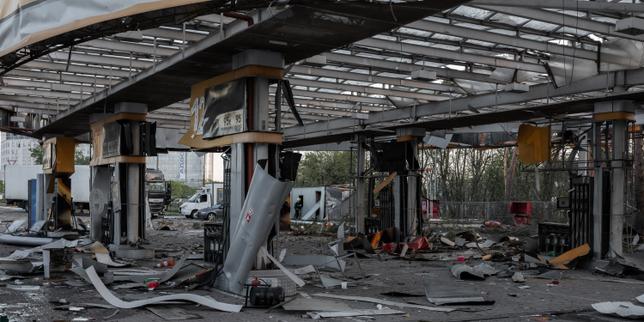
The Russian deep-strike campaign focuses heavily on the systematic destruction of the Ukrainian electrical grid and energy generation assets. By utilizing a mixed strike package—comprising Shahed-type loitering munitions to deplete air defense radars, followed by low-altitude cruise missiles and high-velocity ballistic missiles—Moscow seeks to make Ukrainian urban centers unlivable and cripple the domestic defense-industrial base.
This creates a brutal strategic dilemma for Ukrainian commanders: they must constantly choose between deploying scarce air defense assets to protect civilian infrastructure and energy networks, or sending those same assets to the front lines to shield maneuvering troops from tactical air strikes and guided glide bombs.
The Limits of Economic Resistance
The long-term survival of both nations depends heavily on economic stability. Russia’s transition to a war economy has generated short-term GDP growth driven entirely by state spending on military production. This model, however, introduces severe structural imbalances.
Subsidizing the defense sector while facing comprehensive Western sanctions has triggered persistent domestic inflation, labor shortages across non-defense industries, and high central bank interest rates designed to prevent currency devaluation. The sustainability of this model relies on Moscow's ability to continue exporting oil and gas through ghost fleets and alternative global markets to fund its state budget.
Ukraine’s economic resistance is structurally tied to direct international financial infusions. With a vast portion of its domestic tax base degraded, its ports constrained, and its industrial centers in the east directly targeted, the Ukrainian state budget relies on external capital to maintain basic administrative functions, infrastructure repair, and soldier salaries.
The vulnerability here is political rather than purely economic; any sudden halt or delay in Western financial assistance packages directly undermines domestic fiscal stability, risking hyperinflation and limiting the state's capacity to sustain military supply chains.
The structural reality of the war dictates that a decisive outcome will not emerge from localized tactical gains along the Donbas or Zaporizhzhia fronts. Instead, the strategic outcome depends on a race between the depletion rates of Russia's Soviet-era heavy hardware reserves and the speed with which Western allies can scale up industrial manufacturing to match the minimum consumption requirements of the Ukrainian armed forces. The conflict will remain locked in its current attritional phase until one of these variables reaches its breaking point.