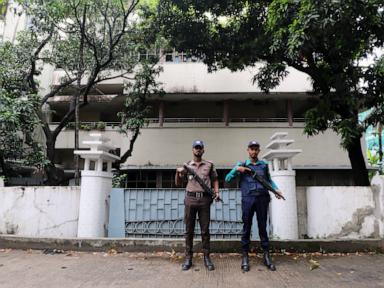
Arson targeting the residence of a former interim head of government in Bangladesh is not an isolated act of street vandalism; it is a calculated signal of institutional fragility and contested legitimacy during a fragile political transition. When political actors bypass formal electoral or judicial mechanisms to strike the personal property of a former caretaker executive, they are executing a specific form of asymmetric signaling designed to intimidate transitional administrators, test the state's monopoly on violence, and raise the personal cost of public service for neutral technocrats.
Standard news coverage reduces these incidents to a linear narrative of rising political tensions and property damage. That framing misses the structural mechanics driving the instability. To understand why the residence of a former interim leader becomes a high-value target, analysts must examine the breakdown of transitional deterrence, the economics of political mobilization, and the historical vulnerability of Bangladesh's caretaker governance model. Building on this topic, you can find more in: What Most People Get Wrong About Sheikh Hasina's Planned Return to Bangladesh.
The Structural Mechanics of Targeted Political Arson
In polarized political systems undergoing regime transition or post-election consolidation, physical attacks on the private assets of former officials serve three distinct operational functions. Unlike mass protests, which aim to demonstrate numerical strength, targeted arson operates through precision deterrence and psychological coercion.
Retroactive Punishment and Precedent Setting
An interim or caretaker administration derives its authority from temporary neutrality rather than a permanent partisan base. Because interim leaders lack dedicated street-level militias or entrenched party machinery, they become uniquely vulnerable once they exit office. Burning a former leader's home establishes a clear precedent for future technocrats, judges, and election commissioners: decisions made against entrenched political factions carry delayed, personal retaliation once state security details are downgraded or withdrawn. Analysts at NBC News have also weighed in on this matter.Testing the State Monopoly on Violence
Max Weber defined the state by its monopoly on the legitimate use of physical force. During periods of heightened political friction in Dhaka and regional administrative hubs, opposition factions and rogue elements probe the boundaries of executive control. An attack on a high-profile residence functions as a stress test of the incumbent security apparatus. If law enforcement fails to prevent the breach or delays prosecution, it signals to grassroots operatives that the state's coercive capacity is either compromised by internal divisions or selectively withheld for political convenience.Asymmetric Cost Imposition
Conventional political campaigning requires massive capital expenditure, logistical coordination, and sustained voter outreach. Targeted arson requires minimal material input—a small group of operatives, basic accelerants, and a brief window of security lapse—to generate disproportionate media saturation and elite anxiety. The cost-to-impact ratio favors the aggressor, forcing the state to divert intelligence and policing resources toward static asset protection rather than broad public order maintenance.
The Institutional Vulnerability of the Interim Governance Model
Bangladesh's political history is heavily shaped by the tension between partisan governments and non-party caretaker or interim administrations. While designed to break deadlocks over electoral credibility, the interim model contains an inherent structural flaw: asymmetric accountability without long-term institutional protection.
During an interim tenure, the executive must make high-stakes decisions—overseeing prosecutions, restructuring bureaucratic appointments, reforming electoral commissions, and managing economic stabilization—that inevitably alienate powerful entrenched networks. These networks retain deep roots within the bureaucracy, business conglomerates, and student wings of major political parties.
Once the transition concludes and power shifts, the former interim leader reverts to private citizen status, stripped of executive authority while the aggrieved political networks regain institutional traction. Without a permanent political party to provide collective defense, the former administrator stands exposed. Standard reporting treats an attack on such a figure as a symptom of general unrest, ignoring that the target selection is specifically engineered to exploit this post-tenure protection gap.
Known Facts vs. Analytical Hypotheses
Separating verified operational realities from strategic inference is essential when assessing politically motivated property attacks in South Asia:
- Verified Reality: Residential attacks against political figures in Bangladesh historically correlate with inflection points in the political calendar—specifically around contested election cycles, judicial verdicts against senior party leaders, or disputes over transitional governance frameworks.
- Verified Reality: Interim administrators operate without organic street-level mobilization capacity, relying entirely on state security forces (such as the police, Rapid Action Battalion, or military detachments) for personal and property protection.
- Analytical Hypothesis: The timing of an arson attack against a former interim leader indicates either a deliberate breakdown in local police perimeter enforcement or a coordinated effort by rival factions to embarrass the current administration by demonstrating its inability to protect high-profile figures.
- Analytical Hypothesis: If left unpunished through transparent judicial proceedings, such incidents will accelerate brain drain from public institutions, as qualified technocrats refuse future appointments to electoral commissions, anti-corruption bodies, and transitional councils.
The Escalation Ladder in Bangladeshi Street Politics
Political violence in Bangladesh rarely erupts spontaneously; it follows a predictable escalation ladder governed by signaling, counter-signaling, and threshold testing. Understanding where residential arson sits on this spectrum clarifies the trajectory of the current crisis.
- Stage 1: Rhetorical Delegitimization
Political rivals frame the interim period or specific transitional policies as unconstitutional, foreign-backed, or partisan. This phase establishes moral permission for grassroots cadres to view former administrators not as neutral referees, but as hostile combatants. - Stage 2: Economic and Logistical Disruption
Factions deploy hartals (general strikes), transport blockades, and commercial shutdowns to impose macroeconomic pain on the sitting administration and test organizational discipline among party ranks. - Stage 3: Symbolic Property Targeting
Operatives escalate to damaging vehicles, party offices, and the private residences of former officials. Arson is the preferred tool at this stage because fire destroys physical heritage, creates visceral visual evidence for broadcast and social media, and carries high symbolic weight without necessarily triggering the immediate military intervention that mass-casualty attacks provoke. - Stage 4: Direct Confrontation and Institutional Paralysis
If Stage 3 attacks fail to elicit strong state deterrence, violence shifts toward direct clashes between rival street wings and security forces, threatening supply chains, garment sector exports, and sovereign credit stability.
Economic and Governance Spillovers
Political instability in Bangladesh carries immediate material consequences beyond domestic security. The national economy relies heavily on ready-made garment (RMG) exports, remittance inflows, and foreign direct investment—all of which are highly sensitive to perceptions of executive stability and rule of law.
When high-profile political arson occurs, international buyers and institutional investors do not evaluate the incident in isolation. They factor it into sovereign risk models alongside port congestion, energy supply reliability, and currency reserve buffers. A visible failure to protect the residence of a former head of government signals weak contract enforcement and unpredictable regulatory continuity.
Domestically, the security apparatus faces a resource allocation dilemma. Every police platoon or paramilitary unit reassigned to static guard duty at the private residences of former officials, judges, and diplomats reduces the manpower available for routine policing, highway security, and anti-smuggling operations. Over time, this defensive posture degrades baseline public safety and inflates internal security expenditures within the national budget.
Limitations of Conventional Security Responses
The standard state response to high-profile political arson involves deploying additional riot police, announcing administrative inquiry committees, and issuing blanket condemnations. Operational experience across transitional democracies demonstrates why these measures routinely fail to halt escalation.
First, administrative inquiry committees in South Asia suffer from severe credibility deficits. When probes lack independent prosecutorial power or fail to publish actionable findings within weeks, both the public and political operatives interpret the delay as institutional cover-up.
Second, static physical security—such as erecting barricades or stationing armed guards outside prominent homes—merely displaces the threat. Determined operatives shift toward softer targets, including the rural ancestral properties of officials, the businesses of their extended family members, or mid-level bureaucrats who lack VIP protection details.
Third, indiscriminate mass arrests of opposition activists following an arson incident often backfire. Sweeping detentions without forensic evidence clog an already overburdened court system, generate grievances that fuel recruitment for radical street wings, and draw scrutiny from international trade partners tying tariff preferences to human rights and governance benchmarks.
Strategic Imperatives for Stabilization
Containing the fallout from targeted political violence requires shifting from reactive perimeter defense to structural deterrence. State authorities and institutional stakeholders must execute three decisive interventions to prevent the escalation ladder from reaching Stage 4.
Enforce Rapid, Forensically Grounded Prosecution
Deterrence depends on the certainty and speed of punishment rather than its severity. Law enforcement must isolate the specific operatives and mid-level financiers responsible for the arson using telecommunications metadata, CCTV triangulation, and financial tracking, bringing formal charges within a strict 30-day window. Prosecuting the operational chain of command disrupts the sense of impunity that enables Stage 3 violence.💡 You might also like: The Quiet Shrinkage of the Persian TableCodify Statutory Post-Tenure Protection Protocols
Security coverage for former heads of interim governments, chief justices, and chief election commissioners cannot remain subject to the discretionary whim of the incumbent home ministry. Parliament or the executive must establish an automatic, threat-tiered statutory protection framework managed by an apolitical security directorate, ensuring that transitional leaders retain standardized physical security for a fixed post-tenure period regardless of political shifts.Establish Cross-Party Red Lines on Private Property
Major political stakeholders must recognize that normalizing residential arson creates a mutually assured destruction dynamic. Once private homes become legitimate targets during opposition cycles, every incumbent leader faces identical vulnerability upon leaving office. Back-channel negotiations facilitated by neutral institutional actors—such as the judiciary or business chambers—must establish an explicit, enforceable consensus excluding private residences and family assets from political mobilization. Without this baseline restraint, every future transfer of power in Bangladesh will remain hostage to asymmetric street coercion.