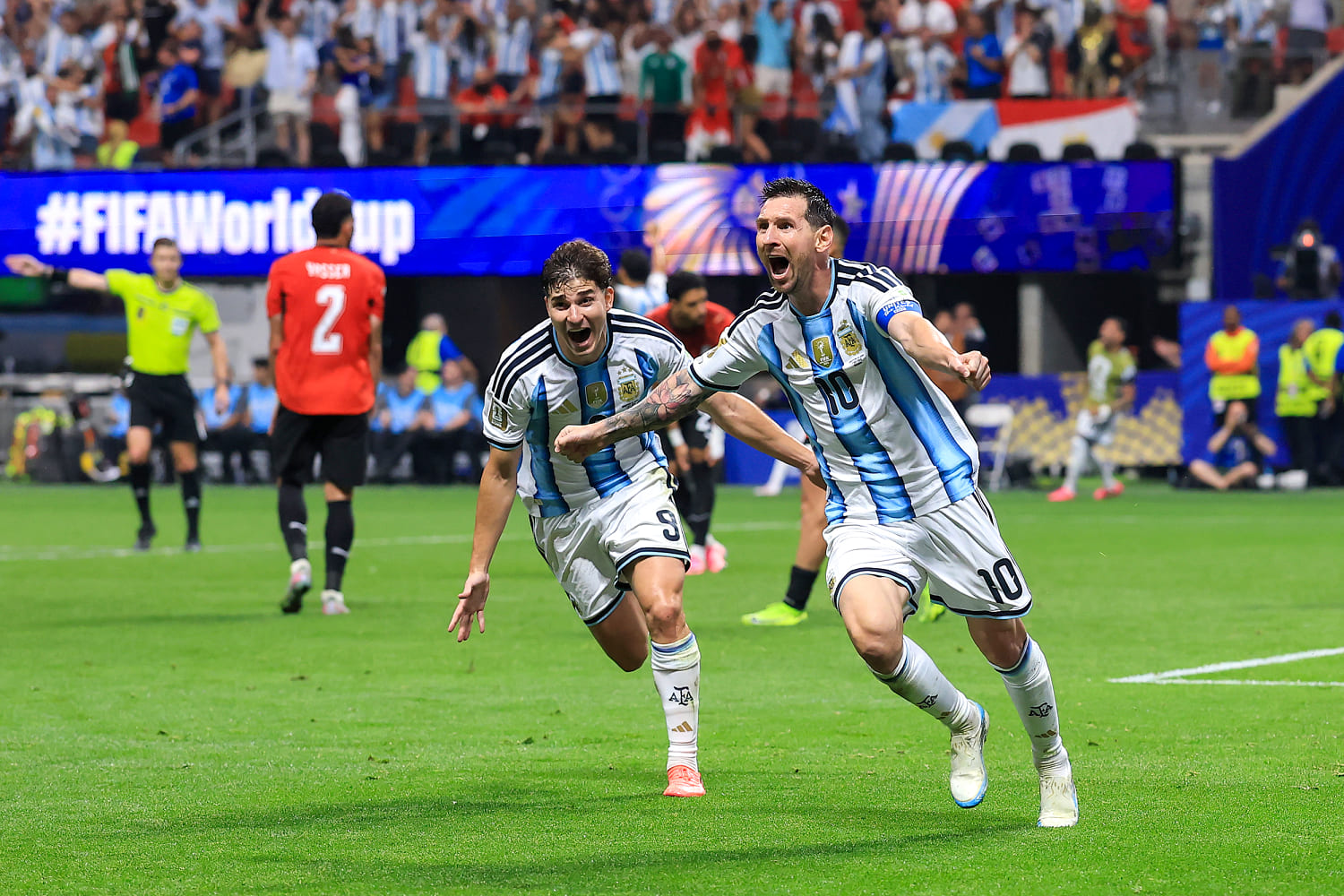
Relying on emotional resilience or "championship DNA" to explain elite sports outcomes obscures the quantifiable tactical shifts that dictate elite football. Argentina’s 3-2 victory over Egypt in the 2026 World Cup Round of 16 was not a mystical triumph of the will. It was the direct result of a structural collapse in Egypt’s low-block defensive system, paired with a calculated risk-asymmetry strategy deployed by Lionel Scaloni in the final 15 minutes of regulation.
By deconstructing the structural bottlenecks, phase transitions, and tactical mechanisms of the match, we can map exactly how a two-goal deficit was overturned in a 13-minute window. Also making headlines recently: Sweeping the Rockies Proves Nothing About the Dodgers and That is the Scariest Part.
The Strategic Failure of the Egyptian Low-Block
Egypt’s initial 2-0 lead was built on an efficient counter-pressing model. Operating in a compact 5-4-1 defensive shape, Hossam Hassan’s side successfully neutralized central progression by limiting the space between their defensive and midfield lines to under 12 meters. This defensive density forced Argentina into lateral ball circulation and low-probability crossing situations.
The system generated two high-value transition opportunities: Further insights regarding the matter are detailed by Yahoo Sports.
- The 15th-Minute Opener: A corner kick routine exposed Argentina’s zonal marking weaknesses, allowing Yasser Ibrahim to exploit the near-post space.
- The 67th-Minute Counter: A vertical break spearheaded by Mohamed Salah and Haissem Hassan exposed Nahuel Molina’s advanced positioning, creating a 2-on-1 isolation against Lisandro Martínez that Mostafa Ziko converted.
The bottleneck for Egypt occurred post-67th minute due to severe physical degradation. A low block requires constant lateral shifting and aggressive physical duels to close passing lanes. By the 75th minute, Egypt's midfield line stopped dropping quickly enough during transitions, expanding the space between their midfield and defensive lines from 12 meters to over 22 meters. This structural gap gave Lionel Messi the spatial freedom required to operate in the half-spaces—the exact zone he had been denied for the opening hour.
Tactical Asymmetry and the Three Catalysts of the Turnaround
Argentina's comeback was driven by three specific tactical adjustments that capitalized on Egypt's physical decline.
[Argentina's Late-Game Structural Shift]

Traditional Build-up:  Horizontal Circulation -> Low-Probability Crosses
                                     vs.
Asymmetric Overload:   Vertical Subloading -> Central Half-Space Access (Messi)
                       -> Defensive Compression -> Free Back-Post Late Runs
1. Vertical Subloading via Set-Pieces
When dynamic open-play progression fails, set-pieces become a team's primary tool for bypassing defensive structures. Despite missing a first-half penalty against Mostafa Shobeir, Messi's delivery quality from dead-ball situations remained mathematically precise. In the 79th minute, Argentina exploited Egypt's dropping defensive line on a free-kick. By pinning Egypt's zonal markers deep within their own six-yard box, Cristian Romero found the space to execute a high-velocity header. This goal did more than just cut the deficit; it forced Egypt to drop even deeper, abandoning any attempt at a high press.
2. Space Creation through Defensive Compression
Messi’s 83rd-minute equalizer was a direct consequence of Egypt’s structural collapse. As Argentina pushed extra bodies into the penalty box, Egypt’s backline compressed horizontally to protect the goalmouth. This defensive compression left the edge of the 18-yard box completely unmonitored. When a loose ball dropped to the edge of the area, Egypt’s exhausted midfield failed to step up and close down the space. This gave Messi the time and angle needed to score his eighth goal of the tournament.
3. Transition Failure on the Counter-Press
The game-winning goal in the 92nd minute came from a critical mistake by Egypt's primary playmaker. Mohamed Salah was dispossessed deep in Argentina's half after being isolated without supporting options. This turnover caught Egypt out of position, leaving them highly vulnerable to a counter-attack. With Egypt's defensive lines stretched, Lautaro Martínez pulled wide to drag the remaining center-backs out of position. This opened up a late-running lane through the center of the box for Enzo Fernández, who scored the decisive goal.
Systemic Vulnerabilities and Future Outlook
While this dramatic comeback keeps Argentina's title defense alive, relying on late turnarounds points to deeper issues in their overall strategy. For the second consecutive knockout round—following an exhausting 120-minute match against Cape Verde—Argentina showed significant defensive weaknesses when facing fast, vertical counter-attacks.
The primary tactical limitation lies in Argentina's rest-defense structure. When their full-backs push high up the pitch to support the attack, the defensive midfielders are left covering too much ground. Elite, structured counter-attacking teams can exploit these wide open spaces before Romero or Lisandro Martínez can shift over to help. Furthermore, Messi's historic scoring run and high volume of shots mask a lack of clinical finishing from Argentina's traditional forwards in open play.
To prepare for their quarterfinal match against Switzerland on July 12, Scaloni must fix these defensive vulnerabilities. The Swiss team uses a highly disciplined mid-block system and excels at quick transitions through wide areas. Argentina cannot afford to fall behind early again; they must adjust their full-back positioning to ensure they have proper cover at the back, preventing opposing teams from breaking through at will during counter-attacks.