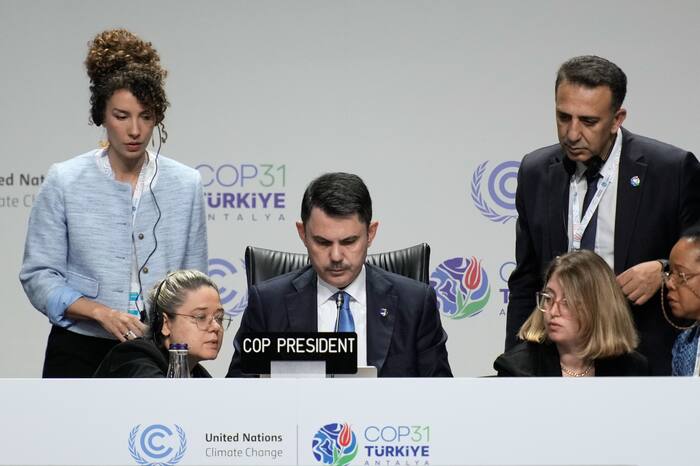
Deleting two words from a diplomatic cover text collapsed the 31st United Nations Climate Change Conference in Antalya, Turkey, triggering the first failure to reach an overarching summit agreement in 17 years. When the joint Turkish-Australian presidency published the final draft of the "Antalya Pact" on November 21, 2026, after 49 hours of overtime negotiations, the text omitted any mention of fossil fuels or the mandate to transition away from them. Instead of securing a lowest-common-denominator consensus, the omission forced a coalition of roughly 130 nations—led by the European Union, the United Kingdom, and vulnerable climate blocs—to reject the pact outright during the closing plenary.
Standard news coverage frames this outcome as a simple diplomatic breakdown or an editorial failure of political will. That view misses the structural economics and game-theoretic mechanics driving the impasse. The collapse in Antalya represents a rational market correction within multilateral climate governance: capital-importing and climate-vulnerable economies refused to sign a document that subsidized fossil fuel incumbency through strategic ambiguity while stripping away investment signals for renewable infrastructure.
The Structural Mechanics of Diplomatic Omission
In multilateral treaty negotiations, a cover decision functions as a macro-level capital allocation signal. Sovereign wealth funds, development banks, and private energy utilities price long-term infrastructure risk based on the consensus trajectory established by the United Nations Framework Convention on Climate Change (UNFCCC). Removing explicit references to hydrocarbons alters that risk pricing immediately.
The Antalya draft operated through three distinct mechanisms of linguistic substitution to protect incumbent energy producers:
- Supply-Side Erasure: Following sustained pressure from major hydrocarbon exporters—specifically Saudi Arabia, Russia, and Iran—negotiators excised the phrase "transitioning away from fossil fuels," which had been established three years earlier at COP28 in Dubai. By targeting the fuel source rather than aggregate emissions, the text attempted to decouple decarbonization targets from upstream oil, gas, and coal extraction.
- Abatement Substitution: While eliminating supply-side phase-out language, the draft explicitly inserted a gigatonne-scale aspiration for Carbon Capture, Utilization, and Storage (CCUS) by 2035. In energy economics, prioritizing unproven or capital-intensive abatement technologies over direct source replacement extends the operational lifespan of stranded fossil assets.
- Unconditioned Demand Targets: The co-presidency introduced a voluntary "35 by 35" pledge aiming to raise electricity's share of total final energy consumption to 35 percent globally by 2035. Crucially, the draft omitted any requirement that this new electrical capacity be generated from renewable sources. Electrifying transport and heating without mandating clean generation simply shifts hydrocarbon demand from tailpipes and boilers to gas- and coal-fired power plants.
This combination created an asymmetric policy instrument. It validated downstream technology deployment (electrification and carbon capture) while neutralizing upstream constraints on oil and gas production.
The Cost Function of Consensus Governance
The UNFCCC operates under a rule of universal consensus, defined operationally not as unanimity, but as the absence of formal objection during a plenary session. Under standard diplomatic conditions, presidencies exploit this rule by watering down text until the marginal cost of signing is lower than the reputational cost of blocking an agreement.
In Antalya, the joint presidency miscalculated the payoff matrix for the progressive coalition. When a cover text regresses behind previously agreed baselines—specifically the COP28 transition mandate and the 2015 Paris Agreement temperature limits—the cost of signing changes from neutral to actively destructive.
Consider the operational impact on three distinct negotiating blocs:
- European Industrial Planners: The EU and its 27 member states have already legislated binding carbon pricing, border adjustment mechanisms, and phase-out schedules. Endorsing a UN pact that omits fossil fuels would undermine the international legitimacy of their domestic carbon tariffs and expose European manufacturers to unmitigated carbon leakage.
- Import-Dependent Developing Economies: Nations such as Bangladesh face acute balance-of-payments vulnerabilities when global liquefied natural gas (LNG) prices spike. An unconditioned electrification target combined with weak transition language locks these economies into volatile imported fuel contracts rather than domestic solar and wind deployment.
- Small Island and Low-Lying States: For Pacific island nations and Latin American blocs like AILAC, COP31 was already confronting scientific confirmation that global heating will temporarily overshoot the 1.5 degrees Celsius threshold. Accepting a text that ignores the primary physical driver of thermal expansion and sea-level rise—coal, oil, and gas combustion—is politically untenable for governments facing existential territorial loss.
By pushing the draft below the COP28 baseline, Turkey and Australia inverted the traditional consensus trap. Roughly 40 countries took the floor during the final plenary to formally object, proving that for a supermajority of states, no deal carries a higher net value than a regressive deal.
Geopolitical Shifts and the Vacancy of Enforcement
The structural failure in Antalya cannot
The Architecture of Omission in UN Climate Diplomacy
news, business
Deleting the phrase "fossil fuels" from a United Nations climate summit final draft is not a clerical oversight or a semantic compromise; it is a deliberate structural intervention designed to decouple emissions targets from supply-side accountability. When Turkey, acting as host or presidency in international climate negotiations, circulates a closing text that omits explicit references to coal, oil, and gas, the mechanism shifts the entire regulatory burden onto downstream abatement technologies and unproven carbon markets. Understanding this omission requires analyzing international climate governance not as an environmental consensus-building exercise, but as a multi-party risk-allocation negotiation where language dictates capital flow, sovereign liability, and asset stranding timelines.
The Mechanics of Lexical Erasure in Multilateral Treaties
In multilateral environmental agreements governed by the United Nations Framework Convention on Climate Change (UNFCCC), decision texts operate through consensus, granting every participating state an effective veto over specific phrasing. Words in a cover decision carry legal, financial, and reputational weight that extends far beyond the diplomatic plenary hall.
The omission of fossil fuels operates through three distinct institutional levers:
- Regulatory Signaling to Capital Markets: Institutional investors, sovereign wealth funds, and development banks use UNFCCC text to calibrate long-term risk premiums. When a final draft explicitly names fossil fuels for phase-out or transition, the cost of capital for upstream exploration and midstream infrastructure rises immediately. Removing the phrase preserves the bankability of long-lived hydrocarbon assets by denying financial regulators an international mandate to penalize fossil-linked portfolios.
- Sovereign Asset Protection and Stranded Asset Deferral: Major hydrocarbon producers and transit hubs face trillions of dollars in potential stranded assets if global demand peaks prematurely. By stripping supply-side language from the text, negotiating blocs shift the policy focus from production limits to emissions management. Under an emissions-management framework, a nation can continue extracting and exporting oil and gas indefinitely, provided the resulting carbon dioxide is theoretically captured or offset elsewhere.
- Asymmetric Compliance Liabilities: Naming fossil fuels creates a clear binary metric for compliance: either production and consumption decline, or a state is in breach of the agreement's spirit. Omitting the fuel source replaces a binary supply metric with a complex, opaque accounting system based on net emissions, allowing states to claim compliance through land-use credits, bilateral offsets, or future technological pledges.
The precedent established at COP28 in Dubai, where parties agreed to "transition away from fossil fuels in energy systems," was the result of nearly three decades of diplomatic friction. Prior to 2023, the words "fossil fuels" never appeared in a final COP cover decision, despite coal, oil, and gas accounting for over 75 percent of global greenhouse gas emissions and nearly 90 percent of all carbon dioxide emissions. When a subsequent draft—such as Turkey's text—reverts to pre-2023 lexical norms, it signals a rollback of the consensus baseline.
Turkey's Structural Incentives as Host and Regional Energy Hub
To understand why a draft under Turkish stewardship would exclude fossil fuel language, one must examine Turkey's domestic energy balance, geopolitical positioning, and macroeconomic vulnerabilities. A COP presidency or host nation does not operate in a vacuum; its drafting team reflects the economic realities of its state apparatus and the diplomatic pressures of its regional alliances.
Turkey occupies a dual position in the global energy architecture:
- Import-Dependent Industrial Economy: Turkey relies heavily on imported natural gas, oil, and thermal coal to power its manufacturing sector and residential heating. Rapidly phasing out fossil fuels without massive, subsidized grid overhauls threatens domestic industrial competitiveness and exacerbates current account deficits.
- Eurasian Energy Transit Corridor: Positioned between major hydrocarbon producers in Russia, the Caspian basin, and the Middle East, and major consumers in Europe, Turkey's strategic leverage depends on pipeline infrastructure, liquefied natural gas (LNG) terminals, and storage hubs. International mandates that explicitly target fossil fuel infrastructure directly threaten the long-term return on investment for Turkey's transit corridors.
- Domestic Coal and Gas Expansion: While Turkey has expanded solar and wind capacity, its energy security strategy continues to incorporate domestic lignite coal mining and offshore natural gas exploration in the Black Sea. A UN text mandating a rapid phase-out of unabated fossil fuels creates immediate domestic policy friction.
Beyond domestic economics, a COP host faces the institutional imperative of securing a gavel—achieving unanimous adoption of a final text before the summit collapses. Petrostates and fossil-fuel-dependent developing economies routinely threaten to block consensus if supply-side restrictions appear in the cover decision. Faced with a binary choice between a weakened text that achieves consensus and a rigorous text that triggers a diplomatic walkout, presidencies frequently sacrifice specificity to preserve the appearance of multilateral progress.
The Substitution Effect: How Omission Distorts Climate Policy
When "fossil fuels" is removed from a climate agreement, the diplomatic vacuum is filled by alternative terminology. These substitute phrases are not neutral synonyms; they represent distinct economic and engineering pathways that alter where capital is deployed.
Emissions vs. Source Accounting
Standardizing on "emissions reductions" rather than "fossil fuel phase-out" treats all tons of carbon dioxide equivalent as fungible, regardless of origin. In atmospheric physics, a ton of CO2 from a coal plant is identical to a ton of CO2 from deforestation. In economic policy, treating them identically creates a moral hazard. It allows high-emitting energy systems to delay structural decommissioning by purchasing low-cost nature-based offsets or promising future reductions in non-energy sectors.
The "Unabated" Loophole
When fossil fuels are referenced indirectly, drafts frequently rely on the qualifier "unabated"—referring to hydrocarbons burned without Carbon Capture, Utilization, and Storage (CCUS). Because the UNFCCC has never adopted a strict, binding definition of what percentage of emissions must be captured for a facility to qualify as "abated," the term functions as a regulatory escape hatch. A power plant capturing 20 percent of its emissions can theoretically claim abated status, extending the operational lifespan of coal and gas infrastructure while failing to meet the physical requirements of the 1.5°C warming threshold.
Technology Neutrality as Delay
Advocates of omitting fuel-specific language argue for "technology neutrality," positing that markets should determine the cheapest way to reduce emissions without government mandates picking winners and losers. In practice, technology neutrality in energy grids favors incumbent infrastructure. Existing coal and gas plants have already amortized their capital expenditures; without explicit regulatory phase-out schedules or steep carbon pricing, incumbent fossil assets outcompete new renewable installations on short-term marginal cost in distorted markets.
The Thermodynamics of Diplomatic Delay
Climate negotiations operate on political timelines, but atmospheric warming is governed by cumulative carbon budgets. The physical relationship between fossil fuel combustion and global mean surface temperature is linear and irreversible on human timescales.
The Intergovernmental Panel on Climate Change (IPCC) Sixth Assessment Report established that limiting warming to 1.5°C with no or limited overshoot requires global greenhouse gas emissions to peak before 2025 and decline by 43 percent by 2030 relative to 2019 levels. Achieving that trajectory requires an immediate, steep contraction in the combustion of coal, oil, and natural gas.
When a UN final draft omits fossil fuels, it creates a structural mismatch between diplomatic output and physical reality:
- Infrastructure Lock-In: Every year that international policy fails to mandate a phase-out, new gas-fired power plants, pipelines, and LNG export terminals reach final investment decision. Once built, these assets have operational lifespans of 30 to 50 years. The committed emissions from existing and planned fossil fuel infrastructure already exceed the remaining carbon budget for 1.5°C.
- The Steepening Mitigation Curve: Delaying supply-side cuts does not reduce the total mitigation required; it compresses the timeline. If emissions remain flat through 2027 due to weak diplomatic signals, the subsequent annual reduction rate required to stay within temperature limits shifts from an orderly economic transition (4 to 5 percent per year) to an economically catastrophic contraction (exceeding 10 to 12 percent per year).
- Adaptation Cost Escalation: Suppressing mitigation language directly inflates future adaptation liabilities. Every tenth of a degree of warming avoided by curbing fossil fuels reduces nonlinear climate damages—such as agricultural yield collapse, wet-bulb heat events, and coastal infrastructure inundation. Omitting the primary driver of warming effectively transfers wealth from climate-vulnerable developing nations, which bear the brunt of physical damages, to hydrocarbon-exporting states, which capture near-term economic rents.
Strategic Countermeasures for Negotiators and Capital Allocators
Relying on consensus-based UN cover decisions to drive fossil fuel phase-outs has proven structurally fragile. When a host nation's draft strips out supply-side language, states, subnational actors, and institutional investors cannot wait for the next annual summit to restore the text. Capital and policy must bypass the consensus bottleneck through targeted, non-UNFCCC mechanisms.
1. Deploy Plurilateral Supply-Side Coalitions
Rather than fighting for unanimous language among 198 parties where a single petrostate holds veto power, ambitious nations must shift binding commitments to plurilateral clubs. Initiatives like the Beyond Oil and Gas Alliance (BOGA) and the Powering Past Coal Alliance (PPCA) establish concrete phase-out dates and end public financing for upstream exploration among willing states. Expanding these coalitions to include trade benefits—such as preferential green technology transfers and shared grid interconnections—creates economic incentives for fence-sitting nations to join, rendering the watered-down UN cover decision secondary to bilateral trade reality.
2. Enforce Border Carbon Adjustments
If international treaties refuse to restrict fossil fuel supply, importing economies must price the embedded carbon of traded goods at the border. Mechanisms like the European Union's Carbon Border Adjustment Mechanism (CBAM) force exporting nations to internalize the cost of fossil-heavy manufacturing. Expanding border adjustments to cover refined petroleum products, petrochemicals, and LNG imports directly penalizes states that rely on diplomatic omissions to protect unabated hydrocarbon industries.
3. Mandate Scope 3 Disclosure and Transition Plans in Financial Regulation
Central banks and securities regulators in major financial centers (New York, London, Frankfurt, Tokyo, Singapore) control the underwriting and debt issuance that keep fossil fuel companies solvent. Financial authorities must decouple prudential regulation from UN diplomatic phrasing. By enforcing mandatory climate risk disclosures that include Scope 3 downstream emissions and requiring banks to hold higher capital reserves against unaligned upstream loans, regulators can tighten the cost of capital for new fossil fuel projects regardless of what Turkey or any future COP presidency writes in a summit draft.
4. Redirect Development Finance to Grid Storage and Transmission
The strongest economic argument used by developing nations to resist fossil fuel phase-out language is grid reliability and baseload power. Multilateral development banks must stop financing transitional natural gas infrastructure and concentrate concessional capital exclusively on utility-scale battery storage, long-duration energy storage, and high-voltage direct current (HVDC) transmission lines. Solving the intermittency bottleneck eliminates the technical justification for keeping coal and gas on the grid, stripping hydrocarbon exporters of their most effective diplomatic talking point in future climate negotiations.