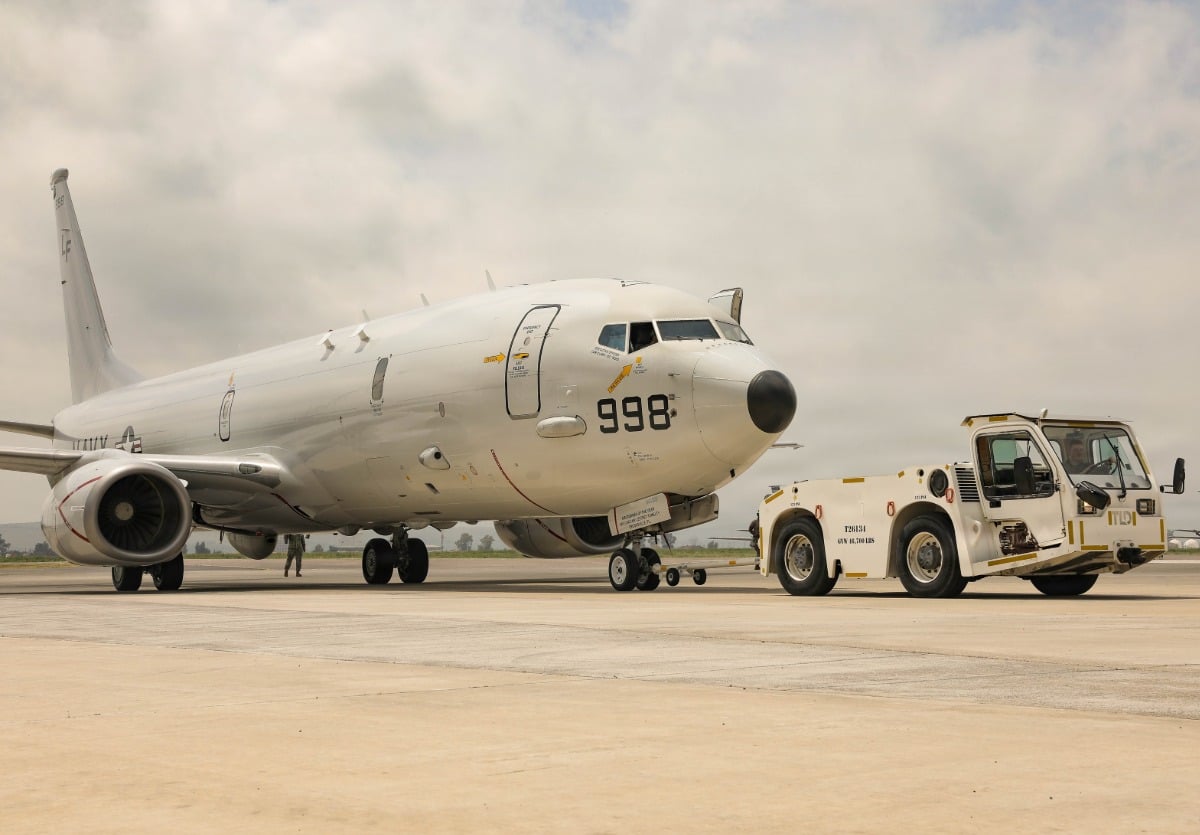
The traditional metric for maritime patrol superiority—fleet size—is obsolete. Modern undersea warfare is governed by a data-velocity bottleneck: the capacity of an airborne platform to ingest, process, and distribute multi-static acoustic data before a submerged target alters its vector. This reality underpins the $121.2 million Naval Air Systems Command contract awarded to Boeing. The deal, structured as a cost-plus-fixed-fee order, finances the integration of Increment 3 Block 2 modifications across nine P-8A Poseidon aircraft: six for the United States Navy and three for the Royal Australian Air Force.
While superficial commentary views this transaction as a routine maintenance allocation, structured analysis reveals a targeted capital deployment designed to resolve precise architectural limitations in Western anti-submarine warfare (ASW). The operational lifecycle of long-range maritime patrol demands a continuous trade-off between structural sustainment and computational relevance. By examining the mechanics of this upgrade, we can isolate the core variables driving modern maritime defense procurement.
The Triad of Airborne ASW Decay
To understand why a nine-aircraft retrofit commands a nine-figure valuation, one must analyze the three structural degradation vectors affecting legacy P-8A configurations. Platforms deployed in high-salinity, low-altitude littoral environments face compounding operational friction that cannot be solved by hull maintenance alone.
       [ Acoustic Ingestion Saturation ]
                      │
                      ▼
[ Diminishing Manufacturing Sources (DMS) ] ──► [ System Bottleneck ]
                      ▲
                      │
    [ Networked Interoperability Gaps ]
1. Acoustic Ingestion Saturation
The primary sensor mechanism of the P-8A is the sonobuoy—expendable acoustic listening devices deployed via a pneumatic rotary launcher. Modern undersea threats utilize advanced anechoic coatings and skewed propeller designs to minimize acoustic signatures, forcing maritime patrol forces to deploy complex multi-static active coherent sonobuoy fields. Processing these intersecting sonar returns generates exponential increases in raw telemetry data. Legacy P-8A mission computing architectures lack the localized processing density required to execute simultaneous passive and active acoustic algorithms without introducing latency.
2. Diminishing Manufacturing Sources and Material Shortages
A major fraction of the $121.2 million contract is explicitly allocated to non-recurring engineering activities designed to mitigate component obsolescence. Defense aviation assets operate on multi-decade horizons, whereas commercial microelectronics lifecycles span less than 36 months. The commercial derivative nature of the P-8A—built on the Boeing 737-800ERX airframe—exposes the platform to supply chain fragility. When tier-three and tier-four component suppliers discontinue specific logic boards or specialized high-output components, the military must fund structural redesigns of the internal housings to accept newer semiconductor architectures.
3. Networked Interoperability Gaps
An isolated sub-hunter is a tactical liability. The operational mandate of the Indo-Pacific theater requires real-time data fusion between manned platforms, surface combatants, and long-endurance unmanned aerial vehicles like the MQ-4C Triton. Legacy communication pipelines rely heavily on standard Link 16 bandwidth profiles, which are highly susceptible to saturation during multi-domain engagement scenarios. Without the high-capacity mission communication suites provided by Increment 3 Block 2, the P-8A becomes an informational silo, incapable of passing target-quality tracking data to remote weapon systems before the tactical window closes.
Technical Deconstruction of the Increment 3 Block 2 Package
The upgrade package does not alter the aerodynamic performance profiles of the CFM56-7B engines or the structural 25,000-flight-hour lifespan of the airframe. Instead, it re-architects the internal payload and digital backbone.
The retrofit centers on Engineering Change Proposal 6 (ECP 6) capabilities, delivered through physical integration componentry known as "A-kits." These kits establish the structural wiring, optical fiber trunks, power distribution modifications, and external antenna fairings necessary to host the updated software and hardware modules.
The physical modifications enable distinct operational capabilities:
- Advanced Mission Computing Architecture: The replacement of legacy processors with high-density server blades capable of parallel data processing. This enables simultaneous execution of the Raytheon APY-10 surface-search radar algorithms alongside high-capacity acoustic tracking programs.
- Weapon Interface Modernization: The upgrade modifies the digital stores management system within the internal five-station weapons bay and the four under-wing pylons. This structural modification facilitates the integration of next-generation kinetic systems, specifically the Lockheed Martin AGM-158C Long Range Anti-Ship Missile (LRASM).
- High-Altitude Anti-Submarine Warfare Capability (HAAWC): The computing system is adapted to support the HAAWC Air Launch Accessory. This kit attaches a flight-control wing package and GPS guidance system to Mark 54 lightweight torpedoes, converting a traditional low-altitude weapon into a precision glide bomb capable of release from 30,000 feet.
This high-altitude release mechanism removes the structural penalty of low-level flight. Dropping down to 200 feet to deploy legacy torpedoes subjects the airframe to extreme atmospheric turbulence and accelerated fatigue cycles while consuming fuel at a rate three times higher than at high altitudes. Operating continuously at 41,000 feet maximizes time-on-station efficiency.
The Industrial Logic of Joint Procurement
The inclusion of the Royal Australian Air Force in this Navy contract mechanism represents an optimization strategy that leverages industrial commonality to manage unit costs. Australia's acquisition of 14 P-8A aircraft to replace its legacy AP-3C Orion fleet creates a critical mass of operational identicality in the Pacific theater.
[ U.S. Navy / RAAF Common Architecture ]
                 │
                 ├──► Joint Supply Chain Stabilization
                 ├──► Interoperable Depot-Level Maintenance (Jacksonville & Cecil Airport)
                 └──► Zero-Lag Tactical Data Fusion via Link 16 / Satellites
By merging RAAF retrofits into the NAVAIR contracting structure, both nations mitigate the premium associated with short production runs of highly specialized components. The non-recurring engineering costs required to redesign obsolete components are amortized across a larger global fleet pool.
Furthermore, this shared architecture guarantees absolute interchangeability at the depot level. The physical modification work occurs across two key industrial hubs: Boeing’s Maintenance, Repair, and Overhaul center at Cecil Airport in Jacksonville, Florida, and a dedicated facility near RAAF Base Edinburgh in South Australia. Because the internal "A-kits" and processing logic are perfectly aligned, a U.S. Navy P-8A operating out of the Western Pacific can utilize Australian maintenance pipelines for advanced mission system repairs without generating configuration conflict.
The Strategic Undersea Reality
The acceleration of this upgrade program is directly correlated with the expansion of adversarial submarine capabilities in the Western Pacific, primarily the deployment of Type 093 class nuclear-powered attack submarines and advanced conventional diesel-electric boats. The modern undersea threat profile is no longer defined by loud, easily localizable acoustic targets. Instead, it features highly quiet hulls operating within deep ocean trenches and contested littoral zones.
The core challenge of modern ASW is the Search Area Cost Function. Every hour spent searching a sector without a detection increases the probability of an adversarial missile launch or the compromise of friendly surface groups. By expanding the sensor processing bandwidth of the P-8A, the Navy effectively expands the area a single platform can scan per mission hour.
However, the strategy is bounded by specific structural vulnerabilities:
- Airspace Contestability: The P-8A is a modified commercial airliner. It lacks low-observable stealth features and possesses a radar cross-section that makes it highly vulnerable to long-range surface-to-air missiles and fifth-generation interceptors.
- Sonobuoy Supply Chain Constraints: The data-driven capability of Increment 3 Block 2 is entirely dependent on the continuous deployment of high-cost sonobuoys. In a high-intensity, sustained conflict, consumption rates will stress current industrial manufacturing capacities, potentially rendering the advanced processing hardware useless if sensor stores are exhausted.
The Strategic Recommendation
The completion of this specific contract segment by May 2029 will achieve parity across the initial batch of nine airframes, but it highlights a broader operational imperative. Defense planners must transition from viewing the P-8A as a standalone search-and-strike platform to treating it as the central node of an distributed sensor matrix.
The logical final play for naval strategists is the immediate integration of these upgraded aircraft with uncrewed surface and subsurface vessels. The P-8A should not seek to enter high-threat anti-access/area-denial (A2/AD) zones to drop sonobuoys directly. Instead, the advanced mission computing suite unlocked by the Increment 3 Block 2 configuration must be positioned outside the threat ring, utilizing its massive data processing capacity to ingest and analyze telemetry streamed from expendable, autonomous maritime drones operating deep within the contested zone. This shifts the platform's role from a tactical search asset to an airborne theater-command node, preserving high-value manned airframes while maximizing undersea target visibility.


