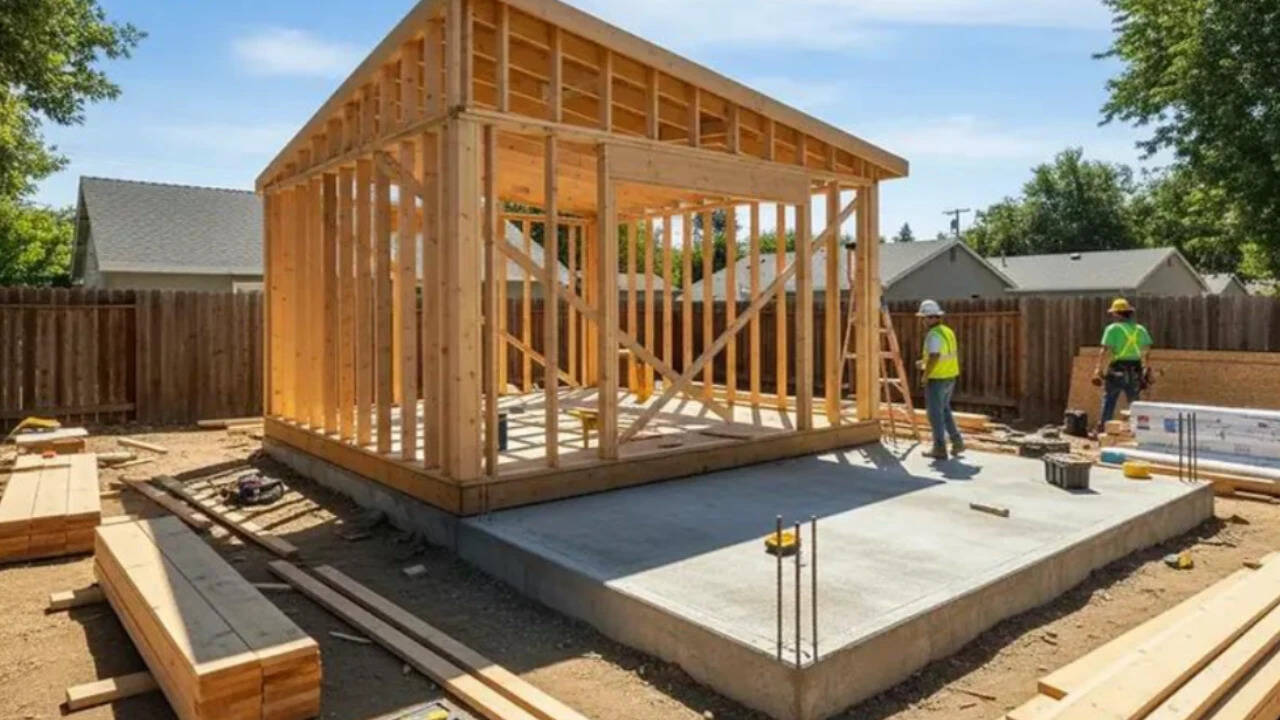
The sentencing of a California accountant to 63 months in federal prison over an $8.2 million Accessory Dwelling Unit (ADU) fraud scheme exposes a structural vulnerability at the intersection of aggressive state housing policy and private capital allocation. When governments rapidly deregulate a sector to solve a supply deficit, capital inflows inevitably outpace verification infrastructure. In California, streamlined permitting laws for backyard homes created a high-velocity market that bad actors exploited by weaponizing professional credentials to manufacture phantom assets.
Standard news coverage treats this event as an isolated criminal anomaly—a rogue financial professional abusing trust. That framing misses the operational reality. The scheme succeeded because it exploited three distinct systemic failures: credential-based trust heuristics, asymmetric information in decentralized construction financing, and the verification lag inherent in rapid municipal deregulation. Understanding how an $8.2 million capital extraction operates requires deconstructing the mechanics of construction lending, the psychology of affinity and authority fraud, and the specific risk-control failures that allow non-existent physical structures to pass through financial underwriting.
The Structural Mechanics of Regulatory Arbitrage Fraud
Fraud of this magnitude rarely relies on technical hacking or sophisticated forgery. Instead, it relies on regulatory arbitrage—exploiting the gap between the speed of a new market opportunity and the legacy compliance frameworks designed to govern it.
Between 2017 and 2023, California enacted a series of aggressive legislative reforms (including SB 1069, AB 2299, and AB 68) designed to eliminate local zoning barriers for ADUs. The policy objective was clear: accelerate residential infill development by reducing municipal discretion, capping impact fees, and mandating ministerial approval timelines.
This legislative shift altered the unit economics of residential real estate:
- Lowered Barriers to Entry: Homeowners and small-scale investors suddenly held development rights that previously required years of variance hearings.
- Compressed Timelines: Permitting windows shrank from years to statutory 60-day review periods.
- Capital Influx: Private lenders, syndicators, and retail investors rushed to fund ADU construction, viewing backyard homes as low-risk, high-yield fixed-income alternatives backed by California residential equity.
In any market undergoing rapid deregulation, due diligence protocols degrade first. Lenders and equity investors competing for deal flow compress their underwriting timelines to match the speed of permitting. When an accountant—an actor culturally and legally conditioned to represent fiduciary conservatism—enters this high-velocity environment, the friction of verification drops to near zero.
The Credential Halo and Authority Bias
In financial crime, the perpetrator’s primary asset is rarely their technical ability to cook books; it is their ability to suppress the counterparty's skepticism. An accountant occupies a unique position in the financial ecosystem. Unlike a real estate developer, whose incentives are visibly tied to project completion and upside capture, an accountant is perceived as a gatekeeper of compliance, tax optimization, and risk mitigation.
This creates a credential halo. Investors evaluating an ADU development pitch from a licensed accountant apply a lower discount rate to operational risk. They assume financial controls are inherent to the operator's professional identity. This cognitive shortcut—authority bias—substitutes for independent third-party verification. When an accountant presents pro forma projections, construction budgets, and municipal permit receipts, counterparties treat the documents as audited outputs rather than unverified marketing collateral.
Deconstructing the $8.2 Million Capital Extraction Engine
To extract $8.2 million across backyard home projects without triggering immediate default alarms, a scheme must solve a fundamental operational problem: the physical visibility of real estate. Unlike securities fraud, where assets exist as ledger entries, construction fraud must account for the absence of physical structures on real parcels of land.
Based on established patterns in federal wire fraud prosecutions involving construction and real estate syndication, this type of capital extraction operates through four sequential phases.
Phase 1: The Yield-Arbitrage Pitch
The operator identifies a market inefficiency that is factually accurate. In California, the cost to construct a detached ADU (typically ranging from $150,000 to $350,000 depending on square footage and utility tie-ins) is substantially lower than the capitalized value the unit adds to the primary property (often $300,000 to $600,000+ in high-cost coastal markets).
By anchoring the pitch in verifiable macroeconomic data—California's housing shortage and favorable state ADU statutes—the perpetrator establishes immediate credibility. Investors are offered fixed-rate promissory notes or preferred equity stakes promising annualized returns between 8% and 14%, ostensibly secured by underlying real property or construction receivables.
Phase 2: Synthetic Deal Flow and Phantom Collateral
Because actual ADU construction is slow, labor-intensive, and subject to supply chain bottlenecks, an operator seeking rapid scale cannot rely on real projects to generate the fees or capital inflows needed to sustain the enterprise. The operation transitions from legitimate development to synthetic deal flow:
- Parcel Identification: The operator identifies existing residential properties—either owned by complicit associates, unwitting clients, or unrelated third parties—that meet basic lot-size criteria for an ADU.
- Document Fabrication: Utilizing standard architectural templates and altered municipal fee receipts, the operator manufactures a "shovel-ready" project file. Because local building departments vary wildly in their digital record-keeping, verifying the authenticity of a municipal plan-check receipt requires manual inquiry that private lenders frequently skip on smaller-balance loans ($150,000–$250,000).
- Duplicate Hypothecation: In advanced stages of construction fraud, the same underlying parcel or project budget is pledged to multiple private lenders simultaneously. Because private notes are often unrecorded or recorded late in the transaction cycle, title searches fail to capture the competing encumbrances.
Phase 3: The Ponzi Liquidity Bridge
Construction projects do not generate cash flow until completion and lease-up—a process taking 9 to 18 months. However, private investors demand quarterly or monthly interest distributions. To bridge this duration mismatch, the operator uses incoming principal from new investors to pay interest obligations to earlier cohorts.
At an $8.2 million scale, assuming an average investment tranche of $100,000 to $250,000, the operator must manage between 35 and 80 distinct capital accounts. Maintaining the illusion of solvency requires continuous capital raising. Every month without construction completion increases the burn rate, forcing the operator to accelerate fundraising and fabricate more aggressive project pipelines.
Phase 4: Asset Diversion and Commingling
Without institutional fund administration—where a third-party escrow agent disburses funds directly to licensed general contractors upon verified inspection milestones—capital flows directly into operating accounts controlled by the perpetrator. Once commingled, investor funds are diverted to cover personal liabilities, unrelated business losses, and liquidity gaps in the distribution schedule.
The Verification Deficit in Decentralized Construction Finance
Why did sophisticated investors and lenders fail to detect the absence of physical construction? The answer lies in the structural flaws of decentralized, small-balance construction lending.
Institutional commercial real estate lending relies on rigid draw administration protocols. Before a bank releases $100,000 for framing or foundation work, an independent construction consultant visits the site, photographs the progress, verifies lien waivers from subcontractors, and confirms municipal sign-off on the building card.
Small-balance ADU financing operates outside this institutional perimeter:
- Unit Size Economics: A $200,000 ADU loan is too small for major institutional banks to underwrite profitably using full commercial draw protocols. The fixed cost of third-party site inspections erodes the lender's net interest margin.
- Reliance on Borrower Attestation: To preserve yield on small loans, private lenders and equity syndicators shift from physical verification to attestation-based underwriting. They accept borrower-submitted photos, invoices, and progress reports at face value.
- Client-Accountant Information Asymmetry: When an accountant raises capital from their existing tax and advisory client base, the dynamic is inverted. The investor relies on the perpetrator for their own financial clarity. Questioning the accountant’s project documentation feels like questioning one’s own financial advisor.
This creates a verification vacuum. The physical asset—a backyard structure hidden behind a primary residence, often invisible from the street—is uniquely suited to exploit lazy underwriting. Unlike a commercial office building or a street-facing retail center, an ADU cannot be verified via a casual drive-by inspection or updated street-level mapping imagery.
Sentencing Math and Federal Deterrence Mechanics
A 63-month federal prison sentence (5.25 years) for an $8.2 million fraud is not an arbitrary judicial number; it is the direct output of the United States Sentencing Guidelines (USSG) under § 2B1.1, which governs larceny, embezzlement, and fraud.
Understanding the sentencing calculus reveals how the federal justice system prices white-collar crime:
- Base Offense Level: For wire fraud or mail fraud carrying a statutory maximum of 20 years or more, the base offense level starts at 7.
- Loss Table Enhancements: The primary driver of federal white-collar sentences is the total intended or actual financial loss. Under the § 2B1.1 loss table, a loss exceeding $3.5 million but not exceeding $9.5 million triggers an automatic 18-level enhancement. At $8.2 million, the defendant sits near the top of this bracket.
- Specific Offense Characteristics: Additional enhancements apply based on operational mechanics—such as the number of victims (10 or more victims adds 2 levels), the use of sophisticated means (2 levels), or the abuse of a position of public or private trust (2 levels under § 3B1.3, directly applicable to a licensed accountant exploiting client relationships).
- Acceptance of Responsibility: A timely guilty plea typically reduces the final offense level by 3 points, preventing a sentence that would otherwise exceed 8 to 10 years.
The resulting 63-month sentence sits squarely within the standard guideline range for an offender with zero prior criminal history (Criminal History Category I) who pleads guilty to an $8.2 million fraud involving abuse of trust.
The Restitution Fallacy
In white-collar sentencing, the judicial order for $8.2 million in restitution rarely equates to victim recovery. Unlike asset-backed lending where a lender forecloses on a physical structure and recovers 60% to 80% of principal through liquidation, fraud involving phantom assets leaves zero collateral.
When funds are dissipated through Ponzi distributions and personal consumption, the recovery rate in federal restitution cases routinely falls below 10 cents on the dollar. Victims suffer a permanent capital impairment, compounded by the tax consequences of claiming theft-loss deductions under Internal Revenue Code Section 165, which require strict substantiation of no reasonable prospect of recovery.
Operationalizing Counterparty Defense in Private Real Estate
The failure mode exposed by this $8.2 million fraud is not unique to California ADUs. It recurs whenever three variables converge: regulatory tailwinds, high-yield retail capital, and unverified operational execution.
Investors, family offices, and private lenders deploying capital into decentralized real estate or small-balance construction must replace credential-based trust with mechanical verification protocols.
1. Enforce Direct Municipal API and Portal Verification
Never rely on PDF copies of building permits, plan-check approvals, or fee receipts provided by the sponsor or borrower. Almost every major California municipality—and most urban jurisdictions nationwide—maintains a public-facing permitting portal (such as Accela Citizen Access). Underwriting teams must independently query the Assessor's Parcel Number (APN) directly through the municipal portal to confirm:
- The active status of the ADU permit.
- The exact square footage and scope of work approved.
- The identity of the licensed general contractor listed on the permit application.
2. Mandate Third-Party Fund Control (Joint-Check Escrow)
Capital must never flow directly into a sponsor's general operating account. Require the use of a licensed construction fund control company. Under a fund control agreement, investor capital is held in an segregated escrow account and disbursed exclusively via joint checks payable to both the general contractor and the specific material supplier or subcontractor—and only after an independent inspector verifies physical completion of the draw milestone.
3. Separate Advisory Roles from Principal Execution
A fundamental rule of corporate governance is the separation of audit/advisory functions from operational execution. When an accountant, attorney, or wealth advisor transitions from advising on investments to acting as the principal sponsor of an investment vehicle, all independent checks and balances collapse. Capital allocators must treat any investment pitched by their own service provider with a higher—not lower—underwriting standard, requiring independent legal review and third-party financial administration.
4. Verify Title Encumbrances via Recorded Deeds of Trust
Promissory notes backed by "project equity" or "construction receivables" offer zero legal protection against duplicate pledging. Every capital deployment into a specific real estate project must be secured by a recorded Deed of Trust or mortgage against the specific APN, backed by a lender's title insurance policy (ALTA Loan Policy) issued by a national title underwriter. If the sponsor refuses to record a lien against the underlying parcel, the investment is an unsecured corporate loan, regardless of how the marketing materials describe the real estate collateral.
As California and other states continue to expand infill housing legislation—such as SB 9 lot splits and SB 10 upzoning—the volume of small-balance, decentralized residential development will accelerate. Capital providers that automate municipal permit verification and enforce strict third-party fund control will capture the genuine yield of housing deregulation, while those relying on professional credentials and borrower attestations will remain exit liquidity for the next cycle of synthetic asset fraud.