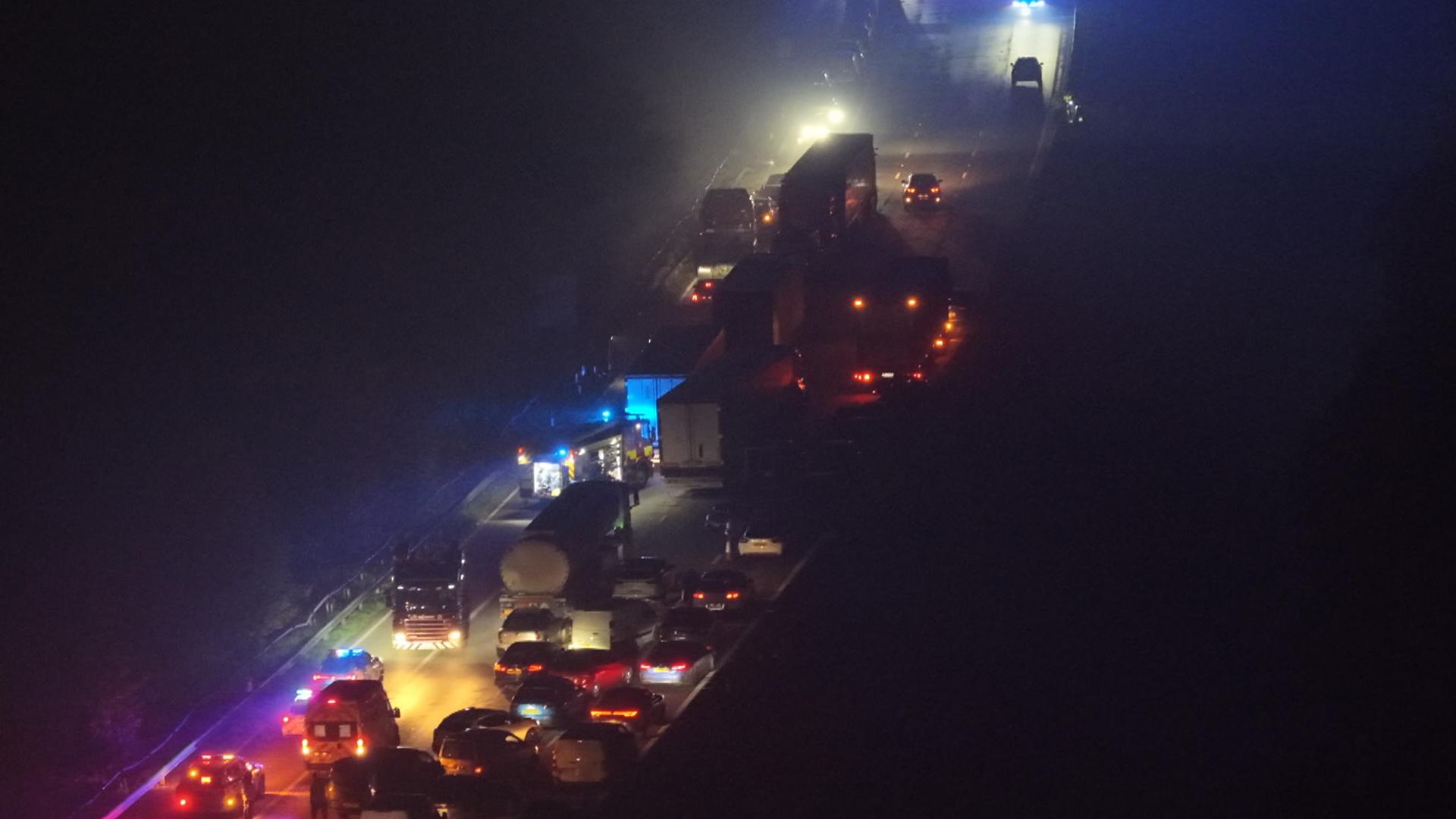
A 30-vehicle collision in dense fog in Kent is rarely a random stroke of bad luck. It is the predictable output of a cascading systemic failure where human perceptual limitations collide with rigid highway infrastructure. Standard news coverage treats multi-vehicle pileups as isolated weather anomalies, focusing on casualty counts and road closures while ignoring the underlying physics and behavioral economics that make such events inevitable under specific atmospheric conditions. When visibility drops below stopping distance thresholds on high-speed corridors, the road network ceases to function as a self-regulating system and instead converts into a kinetic energy trap.
To understand how thirty separate drivers simultaneously fail to avoid a stationary or slow-moving hazard, one must dissect the mechanics of low-visibility traffic flow. The incident in Kent demonstrates that current passive warning systems—variable message signs, static speed limits, and rear fog lamps—are structurally insufficient to override human cognitive biases when atmospheric density degrades visual feedback loops.
The Physics of Sight Distance and Kinetic Energy
Every highway system operates on a fundamental equilibrium: a driver’s Sight Distance ($D_s$) must exceed their Total Stopping Distance ($D_t$). Total Stopping Distance is the sum of Perception-Reaction Distance ($D_r$) and Braking Distance ($D_b$). Under clear conditions on a standard dual carriageway or motorway in Kent, $D_s$ exceeds 500 meters, while $D_t$ at 70 mph (112 km/h) hovers around 96 meters on dry asphalt. The system maintains a wide margin of safety.
Thick fog—meteorologically defined as visibility below 200 meters, and operationally critical below 50 meters—inverts this equation.
When visibility drops to 30 meters, $D_s$ collapses. Even if a driver reduces speed to 40 mph (64 km/h), the Total Stopping Distance on damp asphalt—common during fog events due to high relative humidity and surface condensation—is approximately 36 to 45 meters. The driver is physically overdriving their visual range. They are operating in a blind zone where any stationary obstruction inside that 30-meter envelope cannot be avoided through braking alone.
The kinetic energy equation ($E_k = \frac{1}{2}mv^2$) dictates the severity of the resulting impact. Because energy scales with the square of velocity, a marginal failure to shed speed produces disproportionate structural damage. In a 30-vehicle pileup, the initial impact is rarely the primary source of severe trauma. The two serious injuries reported in the Kent incident align with the mechanics of secondary and tertiary impacts:
- The Primary Strike: An initial vehicle encounters a sudden discontinuity—a stalled car, an abrupt bottleneck, or an animal—and executes emergency braking or suffers a low-energy collision.
- The Compression Wave: Subsequent vehicles enter the fog bank at highway speeds, unable to perceive the brake lights of the stationary queue until they breach the sight-distance threshold. Because reaction time averages 1.5 seconds even for alert operators, a vehicle traveling at 50 mph covers 33.5 meters before the brake pedal is even depressed.
- The Secondary Crush: Vehicles already halted from the primary strike become stationary anvils. Occupants often unbuckle seatbelts or exit vehicles in panic, exposing themselves to high-velocity rear impacts from incoming traffic that still has not received upstream warning.
The Perceptual Illusions of Dense Fog
Human visual processing relies on contrast gradients and peripheral optical flow to judge velocity and closure rates. Thick fog systematically strips both cues from the environment, inducing predictable cognitive errors that accelerate pileup formation.
Contrast Attenuation and Looming Failure
In clear air, a driver judges the distance to a leading vehicle by its angular size and the sharp contrast between the vehicle’s silhouette and the background. Fog scatters light through Mie scattering, bathing the visual field in a uniform, low-contrast veil. Objects do not appear gradually; they materialize abruptly once they cross a specific optical threshold.
This destroys the brain's ability to calculate time-to-collision (TTC) via optical looming—the rate at which an object's image expands on the retina. Without looming cues, drivers fail to register that a leading car is stationary rather than moving at 50 mph until the closure rate becomes insurmountable.
The Velocity Underestimation Bias
Peripheral vision drives speed perception. As objects rush past the edges of a driver's visual field, the brain calibrates its internal speedometer. Fog erases roadside markers, trees, and distant terrain, leaving only a narrow tunnel of gray asphalt and dashed white lines. Deprived of peripheral flow, drivers consistently underestimate their true ground speed by 10 to 20 mph. A driver attempting to maintain a cautious pace will unconsciously drift back toward their habitual cruising speed unless actively anchored to their instrument cluster.
The Moth Effect and Beacon Fixation
When visual references vanish, drivers latch onto the only high-contrast stimuli available: the taillights of the vehicle ahead. While following taillights provides lateral guidance, it creates a dangerous behavioral trap. Drivers unconsciously match the speed of the leading car, assuming the lead driver has clear sightlines. In reality, the lead driver is equally blind. When the lead vehicle strikes an obstacle, the following vehicle—locked into a tight spatial tether to keep the lights in sight—is guaranteed to follow it into the wreck.
Infrastructure Deficits in the Kent Corridor
Kent’s road network serves as a critical arterial funnel connecting London to the Channel ports of Dover and Folkestone. This geography creates a distinct operational profile characterized by high volumes of Heavy Goods Vehicles (HGVs), international drivers unfamiliar with localized microclimates, and rapid transitions between coastal/estuarine air masses and inland valleys.
The North Downs and the low-lying marshlands near the Thames Estuary and Romney Marsh generate frequent radiation and advection fog. Radiation fog forms rapidly overnight as the ground cools under clear skies, pooling in topographic depressions and valleys. A driver can experience 1,000 meters of visibility on a ridge, descend 40 meters into a valley along the M20, A2, or A249, and hit a wall of zero-visibility fog within seconds.
Current infrastructure management relies on three flawed mechanisms to mitigate these sudden transitions:
- Latency in Variable Message Signs (VMS): Advisory speed limits (such as 40 mph or 50 mph warnings) on gantry signs depend on sensor networks or manual operator intervention from regional control centers. Micro-fog events often form faster than sensors can verify and trigger upstream warnings. By the time a gantry displays a fog alert, the initial multi-vehicle collision has already occurred.
- Advisory vs. Mandatory Enforcement: In the UK, amber flashing lights accompanying temporary speed reductions on non-smart motorways and A-roads are strictly advisory unless enclosed in a red ring. Compliance rates for advisory limits drop precipitously when drivers cannot immediately see the hazard. Without automated enforcement cameras actively calibrated to the variable limit, rational-actor economics dictate that drivers maintain speed to avoid being tailgated by aggressive traffic behind them.
- Rear Fog Lamp Misuse: High-intensity rear fog lights are designed to pierce dense mist, yet their misuse creates severe glare and masks brake light actuation. When a line of cars operates with rear fog lamps engaged in moderate mist, the visual field saturates with red light. The transition from a steady high-intensity fog lamp to a brake light produces a minimal luminance delta, delaying the reaction time of following drivers by crucial fractions of a second.
The Game Theory of Highway Deceleration
Why do competent drivers fail to slow down to a safe crawling speed when entering thick fog? The answer lies in a classic Prisoner's Dilemma played out at 60 mph.
Consider an individual driver entering a fog bank. The physically optimal strategy is to decelerate rapidly to 25 mph, ensuring their stopping distance remains within their 30-meter sightline. However, the driver knows that the traffic behind them is likely traveling at 60 mph. If Driver A slows to 25 mph while Driver B behind them maintains 60 mph, Driver A maximizes their probability of being rear-ended at a 35 mph speed differential.
Consequently, drivers adopt a defensive compromise: they lift off the accelerator slightly, dropping from 70 mph to perhaps 55 mph, while hovering a foot over the brake. They accept the forward risk of hitting an unseen stationary object to mitigate the immediate, certain rear risk of being struck by tailgating traffic. When thirty drivers simultaneously execute this game-theoretic compromise, the entire platoon enters the fog bank at a velocity that guarantees a chain-reaction failure the moment a single anomaly disrupts the flow.
Operational Failures in Emergency Response
Once a 30-vehicle pileup crystallizes, the operational environment shifts from traffic management to complex casualty extraction in a compromised zone. The two serious injuries noted in the Kent incident highlight the specific hazards faced by first responders and trapped motorists.
In a high-density pileup, vehicles are frequently wedged together laterally and longitudinally, trapping occupants inside deformed passenger cells. Hydraulic rescue tools (cutters and spreaders) are required, which demands heavy fire appliances reach the epicenter of the wreck. However, a 30-vehicle incident instantly blocks all running lanes and often the hard shoulder, as panicked drivers swerve onto the verge to avoid incoming traffic.
Emergency vehicles must either approach contraflow—a high-risk maneuver requiring complete upstream carriageway closure by police—or fight through miles of gridlocked traffic where drivers fail to form an emergency corridor (Rettungsgasse). Simultaneously, the fog persists, meaning the tail of the rapidly growing traffic jam remains an active collision zone. Police must establish a hard physical perimeter upstream of the queue to absorb or halt incoming traffic before secondary collisions compound the casualty count.
Limitations of Current Mitigation Strategies
No single technological or regulatory intervention eliminates the risk of fog-induced pileups. Every proposed solution carries distinct operational limitations:
- Advanced Driver Assistance Systems (ADAS): Modern vehicles rely on radar, LiDAR, and optical cameras for Automatic Emergency Braking (AEB) and Adaptive Cruise Control (ACC). Optical cameras fail in fog just as human eyes do. While millimeter-wave radar penetrates fog effectively, standard automotive radar systems are programmed to filter out stationary objects (like bridge abutments and overhead signs) to prevent phantom braking at highway speeds. Consequently, an AEB system relying solely on radar may fail to recognize a completely stationary wall of wrecked cars until it is too late to shed total kinetic energy.
- Vehicle-to-Everything (V2X) Communication: Dedicated Short-Range Communications (DSRC) or Cellular-V2X allows vehicles to broadcast sudden deceleration or airbag deployment directly to trailing cars within a 1-kilometer radius, bypassing visual line-of-sight entirely. The limitation is market penetration. Until V2X transponders achieve near-universal adoption across both passenger cars and commercial freight fleets, legacy vehicles remain blind nodes in the network.
- Dynamic Variable Speed Limits (DVSL): Automated gantries that enforce mandatory speed reductions via average-speed or spot cameras reduce variance in vehicle speeds. However, infrastructure costs restrict DVSL deployment to major strategic motorways, leaving secondary A-roads—where much of Kent's regional traffic disperses—entirely unprotected.
Strategic Interventions for Corridor Resilience
Preventing the recurrence of 30-vehicle pileups in high-risk microclimate zones requires shifting from passive driver warnings to active systemic controls. Transport authorities and fleet operators must execute three targeted interventions.
First, regional highway authorities must deploy automated atmospheric-to-gantry integration in known topographic fog traps. Rather than waiting for traffic flow sensors to detect slowing vehicles, roadside visibility sensors (forward-scatter meters) should link directly to mandatory variable speed limit gantries. When optical visibility drops below 100 meters, the system must automatically trigger a mandatory 40 mph limit with active camera enforcement, removing human latency from the warning loop.
Second, road engineering teams should install active road studs (solar-powered LED cat's eyes) with dynamic spacing indicators in high-incident valleys. Standard reflective studs rely on headlight bounce, which fog scatters. Self-illuminating studs remain visible through dense mist, and systems programmed to illuminate in color-coded chevrons give drivers an objective, unmistakable spatial metric to maintain safe following distances without relying on degraded depth perception.
Third, commercial logistics operators moving freight through the Kent corridor must update telematics and fleet protocols for low-visibility operations. Fleet managers should configure onboard telematics to flag high-speed travel during active Met Office fog warnings, penalizing schedules that incentivize drivers to maintain cruising speeds in compromised sightlines. Until V2X penetration reaches critical mass, reducing the kinetic mass of heavy freight entering fog banks remains the highest-leverage intervention to prevent fatal crush injuries in multi-vehicle incidents.