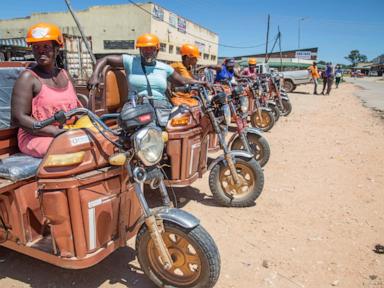
Stand at the edge of a major roundabout in Kampala or Nairobi at six-thirty in the morning, and the first thing that hits you is not the sight of traffic. It is the sound. Thousands of small single-cylinder engines cough, sputter, and rev in an overlapping metallic roar that vibrates straight up through the soles of your shoes. Within minutes, a low, blue-gray haze settles at chest height, stinging your eyes and coating the back of your throat with the sharp taste of unburned petrol and hot oil.
Listen. Beneath that noise is the heartbeat of urban Africa.
Every morning across Sub-Saharan Africa, tens of millions of commuters, nurses, students, and market vendors climb onto the back of commercial motorcycles—known as boda-bodas in East Africa, okadas in Nigeria, and zemidjans in Benin—or squeeze into three-wheeled taxis called tuk-tuks and kekes. Without them, cities would seize up before breakfast. Formal municipal bus systems never grew fast enough to match the explosive expansion of African metropolises, so agile two- and three-wheelers stepped into the breach, threading through gridlocked avenues and bouncing down unpaved neighborhood lanes where full-sized vehicles simply cannot go.
For years, the global conversation around electric vehicles ignored these streets entirely. When executives in Silicon Valley, Munich, or Shanghai pictured the electric transition, they pictured a sixty-thousand-dollar sport utility vehicle plugged into a sleek wall charger inside a private suburban garage. They assumed the rest of the world would eventually catch up to that vision once secondhand sedans trickled south.
They were wrong. While wealthier nations debated charging standards and subsidized luxury electric cars, riders, engineers, and entrepreneurs across Africa quietly started building a different kind of transport revolution from the ground up. Instead of waiting for four-wheeled status symbols, they went straight for the workhorses of the economy—two wheels, three wheels, and a battery you can swap in less time than it takes to buy a cup of tea.
The Arithmetic of Exhaust and Survival
To understand why this shift matters, you have to step away from climate spreadsheets and look at a rider's daily ledger. Consider Samuel, a hypothetical composite character drawn from the lived reality of commercial boda-boda operators in cities like Kampala and Nairobi.
Samuel wakes before dawn in a single-room concrete home on the outskirts of town. He does not own the 125-cubic-centimeter petrol motorbike parked outside his door; like a vast share of commercial riders, he leases it on a strict daily installment contract. Before he earns a single shilling for his daughter's school fees, his rent, or evening bags of maize meal, he owes the bike owner a fixed sum by nightfall. And before he can collect his first fare, he has to visit the fuel station.
Petrol is the silent tax that eats his livelihood alive. Across much of Sub-Saharan Africa, fuel prices swing violently with global crude markets, currency depreciation, and the sudden removal of government subsidies. On an ordinary twelve-hour shift, a commercial motorcycle rider covers between one hundred and two hundred kilometers, burning through three to five liters of fuel. By dusk, petrol alone swallows thirty-five to fifty percent of Samuel's gross earnings. Add frequent oil changes, worn clutch plates, spark plugs, and chains ground down by dust and potholes, and the margin between a good week and a desperate one shrinks to almost nothing.
That economic squeeze sits atop a public health crisis hiding in plain sight. For decades, African ports have served as the final destination for aging internal combustion vehicles retired from Europe, Japan, and North America—cars and vans often fifteen to twenty years old, stripped of modern emissions controls. Combined with millions of lightly regulated two- and four-stroke motorbikes, the result is choking urban air. In several rapidly growing African capitals, fine particulate pollution routinely climbs well above World Health Organization safety thresholds, turning daily commutes into a slow respiratory tax on drivers, roadside vendors, and schoolchildren alike.
Historically, two-wheeled transport in East Africa grew out of sheer ingenuity. The very word boda-boda comes from "border-to-border," coined in the nineteen-sixties and seventies when entrepreneurial cyclists ferried people and goods across the no-man's-land between Uganda and Kenya at Busia and Malaba. What started with reinforced bicycles evolved into imported motorbikes, which multiplied until two- and three-wheelers accounted for seventy to eighty percent of all motorized vehicles on the road in several countries. More than twenty-seven million motorcycles now operate across Sub-Saharan Africa.
You cannot decarbonize a continent by ignoring the machines that actually move it.
Why the Luxury Electric Car Missed the Continent
Why not simply import electric cars and build fast-charging plazas along major highways? Because doing so ignores both basic economics and physical reality.
Think of this mismatch through an explicit metaphor: trying to electrify African cities with imported Western electric SUVs is like trying to repair a village water pump with a yacht engine. It is wildly overbuilt, financially out of reach, and engineered for an environment that does not exist here.
Start with the sticker price. Even the cheapest new electric passenger cars sold in Europe or North America cost tens of thousands of dollars—several multiples of average annual per-capita income across most African nations. Import duties, shipping costs, and high-interest commercial loans push those prices even higher.
Then look at the power grid and the street itself. Many national utilities across the continent are still working to stabilize generation capacity and transmission lines. Plugging tens of thousands of power-hungry residential car chargers into neighborhood transformers every evening at seven o'clock would trigger rolling brownouts. Meanwhile, on the ground, a wide four-wheel chassis loses its advantage the moment traffic stalls. In Lagos or Nairobi, where a ten-kilometer trip can consume ninety minutes of bumper-to-bumper crawl, a car is a metal box trapping you in gridlock. A motorbike slices right through.
Here is the paradox that investors outside the continent routinely miss: commercial riders are actually far better candidates for electrification than affluent suburban car owners.
Math. A private commuter car in London or Los Angeles sits parked ninety-five percent of the day, taking years to rack up enough mileage for fuel savings to offset a higher purchase price. A commercial boda-boda or cargo three-wheeler runs ten to fourteen hours a day, six or seven days a week. Because these vehicles burn so much fuel every single day, switching from petrol to electricity pays back the hardware cost in months rather than years. High utilization turns clean technology from an environmental luxury into immediate cash flow.
Sixty Seconds at the Swap Kiosk
Still, one stubborn wall stood between commercial riders and electric motorbikes: the battery.
A lithium-ion battery pack capable of moving a motorbike and two adults through city traffic accounts for roughly thirty to forty percent of the vehicle's entire manufacturing cost. Asking a working rider to buy that battery upfront makes an electric bike substantially more expensive than a traditional petrol model. Worse yet, if that rider has to plug the bike into a wall socket for four hours in the middle of the afternoon to recharge, they lose peak rush-hour fares. Time parked is money lost.
The breakthrough that unlocked electric mobility across Africa was separating the battery from the bike.
To see how this works, use a straightforward analogy: imagine buying a gas camp stove without having to buy the refinery that produces the fuel. Under a model known as battery-as-a-service, companies such as Ampersand in Rwanda, Spiro across Benin, Togo, Kenya, and Uganda, and Roam in Kenya sell or lease the electric motorcycle frame without the battery included. That single structural choice drops the upfront price of the electric bike down to parity with—and in some markets below—a comparable petrol motorcycle.
Instead of owning the battery, the rider subscribes to energy on the go.
Picture Samuel pulling off a dusty avenue in Kigali or Nairobi at midday, his dashboard indicator blinking down toward ten percent. He rolls up to a brightly lit roadside swap kiosk, no larger than a shipping container, stacked with vertical rows of glowing charging slots. He flips open his seat, releases a latch, and slides out a depleted lithium-iron-phosphate battery pack weighing roughly twenty-five to thirty-five kilograms. An attendant scans the pack, slots it into an open charging bay, and hands Samuel a fully charged replacement. Samuel slides the fresh pack into his bike, locks the seat, pays a small mobile-money fee well below the cost of an equivalent tank of petrol, and pulls back into traffic.
Sixty seconds. No grease on his hands. No waiting by an outlet.
The chemistry inside those rectangular cases matters just as much as the speed of the exchange. Most African swap networks rely on lithium-iron-phosphate batteries—commonly shortened to LFP—rather than the nickel-manganese-cobalt cells favored in many Western performance cars. LFP packs tolerate high tropical ambient temperatures far better, resist thermal runaway, and endure thousands of charge-and-discharge cycles before losing meaningful capacity. They also require no cobalt, sidestepping both price volatility and troubling supply-chain ethics.
For riders, the financial shift is immediate. Between lower swap fees and the disappearance of oil changes, spark plugs, and timing belts—an electric hub or mid-drive motor has roughly twenty moving parts compared to hundreds inside a combustion engine—riders typically keep twenty to forty percent more net income at the end of every week. Over a year, that extra margin buys land, pays tuition, or turns a lease-to-own rider into an outright vehicle owner.
Three Wheels and the Heavy Lifting of Daily Trade
While two-wheeled taxis capture most of the headlines, an equally quiet transformation is unfolding on three wheels.
Consider Amina, a second hypothetical composite character representing the millions of small-scale agricultural traders and urban couriers who keep African markets supplied before sunrise. Twice a week, Amina hauls three hundred kilograms of tomatoes, onions, and cooking oil from a wholesale depot on the edge of town to a neighborhood market five kilometers away. For years, she paid a significant slice of her thin trading margin to hire aging diesel pickups or petrol three-wheelers that broke down whenever rain turned feeder roads into red mud.
Electric three-wheelers—whether configured as passenger tuk-tuks or flatbed cargo haulers—are built specifically for this middle tier of commerce. Unlike motorcycles, which max out around a single passenger and a backpack, an electric cargo trike carries three hundred to five hundred kilograms in an open or covered rear bed. Unlike full-sized delivery vans, it costs a fraction as much to buy, squeezes down narrow market alleys, and runs on standard commercial power.
Electric motors also deliver instant torque from zero revolutions per minute. Anyone who has watched an overloaded petrol tuk-tuk strain, smoke, and slip its clutch while climbing a steep hill knows how poorly small combustion engines handle heavy payloads. An electric drivetrain pulls smoothly from a dead stop, hauling crates of produce, construction materials, solar home kits, or e-commerce parcels up uneven inclines without whining or stalling.
Across Kenya, Tanzania, Nigeria, and Rwanda, fleet operators and small business owners are beginning to deploy electric three-wheelers for everything from cold-chain dairy delivery to municipal waste collection. Because these vehicles follow predictable daily routes and return to central depots each night, operators can either swap their batteries at regional kiosks or charge them slowly overnight when commercial electricity tariffs drop.
Steep Hills, Fragile Grids, and Honest Doubts
It would be dishonest to pretend this transition is effortless, inevitable, or free of real friction. Stand at a boda-boda stage in Kampala during a torrential equatorial downpour and talk to riders who have not yet made the switch, and you will hear legitimate, grounded fears.
First comes range anxiety—not as a mild suburban inconvenience, but as a direct threat to a family's dinner. If you are carrying a passenger toward an outlying suburb at eight o'clock at night and your battery drops to eight percent miles from the nearest swap cabinet, you cannot simply walk to a corner shop and buy two liters of electrons in a plastic jerrycan. Until swap stations blanket secondary towns and rural trading centers as densely as petrol pumps do today, riders operating outside major urban cores remain understandably cautious.
Then there is skepticism about durability. Early skeptics at taxi stands laughed at the first electric prototypes, convinced the motors would burn out climbing Kigali's steepest hills or short-circuit the first time they splashed through knee-deep storm runoff. Engineering teams had to prove—through thousands of brutal test kilometers over washboard dirt roads and flooded intersections—that sealed battery enclosures and high-torque motors could survive conditions that regularly ruin imported street bikes.
The third question is the one energy analysts ask most often: if millions of two- and three-wheelers go electric, where does the power come from, and is it actually clean?
The honest answer depends on where you stand on the map. In East Africa, the math is remarkably favorable. Kenya generates roughly eighty to ninety percent of its grid electricity from renewable sources—principally geothermal steam from the Rift Valley, alongside hydropower, wind, and solar. Ethiopia runs overwhelmingly on hydropower, and Uganda draws the bulk of its electricity from hydroelectric dams along the Nile. Charging an electric motorbike in Nairobi or Addis Ababa means running it on some of the cleanest electrons on the planet.
In countries where national grids still rely heavily on fossil fuels or suffer frequent blackouts, operators are adapting by pairing swap cabinets with off-grid solar arrays and stationary storage banks. Even better, smart charging software allows swap stations to soak up surplus electricity late at night when factories are closed and grid demand dips—turning thousands of scattered motorcycle batteries into a giant, flexible shock absorber that stabilizes fragile utility networks rather than straining them.
Still, real hurdles remain. Access to affordable financing is tight; many riders lack formal credit histories, leaving them dependent on high-interest asset-financing loans. Different EV manufacturers still use incompatible battery shapes and connectors, fragmenting swap networks when shared standards would accelerate growth for everyone. And as the first generation of tens of thousands of packs reaches the end of its road life over the coming years, governments and companies must build local systems to repurpose tired mobility batteries into stationary solar storage for clinics and schools, followed by safe domestic recycling.
When the Roar Begins to Fade
Walk back to that same intersection in Kigali or Nairobi at dusk, and look closely at the stream of headlights pouring past.
Five years ago, you could barely hear the person standing next to you over the clatter of tailpipes, and the evening air tasted of sulfur and spent oil. Today, woven into that familiar traffic, dozens of bikes glide past with nothing more than the soft whir of rubber against asphalt and a faint, clean electric hum.
At the corner swap station, Samuel pulls in under the warm LED canopy. He unlatches his seat, slides out the warm battery pack that carried him through a hundred and forty kilometers of city errands, and clicks a fresh one into place. His phone chimes softly to confirm the swap fee—less than half what he used to hand over at the petrol pump across the street.
He zips his jacket against the evening chill, folds the extra banknotes deeper into his pocket, and rolls silently back out into the stream of traffic, leaving nothing behind him in the night air except the faint, fading whisper of tires on warm tarmac.


