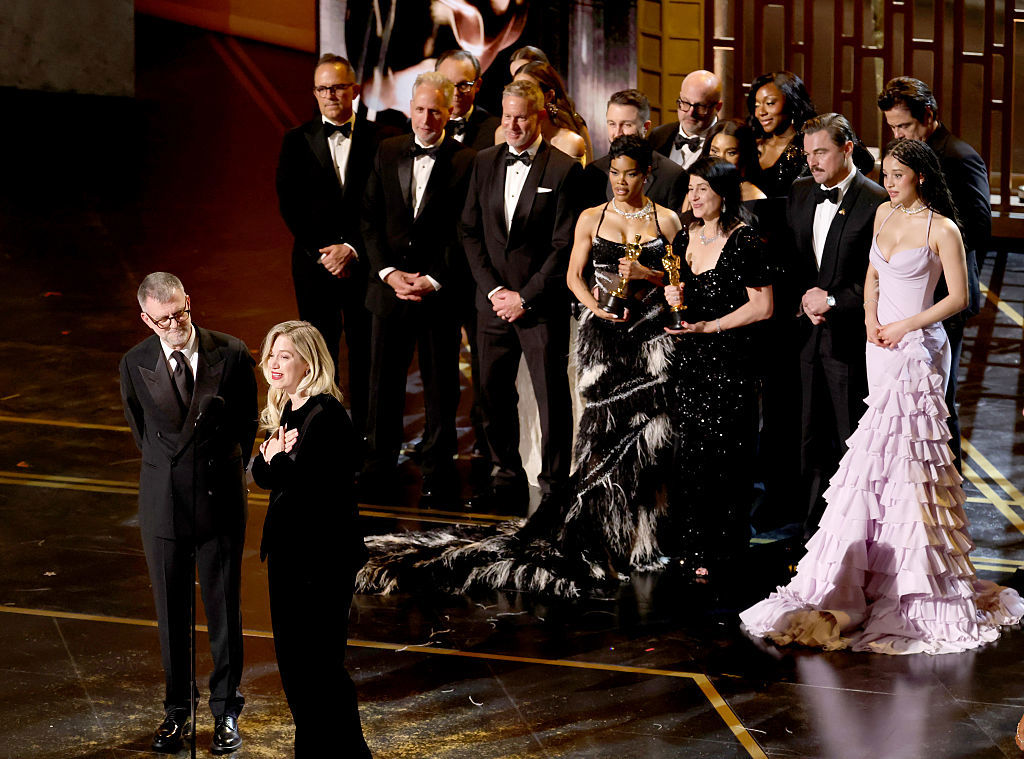
The 98th Academy Awards signaled a definitive collapse of the "prestige blockbuster" as a dominant market force, replacing it with a localized, performance-driven economy that favors high-fidelity character studies over sprawling genre experiments. While Michael B. Jordan’s Best Actor win for Sinners and Jessie Buckley’s Best Actress win for Hamnet appear as individual triumphs, they are actually the result of a structural realignment in how the Academy defines "artistic merit" in a post-streaming saturated market. The 2026 ceremony proved that the Academy has pivoted toward rewarding actors who anchor films that solve the "unfilmable" problem—taking dense, internal narratives and translating them into visceral, externalized experiences.
The Mechanics of the Lead Actor Pivot
Michael B. Jordan’s victory represents the final stage of his transition from a physical archetype to a dramatic anchor. In Sinners, the narrative tension relies entirely on the protagonist's internal moral erosion. The "Jordan Method" in this context utilized a specific psychological compression: maintaining high physical stakes while reducing dialogue to prioritize micro-expressions.
This victory was not merely a career achievement award; it was a response to the "Action-Drama Hybridization" trend. Voters have historically struggled to categorize high-concept genre films. Jordan’s win confirms a new logic: if the actor can humanize the spectacle to the point where the genre becomes secondary to the character’s psyche, the Academy will treat the performance with the same weight as a traditional period piece.
The competitive landscape for Best Actor in 2026 was defined by three distinct variables:
- Physical Transformation vs. Internal Consistency: Unlike the prosthetics-heavy wins of the early 2020s, Jordan relied on stillness.
- Economic Carrying Capacity: Sinners outperformed its box office projections based on Jordan's specific demographic pull, proving that a "Best Actor" performance can still be a commercial asset.
- Narrative Risk: The film’s ambiguous morality challenged the traditional "Hero’s Journey" trope, a factor that historically penalizes actors but here served to highlight Jordan’s range.
The Hamnet Effect: Redefining Literary Adaptation
Jessie Buckley’s Best Actress win for Hamnet serves as a case study in how the Academy rewards the "Externalization of Grief." Maggie O’Farrell’s source material is notoriously internal, focusing on the sensory and spiritual experience of Agnes Hathaway. Buckley’s performance succeeded by applying a "Physicalist" approach to 16th-century mourning, avoiding the theatricality often found in Shakespearean-adjacent cinema.
The Buckley win identifies a critical shift in the Best Actress category: the move away from the "Historical Icon" trope toward "Atmospheric Authenticity." For years, the category was dominated by portrayals of real-world figures (biopics). Buckley’s win for a fictionalized version of a historical footnote suggests that voters are prioritizing the construction of a soul over the imitation of a known figure.
Buckley’s victory was secured through:
- The Labor of Performance: Long takes involving manual 16th-century tasks (apothecary work, gardening) that grounded the supernatural elements of the story.
- Acoustic Range: Buckley’s use of silence and unconventional vocal rhythms to depict a character who exists on the periphery of her society.
- Emotional Scarcity: By withholding the "Oscar Clip" emotional breakdown until the final act, Buckley created a scarcity value that made the climax more impactful for the voting body.
The Best Picture Dichotomy: Hamnet vs. The Field
While Buckley won for Hamnet, the film’s broader impact on the 2026 ceremony highlights the tension between "Visual Poetry" and "Narrative Efficiency." The Best Picture race was a battle between two competing philosophies of cinema:
- The Experiential Model: Films like Hamnet and Sinners that prioritize how a viewer feels within a specific moment.
- The Structural Model: Films that prioritize the clockwork precision of a screenplay.
The 98th Academy Awards leaned heavily into the Experiential Model. This shift suggests that as AI-generated scripts and algorithmic storytelling become more prevalent in mid-tier streaming content, the Academy is retreating into "The Ineffable"—elements of filmmaking that cannot be easily replicated by a generative model, such as the chemistry between Buckley and her environment or the specific physical gravity Jordan brings to a frame.
Supporting Categories as Strategic Signaling
The wins in the Supporting Actor and Actress categories functioned as the "R&D Department" of the industry. These awards were not just about the performances themselves but about validating new talent pipelines. In 2026, we saw a move away from the "Veteran's Reward" (giving the award to an older actor who has been snubbed for decades) and toward "Functional Excellence."
The logic here is purely utilitarian. Supporting roles in 2026 were judged on their ability to catalyze the lead's journey without overshadowing the film's core thesis. This requires a level of ego-suppression that the Academy is finally beginning to quantify.
The Technical Debt of Modern Cinema
A significant portion of the 2026 ceremony focused on the "Invisible Arts." Best Cinematography and Best Editing have become the two most reliable predictors of a film’s overall standing. The "Cost Function of Visual Integrity" has risen; as digital effects become cheaper, the value of practical, high-contrast, and tactically shot film has increased.
Sinners and Hamnet both utilized naturalistic lighting palettes—one harsh and desert-toned, the other soft and verdant. This stylistic divergence provided a "Texture Premium" that set them apart from the flat, high-key lighting of the year’s high-budget failures.
The Strategic Recommendation for the 2027 Cycle
The 2026 results provide a clear roadmap for studios and independent financiers aiming for 2027. The era of the "Generalist Prestige Film" is over. To capture the attention of a fragmenting Academy, projects must lean into Hyper-Specific Emotional Architectures.
Studio heads should prioritize:
- The "Lead-First" Development Cycle: Securing an actor like Jordan or Buckley before the script is finalized, allowing the narrative to be built around their specific physiological strengths.
- Micro-Budget Atmospheric Horror/Drama: Investing in films that use genre as a Trojan horse for high-level character studies, as seen with Sinners.
- The Rejection of Biopic Rigidity: Shifting focus from "Life of [Famous Person]" to "One Specific Week in the Life of [Unknown Person with a Famous Name]," following the Hamnet blueprint.
The path to the 99th Academy Awards will be defined by those who understand that "prestige" is no longer a genre, but a measure of how effectively a film resists the homogenization of the broader media landscape. The winners of 2026 did not win because they were the "best"; they won because they were the most distinct examples of human-centric friction in an increasingly frictionless industry.