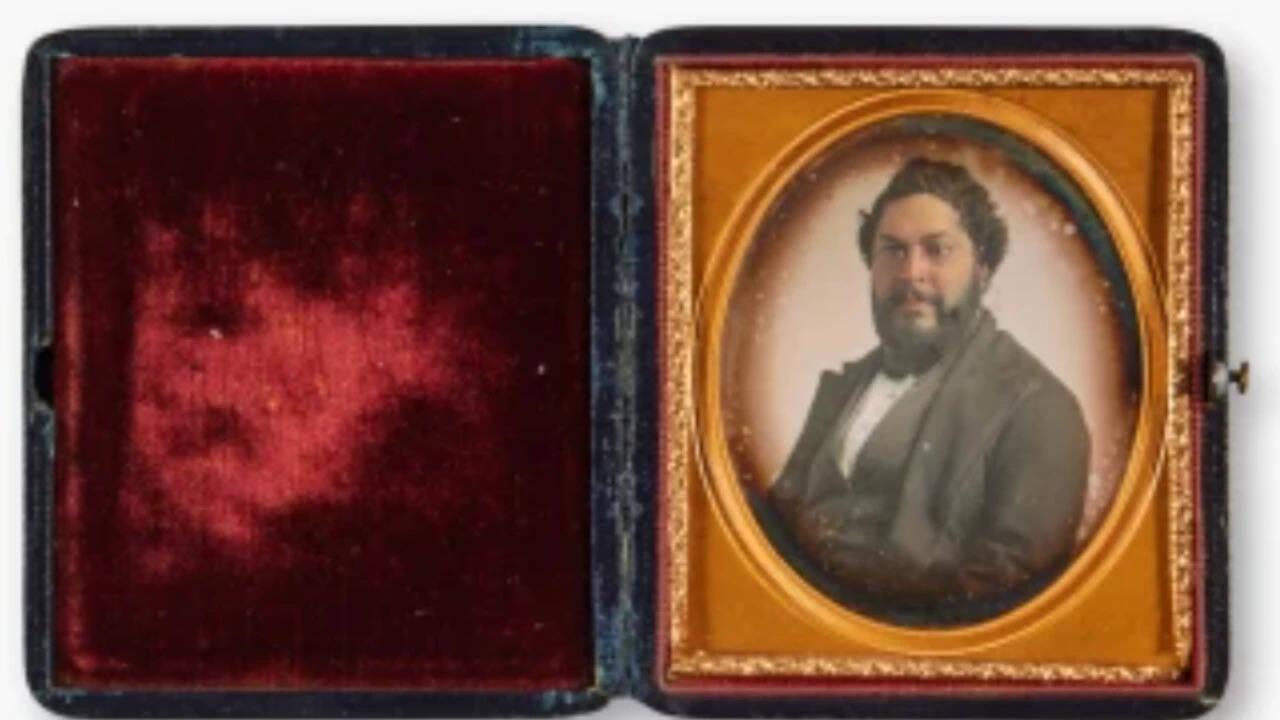
Dust settles differently on things nobody wants. It doesn’t just coat the surface; it dulls the edges, blurs the colors, and slowly convinces everyone in the room that what they are looking at has no value at all.
For decades, a 170-year-old portrait sat in that exact kind of obscurity. A dark, brooding oil painting of an unnamed nineteenth-century gentleman. No signature in the corner. No brass plaque on the frame. No provenance to whisper into the ear of a wealthy collector. When it crossed the auction block in 2025, the gavel came down at a modest $882. Less than the price of a used Honda Civic. Barely enough to cover a weekend getaway.
To the crowd in the room that day, he was just another forgotten face from the 1850s—a stern jawline, period clothing, and eyes staring out from a past that had long since lost its receipts.
Then someone looked closer. And that $882 painting suddenly sold for $230,400.
The canvas didn't change. Not a single brushstroke was added, not a millimeter of varnish restored to manufacture false glamour. The paint was the exact same molecular arrangement of linseed oil and pigment that had sat neglected for more than a century and a half. What changed—the only thing that changed—was the answer to a single, haunting question.
Who is he?
The Anatomy of a Blind Spot
If you have ever walked through an estate sale, a flea market, or the back rows of a regional auction house, you know the feeling. You stand before rows of gilded frames containing the solemn faces of strangers. Great-aunts nobody remembers. Industrialists whose factories turned to rust before your grandparents were born. Civil War officers whose names survived only on weathered granite.
In the art market, we call these works "sleepers"—masterpieces or historically significant pieces hiding in plain sight, misattributed or entirely unidentified. Yet calling them sleepers misses the human truth of why we pass them by. We ignore them because we suffer from a quiet, pervasive arrogance: the belief that if something were truly important, someone else would have already noticed.
Consider a hypothetical buyer walking past that portrait in 2025. Let’s call him Arthur. Arthur collects mid-nineteenth-century antiques not for investment, but because he likes the weight of old wood and the smell of aged canvas. He looks at the portrait. He sees competent brushwork—the way the light catches the bridge of the nose, the subtle tension around the mouth—but he checks the catalog. School of the 19th Century. Sitter unknown. Arthur raises his paddle out of mild curiosity, drops out at eight hundred dollars, and goes home to hang something else over his fireplace.
Arthur didn't fail because he lacked money. He failed because he lacked context.
Without a name, a portrait is merely decoration. It is an aesthetic object competing against every other brown-and-gold painting from the Victorian era. In a market driven by scarcity and story, an anonymous face has a ceiling, and that ceiling is brutally low. Eight hundred and eighty-two dollars is the exact market price of anonymity.
What a Name Actually Buys
I have spent years watching how human beings assign value to objects, and the pattern never wavers. We think we buy things for what they are. In reality, we buy things for what they connect us to.
Think of an ordinary wooden baseball bat sitting in a garage. You might pay fifteen dollars for it at a yard sale. Now, prove that Babe Ruth swung that exact piece of ash in the 1927 World Series, and the price leaps by six zeros. The wood hasn't become harder. The grain hasn't grown prettier. What you are purchasing is proximity to a human life that bent the arc of history.
When researchers finally cracked the identity of the man in that 170-year-old portrait, the painting stopped being an interior design choice and became a primary historical witness. Suddenly, those painted eyes weren't looking at nothing; they were looking at a specific moment in the 1850s, carrying the weight of real decisions, real triumphs, and real survival.
The jump from $882 to $230,400—a staggering 26,000 percent increase in value—isn't a fluke of eccentric billionaires throwing money at canvas. It is the mathematical expression of rediscovered humanity.
Every detail in the painting abruptly shifted meaning once his identity came to light. The cut of his coat wasn't just period fashion; it was the uniform of his station. The set of his jaw wasn't just a painter's stylistic habit; it was the documented temperament of a man who lived through extraordinary pressure. Collectors weren't bidding on oil and linen anymore. They were bidding on the chance to stand in the same room as a ghost who finally had his name back.
The Detective Work Behind the Canvas
How does a face stay lost for 170 years, only to be found in the span of a few months?
It rarely happens through a dramatic, cinematic flash of genius. More often, it happens through stubborn, unglamorous obsession. After the 2025 sale, the buyer—or the specialists brought in to examine the work—did what the original auction house didn't have the time or resources to do. They treated the painting not as a commodity, but as a crime scene.
In the world of historical art authentication, identification works like triangulation. You start with the physical evidence: the weave of the canvas, the specific chemical composition of the pigments, the style of the stretcher bars holding the fabric taut. Those clues anchor the painting to a decade and a city. From there, you study the brush economy—how the artist handled the highlights in the eyes, the impasto on the collar, the blending of skin tones—comparing them against known portraitists working in that exact region during the 1850s.
Once you narrow down the hand that held the brush, you open the ledgers. Nineteenth-century portrait painters kept meticulous studio diaries, exhibition records, and correspondence. You cross-reference who sat for that artist between 1852 and 1858. You match ages, facial structures, hairline patterns, and surviving early daguerreotypes or engravings.
Imagine the moment the match finally clicks. You are staring at a high-resolution scan of a nineteenth-century engraving or an archival photograph on one screen, and the $882 oil painting on the other. You measure the distance between the pupils. You trace the slight asymmetry of the left brow, the exact curve of the ear, the faint crease beside the lip.
Silence. Then, the realization hits you in the chest.
The stranger is gone. Looking back at you is someone the history books already know.
Why We Keep Missing the Treasure in Front of Us
There is a comforting myth that the modern world has already cataloged everything worth finding. We carry supercomputers in our pockets, feed millions of images into visual search engines, and assume that every attic has been cleared and every museum basement inventoried.
That assumption is completely wrong.
Auction houses process thousands of lots every single week. Specialists work under relentless deadlines, sorting estates, estate jewelry, mid-century furniture, and boxes of old letters. When a painting arrives without a paper trail, a cataloger might have twenty minutes to photograph it, measure it, write a three-line description, and assign an estimate. If the signature is obscured by darkened varnish—or if the artist simply never signed it, which was common practice in the nineteenth century—the painting gets labeled Anonymous and tossed into a general sale.
We live surrounded by mislabeled value. Not just in dusty auction rooms, either.
Consider how often we apply that exact same $882 filter to the people and stories around us. We glance at the surface, check for an obvious label, see nothing that screams for immediate attention, and move on. We confuse the absence of recognition with the absence of worth.
The man in the painting didn't become extraordinary when his price tag hit $230,400. He was extraordinary the day he sat in the artist's chair 170 years ago. He was extraordinary while his portrait hung in quiet parlors, while it was packed into wooden crates, while it gathered dust in storage, and while an auctioneer casually knocked it down for less than nine hundred dollars in 2025.
Our ignorance was the only thing keeping him cheap.
The Heavy Price of Memory
When the painting returned to the block with its true identity restored, the atmosphere in the salesroom was unrecognizable from the year before. Phone lines opened. Institutional bidders and private collectors leaned forward. The bidding didn't crawl in fifty-dollar increments; it leaped by thousands, driven by the sudden, urgent realization that this was a singular surviving likeness.
At $230,400, the gavel fell a second time.
There is something deeply moving—and slightly unsettling—about that number. On one hand, it feels like cosmic justice. A man whose contribution to the world had been severed from his own face was finally reunited with his legacy. His portrait will never again sit in a dark corner or get shoved into the back of a storage van. It will be conserved, lit properly, insured, and studied.
On the other hand, that price tag exposes a sobering truth about human memory. Without intervention, even the most remarkable lives fade into anonymous paint. One generation forgets the stories behind the frames on the wall. The next generation sells the house. By the third generation, the portrait is just "some old guy" at an estate auction, waiting for a stranger to decide whether he is worth $882.
Think about the photographs sitting on your phone right now, or the boxes of unlabeled prints tucked into the top shelf of a closet. Strip away the metadata. Strip away the names written in fading ink on the back. Give those images 170 years of quiet dust, and every single one of us becomes an anonymous sitter waiting for someone curious enough to ask who we were.
The next time you pass an old portrait in a thrift store or an auction catalog, pause for three seconds longer than usual. Look past the cracked varnish and the tarnished frame. Somebody sat still for hours while an artist mixed pigments by hand to capture the exact way light fell across their face. They mattered enough to someone to be preserved in oil.
And somewhere behind those quiet, painted eyes, a $230,400 story might still be waiting for someone to remember its name.