The iron rails stretching out from the station do not care about borders. They do not care about maps drawn in smoke or the shifting lines of a front that cuts a country in two. They are simply steel and tie, built to carry people toward their mothers, their children, or the quiet safety of a sleep that isn't broken by the whistle of descending metal.
Until they stop.
Imagine, for a moment, the rhythm of a passenger train at night. The steady, hypnotic click-clack against the ballast. The dim yellow light of the carriage casting long shadows across tired faces. Outside, the pitch-black void of eastern Europe scrolls past—no lights in the villages, curfew in effect, nothing visible save for the ghostly silhouettes of frost-bitten trees. Inside, a child sleeps with their head pressed against a winter coat folded into a pillow. A soldier heading home on leave stares blindly at his boots, wondering how to explain the unexplainable to his wife.
Then comes the sound that changes everything.
It is not a dramatic cinematic explosion. To those inside, it is a sudden, violent tearing of the air, a concussive shockwave that lifts heavy cars off their bogies and turns safety glass into a million diamond shards of shrapnel. In a fraction of a second, the routine of travel—tickets checked, schedules kept, breath fogging the double-paned windows—collapses into fire, smoke, and screaming darkness.
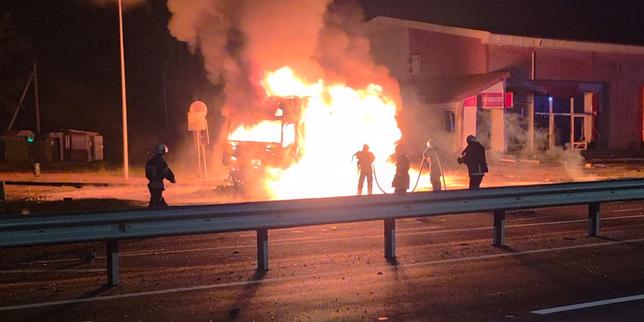
Sunday morning near the Polish border was supposed to be quiet. It was supposed to be a corridor of transit, a narrow thread of normalcy connecting a war-torn interior to the sanctuary of the West. Instead, it became a target. A Russian drone, buzzing through the predawn fog with a payload of high explosives, found its mark on a civilian train.
We talk about these conflicts in numbers. We track the trajectory of ballistic missiles like lines on a weather map. We speak of geopolitical escalations, supply chains, and air defense deficits as if they were abstract variables in a high-stakes math equation. But war is never abstract. It is intensely, agonizingly physical. It is the smell of burning diesel and scorched wool. It is the panic in a conductor’s voice as he fumbles for a flashlight in a cabin choked with acrid smoke.
Consider what happens in the minutes after the blast. The automatic braking systems engage, hissing as pressure bleeds from the lines. Darkness descends as the electrical grid of the carriages dies. For a few agonizing seconds, there is only the sound of ragged breathing and the crackle of flames licking at the undercarriage. Then, boots hit the gravel outside. First responders, railway workers, and surviving passengers stumble into the freezing mud, guided only by the amber glow of the fire.
This is the hidden cost of the conflict in Ukraine. It is not merely the territory lost or gained on a nightly news broadcast. It is the systematic erosion of the spaces where ordinary life tries to persist. When a passenger train becomes a combat zone, the unspoken social contract that protects civilians dissolves entirely. Every journey becomes a gamble. Every ticket bought is a calculated risk against the unpredictable whims of modern aerial warfare.
Why target a train near the border? The strategic rationale, cold and clinical, points toward logistics, toward breaking the arteries of movement that keep a nation functioning, supplying, and evacuating. But the psychological impact dwarfs the tactical gain. By striking a civilian transport corridor so close to a NATO member state, the message sent is deliberate and chilling: nowhere is behind the lines. There is no rear echelon. There is only the zone of fire, expanding outward until it laps against the very gates of Europe.
Let us step back for a moment and look at the architecture of modern fear. It thrives on proximity. For months, those living within striking distance of the western borders held onto a fragile belief in distance. They believed that the closer you got to Poland, the closer you were to safety. They packed their bags, bought their tickets, and watched the border posts approach with a collective holding of breath. When that train was struck, that psychological buffer vanished. The front line is no longer a trench in the Donbas or a ruined suburb of Kharkiv; it is the railway track outside your window, the station platform where you say goodbye to your father, the bridge you cross on your way to work.
Yet, in the immediate aftermath of the wreckage, something else happens. It is a phenomenon rarely captured in military briefings or diplomatic cables. It is the stubborn, almost defiant refusal of people to surrender their humanity.
In the freezing darkness outside the shattered carriages, strangers did not panic in isolation. Hands reached out through the broken windows. Coats were stripped off and wrapped around shivering shoulders that had no biological relation to the givers. Local villagers, awakened by the concussive boom, rushed out of their homes with thermoses of hot tea, blankets, and flashlights before the official rescue teams even arrived. They didn't ask who was a soldier, who was a refugee, or who held a passport stamped with the right visas. They saw human beings broken by steel and fire, and they went to work.
This is the duality of the crisis we are watching unfold. On one side stands the calculated machinery of destruction—autonomous drones, guided munitions, and the bureaucratic coldness of strategic calculus. On the other stands the raw, stubborn resilience of a populace that refuses to stop moving, living, and caring for one another, even when the tracks beneath them are blown to pieces.
We must admit how frightening this reality is. It forces us to confront a world where the rules we thought governed civilization—rules protecting civilians, hospital trains, and humanitarian corridors—are treated as negotiable suggestions by those holding the detonators. It leaves us with a lingering, hollow ache in the pit of our stomachs because we know that no treaty can fully insulate the innocent from the reach of a low-flying drone in the dark.
The smoke eventually clears from the fields near the border. The twisted metal of the carriages is hauled away by heavy cranes, and repair crews descend on the tracks to drive new spikes into the ties and string new copper wire overhead. Within twenty-four hours, the line will likely reopen. Another train will roll down those same rails, carrying another set of exhausted travelers staring into the dark, listening to the rhythm of the wheels, and hoping against hope that the night will hold nothing worse than the cold.
They will ride because they have to. Because life, in all its defiant fragility, demands forward momentum. And as long as those trains keep running into the dark, bearing the weight of a people refusing to be erased, the true frontline of this war will remain what it has always been: the space between despair and the next station.