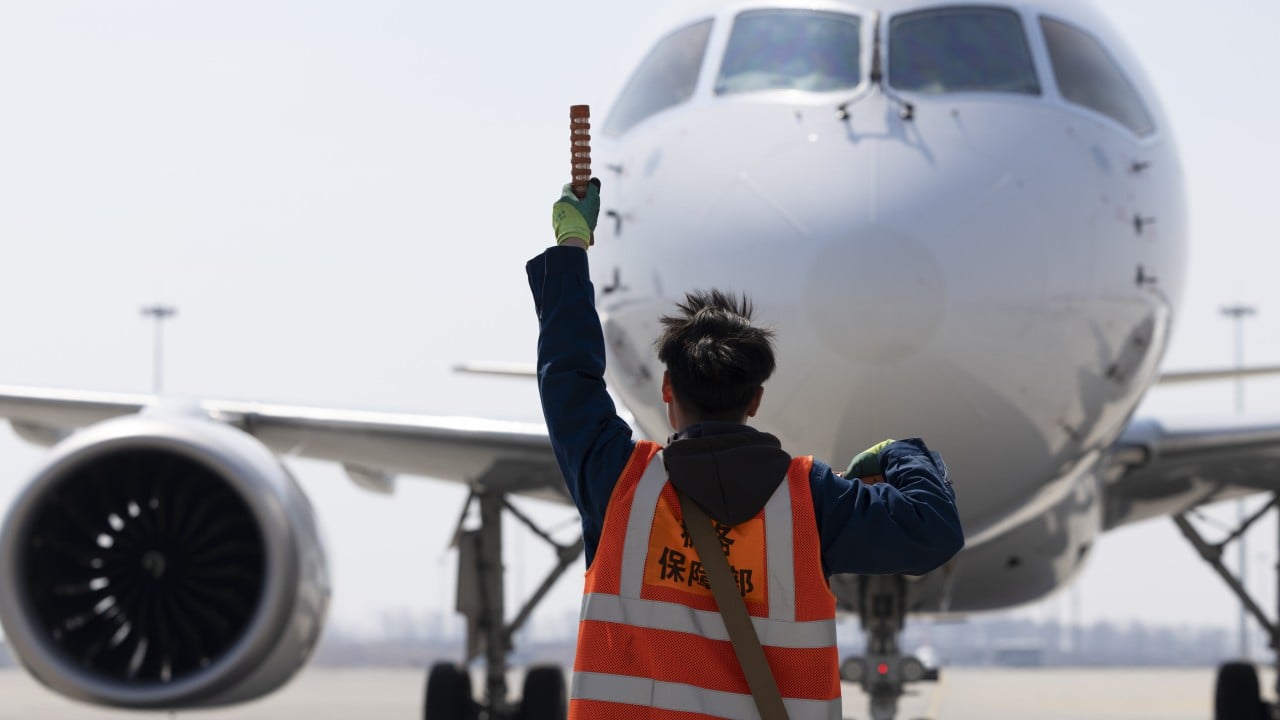
Five percent of the global commercial jet market over twenty years sounds modest on paper. When you look at how many narrowbody planes Airbus and Boeing crank out every single month, that small slice turns into a massive engineering and diplomatic mountain.
The C919 is supposed to lead that push for China, giving the Commercial Aircraft Corporation of China (COMAC) a real foothold in commercial aviation. Airlines are hungry for extra slots because delivery backlogs at Western manufacturers stretch years into the future. Still, hitting even a single-digit share of global deliveries over two decades isn't automatic. It takes steady factory output, foreign safety approvals, and hardware that doesn't stall when trade tensions flare.
What a 5% Global Share Actually Means on the Factory Floor
Forecasts stretching out twenty years tend to blur big numbers together, so let's ground it in actual metal and rivets. Aviation forecasters—including COMAC's own long-range fleet outlooks alongside industry analysts like Cirium—project tens of thousands of new commercial aircraft entering service over the next two decades, with single-aisle jets doing the heavy lifting. Capturing roughly 5% of that wave doesn't mean building a handful of showpiece jets for state media. It means delivering hundreds upon hundreds of airframes consistently, year after year, without months-long dry spells.
Here's the catch that trip up casual observers. Order books look huge on press releases, yet deliveries are what generate cash, build airline familiarity, and prove a factory can scale. Many early C919 commitments came from domestic carriers and state-linked leasing companies. Actual annual deliveries have moved slowly compared with Airbus and Boeing assembly lines, constrained by supply chain pacing and component availability.
If you work in fleet planning, you know a single-aisle jet earns its keep through dispatch reliability and predictable maintenance intervals. Once a plane enters service, airlines watch how often it goes tech, how fast spare parts arrive, and how many hours it spends flying paying passengers rather than sitting in a hangar. Early C919 jets operated by China Eastern Airlines, Air China, and China Southern Airlines have racked up millions of passengers and crossed heavy maintenance milestones like C-checks. That operational track record is real progress. Even so, scaling from boutique annual output to high-rate industrial production is a completely different beast.
Why the C919 Still Relies on Western Parts
Walk past the fuselage and look under the wing, and the biggest irony of the C919 jumps right out. Marketed as a flagship of Chinese aerospace ambition, the jet still depends heavily on foreign-made systems—most visibly its CFM International LEAP-1C engines, built by a joint venture of GE Aerospace and Safran. Avionics, flight controls, and other critical subsystems have also relied on international suppliers.
That creates a structural bottleneck nobody can wish away. When export controls tighten or engine makers face their own supply snarls, COMAC feels the squeeze immediately. We already saw how slow delivery pacing was in 2025 and into 2026, falling short of earlier airline expectations. You can't easily capture 5% of the world market if a critical piece of your propulsion chain sits outside your direct control.
China has been pushing hard on its domestic CJ-1000A turbofan to eventually replace the LEAP-1C. Yet certifying a brand-new commercial jet engine and ramping it to high-reliability mass production takes years of grueling testing. Honestly, any airline buyer looking at a 20-year fleet plan has to weigh whether they're buying a mature, globally supported platform or signing up for long-term component transitions.
- Engine supply exposure: Delays or export restrictions on foreign turbofans directly cap how many planes roll out the door.
- Domestic engine timeline: Homegrown alternatives like the CJ-1000A won't rescue near-term production schedules.
- Global spares network: Airlines flying outside China need worldwide maintenance support, not just hubs at home.
Western Certification and the Fight Beyond China
Domestic demand inside China gives COMAC a massive cushion. With domestic travel growth and fleet replacement needs over two decades, selling planes at home—potentially at competitive list prices—is the most straightforward path to volume. Even there, high-speed rail competes fiercely on shorter corridors, and Airbus already holds a deep installed base across Chinese fleets.
Stepping outside China to hit a true world market share is much tougher. To fly freely across Europe, North America, or major international hubs, the C919 needs airworthiness validation from bodies like the European Union Aviation Safety Agency (EASA) or the U.S. Federal Aviation Administration (FAA). That process isn't a rubber stamp. Regulators dig into design data, manufacturing quality systems, pilot training, and safety redundancies over years of inspection and testing.
Progress has been happening—such as expanded technical engagement in Shanghai and the C919's first scheduled international passenger service in August 2026 between Beijing and Ulaanbaatar. Neighboring markets in Asia and developing regions offer the most realistic early export openings, especially where airlines struggle with long wait times for Airbus A320neo or Boeing 737 MAX jets.
A lower sticker price won't win over risk-averse airline executives if maintenance costs, fuel burn, or spare-parts lead times stay murky.
What Airlines and Analysts Get Wrong About the Duopoly
A common misconception is that the Airbus-Boeing duopoly will simply crack open the moment a third narrowbody jet shows up. Airlines aren't charities looking to balance geopolitics; they're running tight-margin operations where a grounded plane costs tens of thousands of dollars a day. Switching narrowbody families means retraining pilots, reconfiguring mechanics' tooling, rewriting maintenance software, and managing residual values when selling or leasing used jets later.
At the same time, writing COMAC off completely is a mistake too. Two decades is a long time in aviation. New variants—like shorter high-altitude versions or stretched models aimed at higher seating capacity—are already in flight testing or development. If supply bottlenecks at Western OEMs drag on and COMAC steadily improves reliability and delivery cadence, a 5% global share over twenty years is very much within reach.
Practical Ways to Track Whether COMAC Hits Its Target
If you're following this story as an investor, aviation analyst, or traveler watching fleet shifts, skip the hype and track four concrete signals:
- Annual delivery totals vs. airline plans: Compare actual delivered airframes each year against what carriers originally scheduled, not just headline order announcements.
- EASA certification milestones: Watch for formal regulatory findings and validation stages rather than informal technical visits.
- Non-Chinese airline commitments: Look for firm orders from independent foreign carriers outside state-backed leasing channels.
- CJ-1000A testing and entry timeline: Track flight-test hours and certification updates on domestic engines to see if supply-chain independence is actually closing in.