Fossils are usually quiet. They sit in museum cases, half-crushed by stone, whispering hints about creatures that walked or flew millions of years ago. But every now and then, a specimen speaks up.
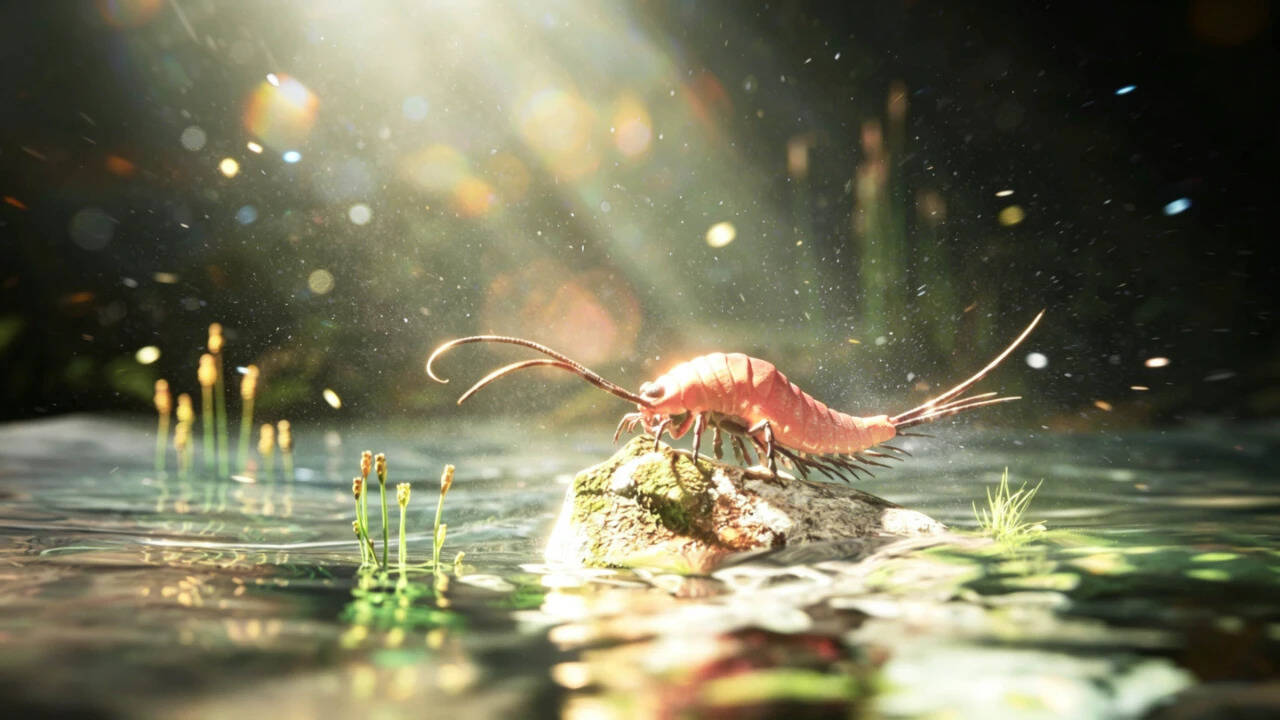
Meet Bojophlebia or similar ancient marvels from the Carboniferous period. Picture a world where dragonflies grew wings the size of hawks and the air choked with thick, oxygen-rich humidity. You probably picture massive forests and creeping bugs crawling across rotting logs. You don't picture a 324-million-year-old insect kicking its legs in open water with specialized swimming paddles.
Most people assume prehistoric bugs were just landlubbers before taking to the skies. That assumption is dead wrong. Evolution gets weird when you look closely at the fossil record. Early insects didn't just crawl or fly; they experimented with aquatic lifestyles long before modern beetles figured out how to paddle.
The Carboniferous Swimmers
Deep time hides plenty of surprises. Back during the Carboniferous, Earth looked alien. Massive clubmosses dominated the landscape. Oxygen levels sat around thirty percent. Insects exploded in size and diversity.
Paleontologists studying these ancient ecosystems often focus on wing venation and flight mechanics. Flight gets all the press. Yet, wings weren't the only evolutionary trick these creatures developed. Some species kept adaptations for a fully aquatic or amphibious childhood. Nymphs and larvae needed ways to navigate swampy pools filled with hungry prehistoric fish and giant amphibians.
They grew paddles. Specialized, flattened leg segments edged with dense rows of setae functioned just like modern oars. Physics doesn't change over hundreds of millions of years. Fluid dynamics remain constant. If you want to push through water efficiently, you need surface area and propulsion. These ancient insects solved that engineering problem long before the dinosaurs ever hatched.
Why Textbooks Get Prehistoric Bugs Wrong
Popular science loves a clean narrative. Land animals come from the sea. Insects take to the air. The reality is messier.
When you dig into the literature on Paleozoic entomology, you find a chaotic playground of trial and error. Nature threw every biological experiment at the wall. Some insects developed gill-like structures on their abdomens. Others modified their legs into flat, oar-like appendages.
I’ve spent hours poring over fossil descriptions and plates from paleontology journals. The level of preservation in certain Lagerstätten—rare sites with exceptional fossilization—blows my mind. You can see individual micro-trichia and swimming hairs preserved in fine-grained shale.
The standard textbook view treats ancient insects as primitive drafts of modern forms. That is lazy thinking. These animals were highly specialized for their specific niches. A 324-million-year-old swimming paddle isn't a crude prototype. It is a finely tuned evolutionary tool that worked remarkably well in ancient coal swamps.
What Swimming Paddles Tell Us About Climate
Ancient ecosystems offer clues about modern climate change. The Carboniferous experienced massive swings in ice ages and tropical expansions. Insects lived through it all.
When you examine how these aquatic nymphs adapted to fluctuating water levels and low oxygen pockets in stagnant swamps, you see resilience. Aquatic insects act as environmental barometers. Their presence in the fossil record maps out ancient freshwater networks that have long since vanished beneath miles of sedimentary rock.
Look at modern aquatic bugs like diving beetles or backswimmers. They use similar hydrodynamic principles. Nature rarely invents a completely new wheel. She modifies existing structures. The leg modifications seen in Paleozoic fossils show that the basic blueprint for swimming underwater predates most modern vertebrate groups.
The Problem with Fossil Interpretation
Reconstructing soft tissue from flattened rock is brutally difficult. Compression fossils turn three-dimensional biology into two-dimensional puzzles.
Skeptics often ask how researchers can be certain a specific appendage functioned as a swimming paddle rather than a digging tool or a gill guard. The answer comes down to comparative morphology and functional mechanics. Researchers look at modern analogs, run stress models, and analyze the aspect ratio of the limb segments.
If an appendage has a broad, flattened profile edged with rigid bristles, it creates thrust. It is not built for shoveling mud. It is built for moving through water.
When scientists make mistakes in this field, it usually stems from over-reliance on incomplete specimens. A single broken leg can throw off an entire functional analysis. That is why finding complete, articulated fossils makes headlines. Every preserved swimming paddle adds a solid data point to our understanding of ancient food webs.
How to Study Ancient Insects Yourself
You don't need a PhD to appreciate Paleozoic entomology. You just need curiosity and access to the right resources.
- Visit natural history museums with strong Paleozoic collections, such as the Smithsonian or the Field Museum, to see actual compression fossils up close.
- Read open-access journals like Papers in Palaeontology or the Journal of Paleontology to see how researchers analyze micro-structures in fossilized wings and legs.
- Support local fossil clubs and citizen science initiatives that help preserve roadcuts and quarries where these ancient layers are exposed.
Next time you swat a mosquito or watch a water strider dart across a pond, remember the deep lineage at play. That tiny animal carries a biological legacy forged over three hundred million years of aquatic survival, evolutionary redirection, and relentless adaptation.