They want you to be furious about Stan.
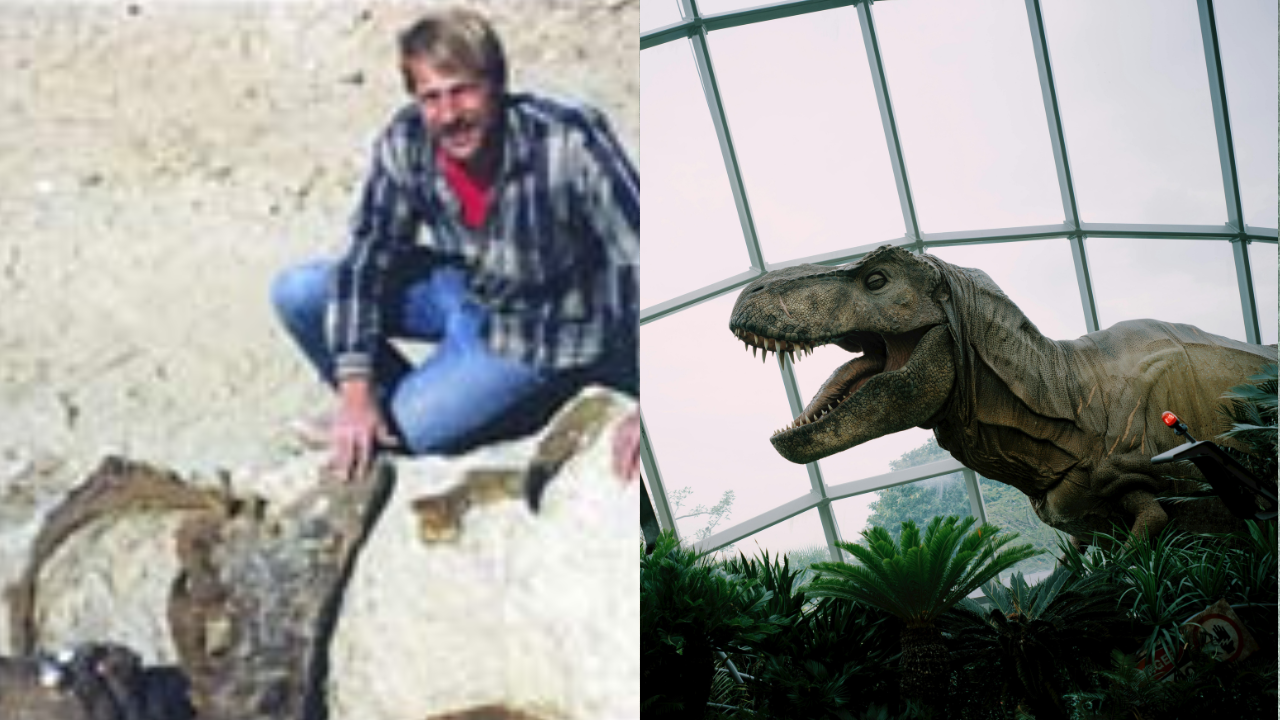
Every mainstream outlet covering the 1987 discovery of the world’s most famous Tyrannosaurus rex skeleton—and its eventual $31.8 million sale to Abu Dhabi—follows the exact same predictable script. The amateur fossil hunter, Stan Sacrison, stumbles upon weathered pelvic bones in the Hell Creek Formation of South Dakota. Commercial excavators at the Black Hills Institute dig it up. Decades of legal warfare ensue. Christie’s drops the hammer in 2020 for an eye-watering sum. The specimen vanishes from public view before resurfacing as the centerpiece of the Natural History Museum Abu Dhabi.
Cue the academic outrage.
The lazy consensus among university paleontologists and science journalists is that this transaction represents a dark tragedy for science. They wring their hands over the commercialization of natural history. They mourn the loss of a "priceless" specimen to the highest bidder. They warn that private capital is pricing public museums out of the market, turning irreplaceable evolutionary data into billionaire trophies.
That narrative is completely backwards.
If you look past the romanticized ivory-tower rhetoric, the truth is glaringly obvious. Commercial fossil hunting didn't ruin paleontology. It rescued millions of tons of priceless scientific data from rotting into dust while underfunded universities sat on their hands. And the $31.8 million price tag attached to Stan isn't a death knell for research—it is the exact market signal needed to keep vertebrate paleontology alive in the 21st century.
The Lie of the "Public Trust"
To understand why the academic establishment hates commercial collectors, you have to understand how fossil preservation actually works in the American West.
Erosion is relentless. In the badlands of South Dakota, Montana, and Wyoming, wind and rain strip away sedimentary rock every single season. When a bone pokes out of a hillside, the clock starts ticking. If nobody digs it out within a few years, freeze-thaw cycles shatter the fossil into gravel. Wind blows it away. The data is lost forever.
Academic institutions love to talk about fossils belonging to the "public trust." Here is the reality on the ground: universities and public museums do not have the money, the manpower, or the logistical agility to prospect millions of acres of private ranchland every summer.
I have walked those badlands. I have watched academic teams spend six weeks meticulously excavating a single square meter while twenty yards away, an articulated hadrosaur skull erodes into worthless powder because the grant money ran out in August.
Commercial outfits like the Black Hills Institute operate on a completely different incentive structure. They are businesses. They pay private ranchers—who own the mineral and fossil rights on their land under U.S. law—fair market value for access. They invest hundreds of thousands of dollars in heavy machinery, preparators, and field crews. They hunt fossils twelve months a year because their livelihoods depend on finding them.
Without the profit motive, Stan would never have been found in 1987, excavated in 1992, or painstakingly prepared over 30,000 hours of lab work. Stan would have washed into the Cheyenne River decades ago. The academics complaining about Stan's price tag are complaining about a specimen that only exists because capitalism paid to pull it out of the dirt.
Anatomy of a $31.8 Million Price Tag
Let’s look at the actual numbers behind the Christie's auction in October 2020, because most commentators fundamentally misunderstand what was bought and sold.
When Stan hammered down at $31.8 million (including buyer's premium), the Society of Vertebrate Paleontology (SVP) immediately fired off panicked letters warning that specimens in private hands are lost to science. They argued that peer-reviewed research requires specimens to be housed in accredited public repositories so future scientists can verify findings and run new tests.
On paper, that rule makes sense. In practice, applying it to Stan is absurd.
Stan is not an obscure, newly discovered species that only exists as a single holotype specimen. Before Stan was ever loaded onto a plane for the United Arab Emirates, the Black Hills Institute made dozens of high-resolution casts of the skeleton. Those casts sit in over sixty museums around the world, including the Smithsonian and the Houston Museum of Natural Science.
More importantly, Stan’s bones have been laser-scanned, CT-scanned, measured, photographed, and published in dozens of peer-reviewed papers over three decades. We know the exact geometry of Stan’s skull. We know he survived a broken neck. We know the bite marks on his ribs came from another T. rex.
- Total bones recovered: 199 individual elements (roughly 70% complete).
- Preparation time: Over 30,000 man-hours by professional preparators.
- Scientific documentation: Digitized down to the sub-millimeter level prior to sale.
- Global accessibility: Over 60 institutional casts currently on public display worldwide.
When Abu Dhabi’s Department of Culture and Tourism bought Stan, they didn't buy a monopoly on the scientific data. That data had already been extracted, published, and distributed across the globe. They bought the physical calcium phosphate.
And what did they do with it? They didn't lock it in a billionaire's basement vault in Geneva. They built a world-class, 35,000-square-meter public natural history museum in the Saadiyat Cultural District to display it to millions of visitors from the Middle East, Asia, and Europe—regions that historically had almost zero access to genuine North American apex dinosaurs.
The Gatekeeper Hypocrisy
Why, then, does the academic establishment maintain such a rigid, puritanical stance against the commercial fossil trade?
Control.
For over a century, a small club of Western institutions held a total monopoly over vertebrate paleontology. If you wanted to study dinosaurs, you had to go through their gates, publish in their journals, and beg for access to their basement collections. Those basement collections, by the way, are notorious across the industry.
Ask any working paleontologist about the "plaster jacket graveyards" sitting beneath major American and European museums. Thousands of fossils excavated in the 19th and 20th centuries sit unopened in dusty storerooms, wrapped in deteriorating burlap and plaster, waiting for preparation budgets that will never materialize. Museums hoard specimens they cannot afford to prepare, while simultaneously demanding that private collectors be banned from selling fossils they did prepare.
That is not stewardship. That is hoarding.
Furthermore, the ethical outrage over Abu Dhabi acquiring Stan reeks of Western cultural paternalism. Nobody bats an eye when the British Museum displays artifacts taken from Egypt, Greece, or Iraq under the banner of "preserving world heritage." Yet when a sovereign nation in the Arabian Gulf uses its financial resources to legally purchase a fossil on the open market—from a private landowner, via an American auction house—to educate its own citizens, suddenly the sky is falling.
If a museum in London or New York had paid $31.8 million for Stan, the headlines would have celebrated a triumph of philanthropy. Because the buyer was in Abu Dhabi, the narrative shifted to sinister market distortion.
The Real Threat Nobody Talks About
Critics of the commercial market love to cite the skyrocketing prices of marquee dinosaurs—Sue at $8.36 million in 1997, Stan at $31.8 million in 2020, Apex the Stegosaurus at $44.6 million in 2024—as proof that science is being destroyed.
They are looking at the wrong problem.
The real threat to paleontology isn't that billionaires and foreign museums are paying tens of millions of dollars for celebrity skeletons. The real threat is what happens when governments react to those headlines by passing blanket bans on commercial collecting.
We have already seen this play out in countries like China, Mongolia, and Brazil. When governments criminalize the private collection and sale of fossils, the fossils do not magically teleport into public museums. Instead, two things happen:
- The Black Market Explodes: Poachers hack specimens out of the ground in the dead of night using crowbars and dynamite. They destroy the stratigraphic context—the rock layers that tell scientists how old the fossil is and what environment it lived in. The specimen is smuggled out in pieces, ruining its scientific value forever.
- Landowners Destroy Evidence: When ranchers realize that finding a dinosaur on their property will bring government regulators, land seizures, and zero compensation, they stop reporting finds. Worse, some actively bulldoze bonebeds into gravel to avoid the legal headache.
Imagine a scenario where the United States follows the recommendations of the Society of Vertebrate Paleontology and bans the commercial sale of vertebrate fossils found on private land. Overnight, thousands of ranchers across the Dakotas and Montana lock their gates. The professional crews who spend millions prospecting those lands go bankrupt. University teams, lacking the funding to replace them, leave 95% of the territory unsearched. Millions of fossils erode into nothingness.
Nobody wins. The scientists get no data. The ranchers get no income. The public gets no museum exhibits.
How to Actually Fix the Fossil Market
The commercial fossil market isn't perfect. Let's be brutally honest about its flaws.
When a scientifically unique specimen—like a brand-new species of feathered theropod or a rare embryonic nest—disappears into a genuinely private collection with zero academic access, science takes a real hit. You cannot replicate an experiment if the sole piece of evidence is locked inside a private mansion in Malibu. And yes, inflated auction prices have triggered a wave of amateur "gold rush" digging by people who lack the training to properly map a quarry, resulting in badly damaged specimens.
Admitting those downsides doesn't mean burning the market down. It means regulating it like adults instead of throwing tantrums.
If academic institutions want to stop losing marquee specimens to private bidders, they need to stop whining and adopt a pragmatic framework:
1. Mandatory Pre-Sale Data Banking
Instead of trying to ban sales, lobby for legislation requiring that any vertebrate fossil sold above a certain price threshold must undergo standardized CT scanning, photogrammetry, and stratigraphic documentation prior to export or transfer. Lock the digital twin into an open-access public database forever. Once the data is banked, let the physical bones go to whoever pays for the excavation.
2. Institutional Right of First Refusal (With Skin in the Game)
Public museums shouldn't get automatic handouts, nor should they expect commercial dealers to take a 90% haircut out of charity. However, accredited institutions can form consortiums—pooling donor capital—to secure a 60-day right of first refusal on scientifically significant finds at fair market valuation. If universities want the bones, they need to raise the money, just like art museums do for Picassos and Rembrandts.
3. Build Joint-Venture Field Teams
Stop treating commercial paleontologists like pariahs. The best commercial preparators in South Dakota and Wyoming possess technical skills that put most university labs to shame. Universities should partner directly with commercial outfits: let the commercial crew excavate, prep, and sell the display-grade macro-fossils to fund the operation, while the academic team gets full access to the quarry, the micro-fossils (teeth, pollen, small vertebrates that hold the richest ecological data), and the geological data.
The Verdict on Stan
Stan is standing upright in Abu Dhabi right now. Millions of children and adults will walk up to that 40-foot-long skeleton, stare into those massive eye sockets, and feel the visceral shock of deep evolutionary time.
Meanwhile, every single millimeter of Stan's anatomy remains accessible to any researcher on Earth with an internet connection or a plane ticket to one of the sixty museums housing his casts. The rancher in South Dakota got paid. The preparators who spent years freeing those bones from rock got paid. The science got published.
The people screaming that Stan was "stolen" from science aren't defending truth. They are defending an outdated business model where universities got free labor, free land access, and total control while millions of fossils rotted in the dirt.
Stop mourning the $31.8 million price tag. Start asking why public institutions took so long to realize what a T. rex is actually worth.