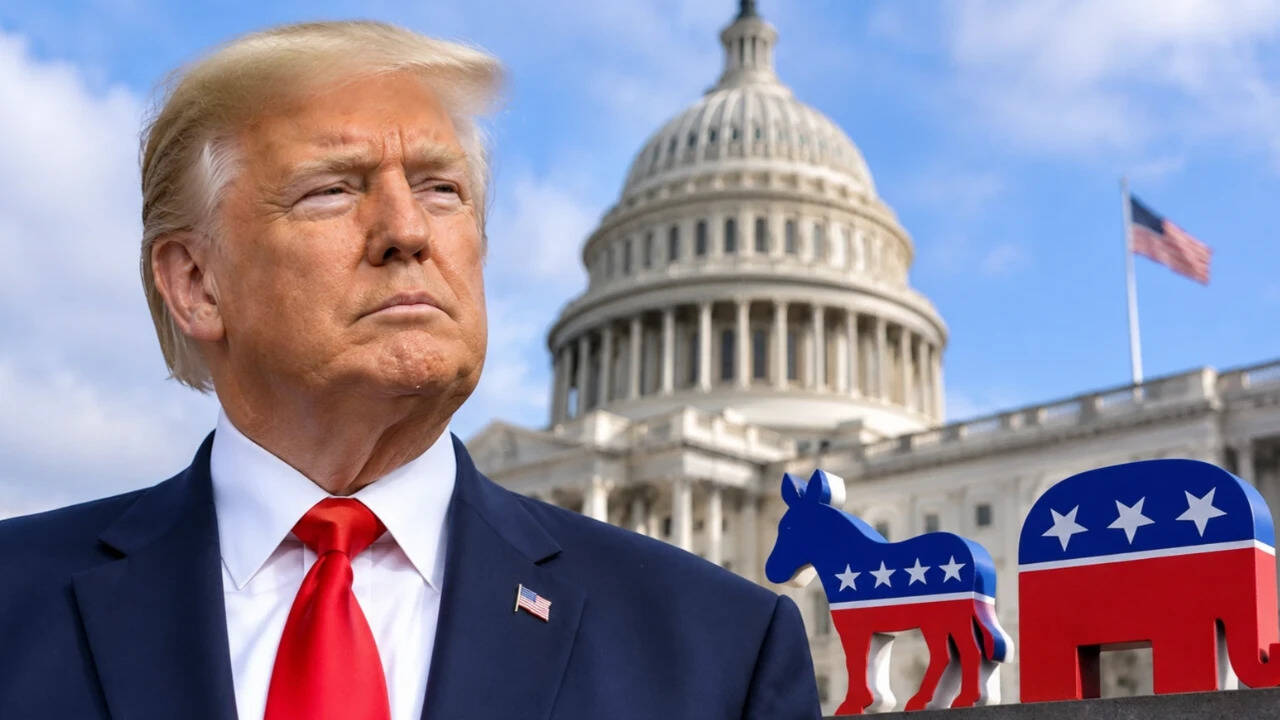
A Democratic takeover of Congress in the 2026 midterm elections would not automatically end a U.S. military campaign against Iran, nor could lawmakers force an immediate withdrawal with a simple floor vote. The Constitution grants the president broad latitude as commander-in-chief, and any direct legislative order to halt operations would collide head-on with a presidential veto that requires a two-thirds supermajority in both chambers to override. Yet an opposition-controlled House and Senate possesses quieter, far more devastating weapons—specifically, the power to choke off supplemental war funding, repeal decades-old war authorizations, and weaponize oversight hearings to fracture the administration's domestic support.
Washington runs on myths about how wars end. Pundits love to imagine dramatic midnight votes on the House floor that instantly recall troops from overseas. That is pure fiction. In reality, modern American conflicts rarely end because Congress passes a law commanding the Pentagon to stand down. They end when the financial oxygen gets cut off, or when the political cost of sustaining the fight becomes too toxic for the White House to bear.
To understand what happens if voters hand the gavel to the opposition in November 2026, you have to look past the cable news shouting matches and examine the cold mechanics of Capitol Hill.
The Veto Trap and the War Powers Illusion
Every time tensions flare in the Persian Gulf, lawmakers rush to microphones waving the War Powers Resolution of 1973. On paper, the law looks formidable. It requires the president to notify Congress within 48 hours of committing armed forces to military action and forbids troops from remaining for more than 60 days—with a 30-day withdrawal period—without congressional authorization or a formal declaration of war.
In practice, it is a paper tiger.
Every president since Richard Nixon, regardless of party, has dismissed the 1973 law as an unconstitutional infringement on executive authority. Even if a newly elected Democratic majority in 2027 passes a concurrent resolution demanding the removal of U.S. forces from Iranian airspace or waters, the Supreme Court's 1983 INS v. Chadha decision stripped concurrent resolutions of binding legal force unless presented to the president for signature.
That means any binding joint resolution to halt hostilities hits Donald Trump's desk. He vetoes it. The war continues. Unless the opposition captures an almost mathematically impossible 67 Senate seats and 290 House seats in the 2026 midterms, overriding that veto is dead on arrival.
Follow the Money Through the Appropriations Choke Point
If direct orders fail, the Power of the Purse does not. Article I, Section 9 of the Constitution is explicit—no money can be drawn from the Treasury except through appropriations made by law. Unlike a standalone resolution demanding troop withdrawal, an appropriations bill does not require Congress to pass a new law to stop an action. It simply requires Congress to stop passing checks.
Modern warfare is obscenely expensive. Naval carrier strike groups burning fuel in the Arabian Sea, continuous aerial refueling sorties, and the rapid expenditure of precision-guided munitions drain standard Pentagon accounts within weeks. To sustain a high-intensity conflict with Iran, the White House inevitably has to come back to Capitol Hill with hat in hand, begging for supplemental defense appropriations.
An opposition Speaker of the House and Senate Majority Leader do not need a veto-proof majority to kill a supplemental spending bill. They just refuse to bring it to the floor.
Consider a hypothetical scenario where the Pentagon burns through its available Overseas Contingency Operations funds by spring 2027. The White House submits an emergency $60 billion request to replenish Tomahawk cruise missiles and interceptor stocks. A hostile House Appropriations Committee simply sits on the bill. Or, worse for the administration, attaches a rider stating that zero dollars in the legislation may be used for offensive strikes inside Iranian territory.
Trump could veto the bill to protest the restriction, which only leaves him with zero funding anyway.
The Pentagon Accounting Shell Game
Veteran defense analysts know the executive branch has tricks to buy time when Congress locks the vault. Under reprogramming authorities and the Feed and Forage Act of 1861, the Defense Department can shuffle money between existing accounts or incur obligations for basic troop subsistence without immediate appropriations.
During his first term, Trump famously redirected billions in Pentagon construction funds to build border barriers after Congress refused to pay for them. In an Iran conflict, the White House would undoubtedly attempt similar accounting gymnastics, raiding maintenance budgets and deferred modernization funds to keep ships afloat and planes flying.
Yet those stopgaps only delay the inevitable. You cannot fund a prolonged regional war out of spare parts budgets. Eventually, readiness collapses, training halts, and the Joint Chiefs of Staff start quietly warning the Oval Office that the military is eating itself alive to sustain an unfunded operation.
Stripping the Legal Veneer of the 2001 and 2002 AUMFs
For more than two decades, presidents of both parties have stretched the 2001 Authorization for Use of Military Force (AUMF)—written specifically to target the perpetrators of the September 11 attacks—into a blank check for global intervention. Alongside the 2002 Iraq AUMF, these zombie statutes have been cited by executive branch lawyers to justify everything from drone strikes in Africa to the 2020 killing of Iranian General Qasem Soleimani.
If a 2026 midterm wave installs a Democratic majority, repealing both authorizations becomes an immediate legislative priority. While repealing them outright still faces a presidential veto, Congress can attach AUMF sunset provisions to must-pass legislation, specifically the annual National Defense Authorization Act (NDAA).
Forcing the president to choose between signing a bill that terminates his broad legal cover for Middle East operations or vetoing a routine pay raise for American troops creates a brutal political vise. Even if the administration pivots to citing Article II commander-in-chief powers as its sole legal basis—a posture the Justice Department's Office of Legal Counsel has increasingly favored—losing statutory authorization strips the war of institutional legitimacy.
Allies notice when a president fights without Congress. European partners, already wary of regional escalation, become vastly more reluctant to grant overflight rights, share intelligence, or permit staging at overseas bases when the American legislative branch is actively trying to pull the plug.
The Subpoena Cannon and Public Exhaustion
Wars rarely collapse in a vacuum; they erode from the inside out when the public loses faith in the narrative coming from the podium. During a unified government, congressional oversight committees act as cheerleaders or protective shields for the White House. A flip in the 2026 midterms turns the House Armed Services, Foreign Affairs, and Intelligence committees into hostile interrogation rooms.
Subpoena power changes the media ecosystem overnight. Instead of curated Pentagon briefings, cable networks broadcast four-hour hearings featuring retired generals, intelligence whistleblowers, and diplomatic defectors testifying under oath about miscalculated casualty projections, depleted missile stockpiles, and ignored diplomatic off-ramps.
Look back at the final years of the Vietnam War or the aftermath of the 2003 Iraq invasion. Once the Senate Foreign Relations Committee began televising hearings that exposed the gap between official optimism and ground reality, public support cratered. A president can ignore a non-binding resolution, and he can temporarily maneuver around a budget freeze, but he cannot govern effectively when his own party's vulnerable incumbents are begging him to end a conflict before the next election cycle wipes them out.
The Dangerous Paradox of a Lame-Duck Escalation
There is a dark counter-argument that every serious national security strategist in Washington quietly worries about. What if losing Congress in November 2026 does not restrain the White House, but instead provokes a frantic, high-stakes escalation during the lame-duck session?
Between Election Day in early November and the swearing-in of the new Congress on January 3, 2027, the outgoing partisan majority still holds the gavel. A president staring down two years of hostile subpoenas and budgetary strangulation might calculate that his only window to achieve decisive military objectives—whether crippling Iranian nuclear infrastructure or degrading naval capabilities in the Strait of Hormuz—is closing fast.
History shows that cornered executives often double down before the institutional walls close in. Rather than winding down operations to appease an incoming opposition majority, the administration could surge assets into the theater during November and December, betting that once American troops are locked in heavy combat, even a newly empowered opposition Congress will blink before cutting off funds to soldiers under fire.
No politician wants to be accused of abandoning troops in a firefight. That single psychological barrier has saved more unauthorized military campaigns than any constitutional doctrine ever written.
Diplomacy by Backchannel and Foreign Leverage
An opposition victory in 2026 also alters the calculus in Tehran. Iranian leadership tracks American domestic politics with obsessive precision. If the ruling establishment in Tehran watches the president's party suffer a historic rebuke at the ballot box—especially if war fatigue and oil price shocks drive the defeat—their negotiating posture shifts immediately.
Tehran will recognize that the White House's clock is ticking. Instead of making concessions to relieve military pressure, Iranian negotiators are far more likely to hunker down, absorb strikes, and wait for the incoming Congress to tie the administration's hands in January.
Simultaneously, an opposition-led Senate Foreign Relations Committee can open parallel diplomatic signaling. While the Constitution vests formal treaty-making and diplomatic execution in the president, senior senators routinely travel abroad, meet with foreign ministers, and signal to international counterparts what kind of agreements Capitol Hill will actually fund or ratify. When foreign capitals realize the president no longer speaks for the entire U.S. government, Washington's coercive leverage evaporates.
The Real Lever of Power
Ultimately, a midterm defeat in 2026 will not hand Congress a remote control to switch off an Iran conflict from the House floor. The framers designed a system that favors executive speed in foreign crises and legislative friction over time.
Trump would retain command of the armed forces, control over tactical targeting, and the unilateral authority to negotiate ceasefires. Yet governing a war without the legislature is like driving a heavy tank across a desert with a punctured fuel line. You can keep moving forward for a surprisingly long distance on momentum and reserve tanks, intimidating everyone in your path, until the gauge hits empty and the engine seizes completely.