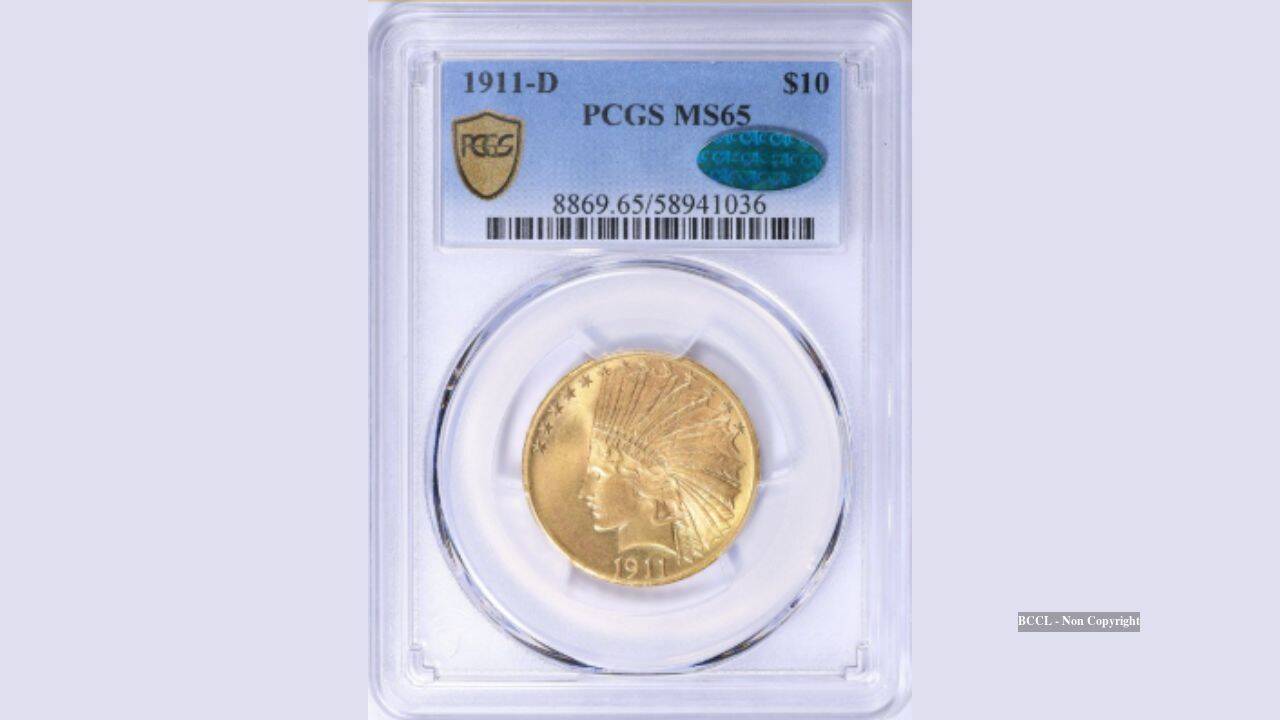
A single 1911 Denver Mint gold coin—specifically the 1911-D Indian Head quarter eagle—can command $500,000 or more at major auctions not because of its gold weight, which sits around $300 in melt value, but because of an acute intersection of low initial mintage, extreme survival scarcity, and the unforgiving mechanics of third-party coin grading. When a coin of this caliber surfaces from a family safe-deposit box, its valuation hinges entirely on whether its surfaces survived a century without abrasive cleaning or heavy circulation, turning a forgotten heirloom into an institutional-grade asset.
Most headlines treat a half-million-dollar coin discovery like a lottery ticket. Having covered the rare coin market and high-end collectibles for decades, I can tell you it is closer to an archaeological recovery mission fraught with financial traps. One wrong move by an heir—wiping away a century of toning with a dish towel, or selling directly to a local pawn shop—can obliterate 99 percent of the coin's value before an auctioneer ever sees it.
The Anatomy of the 1911-D Quarter Eagle
To understand why buyers pay seven-figure sums for top-tier specimens and over $500,000 for high-end Mint State examples, you have to look at the specific mechanics of the 1911 Denver Mint issue. In 1911, the Denver Mint struck just 55,680 Indian Head quarter eagles ($2.50 gold pieces). By U.S. Mint standards, that is a tiny production run.
Compare that figure to the Philadelphia Mint, which produced over 704,000 of the exact same coin that year. Denver was a young branch mint, having opened for coinage only five years earlier in 1906. Its primary mandate was supplying regional commerce in the American West, where gold coins still circulated heavily in daily transactions rather than sitting in vaults.
Then came 1933. Executive Order 6102 signed by President Franklin D. Roosevelt required Americans to surrender most of their gold coins to the Federal Reserve. Millions of quarter eagles, half eagles, and double eagles were melted down into standard gold bars. The 1911-D was already scarce before the recall; after the melting pots cooled, surviving examples in uncirculated condition became extraordinarily rare.
The Incuse Design Flaw
Numismatists love the Indian Head quarter eagle for its artistry, designed by Boston sculptor Bela Lyon Pratt. Unlike almost every other U.S. coin, which features raised designs above a flat background, Pratt sunk the portrait of the Native American chief and the standing eagle below the flat surface of the coin. It is an incuse design.
Collectors admired the aesthetic, but the design created a brutal problem for preservation. Because the flat fields are the highest points on the coin, they absorb every single scratch, bag mark, and point of friction. On a standard coin, the raised design protects the flat background fields. On a 1911-D quarter eagle, the fields are completely exposed.
Finding a 1911-D that avoided circulation wear is hard enough. Finding one whose flat, exposed fields avoided contact marks from canvas mint bags during transport is nearly impossible. That physical vulnerability is the single biggest driver behind the massive price leaps on the upper end of the grading scale.
How the Grading Scale Dictates Six-Figure Leaps
In the modern rare coin market, raw coins—those not encapsulated in tamper-evident plastic holders by leading grading services like Professional Coin Grading Service (PCGS) or Numismatic Guaranty Company (NGC)—rarely achieve top dollar. Institutional buyers and wealthy collectors rely on the Sheldon Scale, a 1-to-70 numeric grading system, to establish trust and liquidity.
For a common date coin, the difference between a grade of Mint State 63 (MS63) and Mint State 65 (MS65) might mean a few hundred dollars. For the 1911-D quarter eagle, a single numeric point represents hundreds of thousands of dollars.
| Grade Tier | Physical Characteristics | Approximate Market Position |
|---|---|---|
| About Uncirculated (AU50–AU58) | Slight friction on the flat fields; minor loss of original mint luster. | Typically trades between $5,000 and $15,000. |
| Mint State 62–63 (MS62–MS63) | No wear from circulation, but visible contact marks on the exposed fields. | Generally ranges from $25,000 to $65,000. |
| Mint State 64 (MS64) | Strong mint luster with minimal, well-hidden marks; sharp strike on the mintmark. | Crosses into the $100,000 to $175,000 territory. |
| Mint State 65 (MS65) | Gem quality. Virtually mark-free fields with full, vibrant original luster. | Commands $450,000 to $650,000+ depending on eye appeal. |
| Mint State 65+ / 66 (MS65+–MS66) | Condition census rarity; among the finest known examples in existence. | Can exceed $1,000,000 at major public auctions. |
Look closely at the jump between MS64 and MS65. That single point separates a six-figure coin from a half-million-dollar headline. Why? Because registry set collectors—wealthy individuals competing publicly to assemble the highest-graded sets of U.S. coins—bid aggressively for the limited supply of Gem MS65 specimens. Population reports from PCGS and NGC show only a few dozen coins graded at MS65, and virtually none higher. When a fresh example emerges from a family safe-deposit box and earns that grade, multiple bidders will fight for it because they know another might not appear on the market for five years.
The Counterfeit Minefield and the Weak D
Any discussion of a 1911-D quarter eagle has to address the elephant in the room: counterfeits. The 1911-D is one of the most heavily counterfeited coins in American numismatics.
During the mid-twentieth century, skilled counterfeiters in the Middle East and Europe produced thousands of fake 1911-D quarter eagles using real gold. Because the coin's value is vastly higher than its gold content, counterfeiters could afford to strike fakes in genuine 90 percent gold alloy and still turn an enormous profit. Many of these counterfeits are so well-made that they fool local coin dealers, estate appraisers, and casual collectors.
Even more common than outright fakes are altered coins. Dishonest operators take a genuine, common 1911 Philadelphia quarter eagle—worth a few hundred dollars—and solder or emboss a tiny "D" mintmark onto the reverse, just to the left of the arrowheads.
Authenticators look for specific diagnostic markers that counterfeiters struggle to replicate:
- The Wire Rim: Genuine 1911-D coins frequently exhibit a sharp, raised wire rim along the edge, caused by high striking pressure pushing metal between the die and the collar.
- Mintmark Placement and Font: The "D" on an authentic coin sits in a precise position relative to the bottom arrowhead and features specific serif characteristics that differ from added mintmarks.
- Die Polish Lines: Authentic dies developed microscopic striations from the minting process, leaving faint raised lines in the recessed areas of the coin that cast counterfeits cannot reproduce.
There is also a recognized variety known as the Weak D. On some genuine coins, the Denver mintmark was lightly impressed into the working die, leaving a faint, ghost-like "D" that is barely visible without magnification. While still valuable, a Weak D generally trades at a discount compared to a bold, sharp mintmark, simply because buyers prefer unmistakable visual confirmation of the coin's origin.
Why Safe-Deposit Boxes Preserve Six-Figure Coins
When major rarities surface today, they rarely come from sock drawers or attic trunks. They almost always come from bank safe-deposit boxes. Understanding why explains the survival of top-grade coins.
In 1911, buying a $2.50 gold coin at face value was a significant outlay for an average worker, roughly equivalent to $80 or $90 in purchasing power today. Wealthier individuals, bankers, and early coin collectors often purchased newly minted gold coins directly from local banks around the holidays to give as gifts or keep as hard savings.
If a Denver resident put a crisp, uncirculated 1911-D quarter eagle into a small paper envelope inside a bank vault in 1912, two critical things happened. First, the coin bypassed the 1933 gold recall because safe-deposit boxes were private and never systematically raided by federal agents, despite widespread myths to the contrary. Second, the coin remained untouched in a dark, temperature-stable environment for decades.
Over 80 or 100 years, the sulfur compounds in cheap paper envelopes interact slowly with the 10 percent copper alloy mixed into U.S. gold coins. This creates a thin, natural patina—often a rich, reddish-orange or deep honey hue—known as original skin. Veteran dealers and auction graders prize original skin above almost everything else. It proves the coin has never been dipped in harsh acidic cleaners or artificially brightened.
The Fatal Mistakes Heirs Make
When a family opens a relative's safe-deposit box and finds a gold coin, the instinct to prepare it for sale often triggers catastrophic financial damage. The numismatic market is merciless toward altered surfaces.
Polishing and Cleaning
The most destructive mistake is cleaning the coin. Heirs see dark spots, fingerprints, or dull toning and reach for silver polish, baking soda, a pencil eraser, or even a soft microfiber cloth.
Gold is a soft metal. Even rubbing a coin gently with a cotton shirt leaves thousands of microscopic hairlines across those exposed flat fields. The moment a professional grader sees parallel hairlines under a 5x loupe, the coin is disqualified from receiving a standard numeric grade. Instead of MS65, it receives a Details designation—such as "UNC Details - Cleaned."
That single word on the plastic label cuts the coin's value by 60 to 80 percent instantly. A $500,000 gem becomes a $75,000 problem coin overnight, and no restoration process can ever put the original mint luster back on the metal.
Selling to the Wrong Venue
The second major error is seeking a quick sale at a local "We Buy Gold" storefront, a pawn shop, or a generalist estate buyer. Most local bullion dealers operate on tight margins based on melt value. If an appraiser doesn't recognize the tiny "D" mintmark on the reverse—or doesn't understand the exponential price curve of high-grade Indian Head gold—they might offer $400 to $1,500 for a coin worth half a million dollars.
Even well-meaning local coin shops rarely have the capital or the client base to handle a $500,000 rarity. If they buy it, they have to price in the risk of getting it graded and waiting months to resell it at a major convention, meaning the family leaves hundreds of thousands of dollars on the table.
The Institutional Path to Maximum Value
Extracting full market value from a high-grade 1911-D quarter eagle requires treating it like fine art rather than scrap metal. The established pipeline for high-end numismatic discoveries follows a strict sequence designed to protect the asset and create competitive bidding.
First, handle the coin strictly by its edges, wearing clean cotton or nitrile gloves, over a soft surface like a folded towel. Drop it onto a hardwood floor from waist height, and a rim ding will cost you $200,000. Keep it in whatever original envelope or holder it was found in, as provenance notes can occasionally add appeal.
Second, bypass local retail buyers and submit the coin directly to PCGS or NGC, either independently or through an authorized submission center that specializes in six-figure rarities. At this valuation tier, grading services require walkthrough or express service tiers, where fees are calculated as a percentage of the coin's declared value—often 1 percent or more—alongside insured registered mail shipping.
Third, once the coin is authenticated, graded, and sealed in a tamper-evident holder, consign it to a major numismatic auction house such as Heritage Auctions or Stack's Bowers Galleries. Private treaty sales to dealers happen, and they offer immediate cash, but a major public auction puts the coin in front of the exact wealthy collectors competing for registry set dominance.
Auction houses waive seller fees on high-value rarities—and frequently offer consignors a percentage of the buyer's premium—because a headline coin like a Gem 1911-D quarter eagle draws massive publicity to their entire sale catalog. When two determined bidders lock horns over a coin that hasn't been seen in public for a century, the final hammer price regularly shatters conservative pre-sale estimates.