The Pentagon has a multi-billion-dollar fever, and the only prescription, apparently, is spending millions on heavy tactical vehicles to swat plastic quadcopters out of the sky.
When the U.S. Marine Corps announced the full-rate production of its Marine Air Defense Integrated System (MADIS)—bolstered by multi-million-dollar contracts for autonomous ground integrations like the Kodiak-driven ROGUE-Fires platforms and automated fire-control optics—the defense tech sector cheered. The defense trade press dutifully echoed the party line: Finally, our troops are getting high-tech shields against the drone threat.
I have spent years watching the Department of Defense burn through cash on over-engineered procurement cycles, and I am here to tell you that this entire mechanical strategy is built on a fundamental misunderstanding of modern attrition warfare.
The Marine Corps is investing heavily in complex, expensive ground vehicles to hunt down $500 first-person view (FPV) commercial drones. They are bringing heavy metal to a software fight. It is a mathematical trap that our adversaries are waiting for us to spring.
The Arithmetic of Absolute Attrition
The lazy consensus says that if a threat is aerial, you build a mobile surface-to-air platform to kill it. That logic worked perfectly against a Soviet Mi-24 Hind helicopter or a Su-25 Frogfoot. It fails completely when the threat looks like a swarm of DJI quadcopters carrying 3D-printed thermite munitions.
Look closely at what MADIS actually is. It is a pair of heavy Joint Light Tactical Vehicles (JLTVs) packed with radar arrays, electronic warfare jamming pods, electro-optical sensors, a 30mm cannon, and Stinger missiles. It is an impressive piece of engineering. It also costs over a million dollars per unit once you factor in the mission payloads.
Now let us look at the math that actually matters in a conflict over the Taiwan Strait or the plains of Eastern Europe.
Imagine a scenario where a single Marine Littoral Regiment is deployed to a remote island in the First Island Chain. They are equipped with a section of these advanced counter-drone vehicles. The adversary does not send a multi-million-dollar fighter jet. They send 200 commercial-grade FPV drones, launched from civilian fishing vessels or hidden coastal positions, costing roughly $100,000 in total.
- The Ammo Problem: A Stinger missile costs over $400,000 per shot. Firing a Stinger at a $500 carbon-fiber drone is a financial defeat even if the missile hits.
- The Kinetic Capture: The 30mm cannon is highly accurate, thanks to automated fire-control systems. But a 30mm barrel has a limited ammunition capacity before it requires a dangerous, manual resupply.
- The Signature Trap: Active radar tracking systems scream in the electromagnetic spectrum. The moment a MADIS vehicle turns on its radar to search for low-flying drones, it becomes the brightest beacon on the battlefield for long-range anti-radiation missiles and loitering munitions.
We are spending millions to protect a truck that only exists to protect itself from a drone that costs less than an iPad. That is not defense. That is strategic bankruptcy.
Why Autonomy Can't Save the Wrong Vehicle
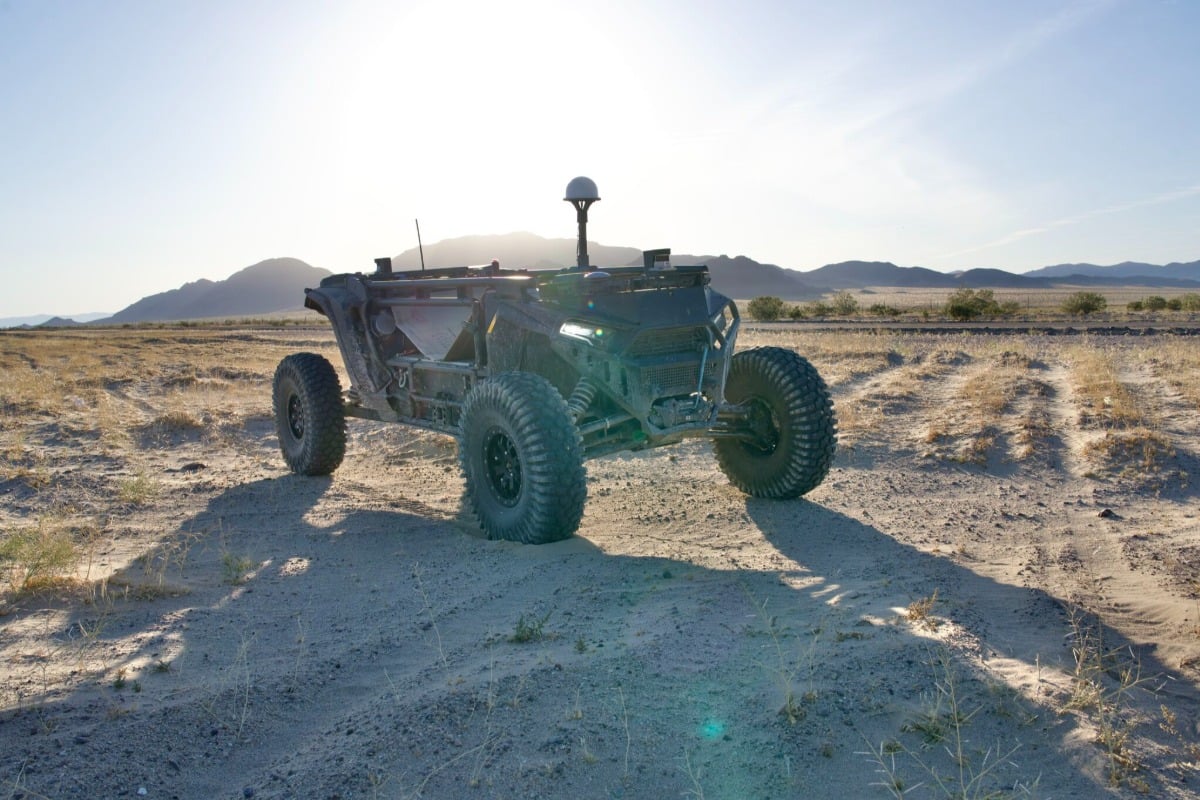
The latest pivot by defense planners is to remove the human entirely. By integrating autonomous driving software stacks into platforms like the Remotely Operated Ground Unit for Expeditionary Fires (ROGUE-Fires), the argument is that we can at least eliminate the risk to human operators while fighting drone swarms.
This misses the point. The issue is not who is sitting in the driver’s seat; the issue is the physical footprint of the vehicle itself.
Heavy ground vehicles, whether autonomous or crewed, are bound by the realities of terrain, bridge weight limits, and logistics. They require massive fuel pipelines, specialized maintenance personnel, and heavy heavy-lift transport assets to deploy across distributed maritime environments. In the time it takes to transport a single mechanized counter-drone section across an archipelago, an adversary can manufacture and deploy ten thousand loitering munitions via commercial shipping containers.
If your defensive platform requires an entire global supply chain just to keep its tires inflated and its sensors calibrated, it cannot survive a high-intensity conflict against an adversary operating with localized, distributed production.
The Dismounted Reality Nobody Wants to Fund
The real solution to the small-unit drone threat is ugly, unglamorous, and does not generate massive profit margins for traditional prime defense contractors. It does not look like an autonomous vehicle rolling through the desert. It looks like a grunt with a lightweight, MOS-agnostic handheld jammer and a 12-gauge shotgun loaded with electronic warfare elements.
The Marine Corps has made minor nods toward this reality by starting to field dismounted, handheld prototype systems to Marine Expeditionary Units. But these programs receive a fraction of the funding poured into heavy vehicle platforms.
True resilience against the modern drone threat requires decentralization. Every single infantry squad needs organic detection and defeat capabilities embedded directly into their standard gear, not a distant vehicle asset managed by a specialized Low Altitude Air Defense battalion.
The Brutal Truth of the Modern Battle Space: If a defensive system cannot be carried on a Marine's back or tossed into the back of an unarmored utility vehicle, it is too heavy, too expensive, and too slow to survive the drone revolution.
The downside to this decentralized approach is obvious: it places an immense cognitive load on the individual squad leader. Training thousands of Marines to read the electronic warfare environment and operate handheld signature-management tools is far harder than buying 50 shiny new autonomous trucks from an aerospace giant. But it is the only approach that respects the cold physics of attrition warfare.
Stop trying to build a better mechanized shield. The era of the multi-million-dollar tactical vehicle as a primary defensive asset is over. Until the Pentagon shifts its procurement dollars away from heavy iron and toward distributed, low-cost, software-defined infantry gear, we are simply buying exceptionally expensive targets for the next generation of cheap drones.